





Formaldehyde Overview: Properties, Applications, Safety & Sourcing Guide
Formaldehyde, also known as methanal, is a colorless gas with a pungent, irritating odor and the chemical formula CH₂O. As the simplest aldehyde compound, it plays a critical role across industrial manufacturing, scientific research, and pharmaceutical production. This highly reactive chemical is typically supplied commercially as an aqueous solution called formalin due to its gaseous state at room temperature.
Understanding formaldehyde's properties becomes essential for professionals working across diverse fields, from histology laboratories preserving tissue specimens to manufacturing facilities producing resins and adhesives. However, its classification as a known human carcinogen demands strict safety protocols and comprehensive handling procedures regardless of application.
This comprehensive guide explores formaldehyde's fundamental characteristics, diverse applications, critical safety requirements, and sourcing considerations to support informed decision-making for your specific needs.
Properties of Formaldehyde
Formaldehyde's unique physical and chemical properties make it valuable for applications that require high reactivity and cross-linking capabilities. These same properties also create significant health hazards and handling challenges that require careful management.
Key Facts About Formaldehyde:
- Compound Name: Formaldehyde
-
Synonyms: Methanal, Methylene oxide, Oxomethane, Methylaldehyde, Formalin (aqueous solution), Formic aldehyde, UN 1198 (solution), UN 2209 (gas)
-
Chemical Formula: CH₂O
-
CAS Number: 50-00-0
-
Molar Mass: 30.03 g/mol
-
Appearance: Colorless gas at room temperature; commercial formalin solutions are clear liquids with a sharp, pungent odor
Density Characteristics
Gas density of 1.09 g/L at 20°C makes formaldehyde heavier than air, causing vapors to accumulate in low-lying areas and creating exposure hazards in poorly ventilated spaces. Formalin solution density is approximately 1.08-1.09 g/cm³, slightly denser than water. Understanding these density values helps predict vapor behavior and design appropriate ventilation systems for safe handling.
Thermal Properties
With a boiling point of -19.1°C (-2.4°F) and melting point of -92°C (-134°F), formaldehyde remains gaseous at normal room temperatures. These extremely low thermal transition points mean the compound readily vaporizes from aqueous solutions, creating continuous vapor release even from sealed containers with minor leaks. Applications must account for this high volatility through proper containment and ventilation.
Formaldehyde is an essential chemical in laboratory, medical, and industrial applications, including tissue preservation, disinfection, and resin production. Laboratories and manufacturing facilities across the United States that need high-purity formaldehyde can contact Lab Alley at 512-668-9918 to order the ideal grade and packaging size for their specific use.
Solubility Characteristics
Formaldehyde shows high solubility in water, with stable solutions containing 40-50% formaldehyde commonly used in commercial applications. This exceptional water solubility enables diverse formulation options and application methods. The compound is also miscible with alcohols and most polar organic solvents, providing flexibility for chemical synthesis and specialized formulations.
pH Behavior
Formalin solutions exhibit slightly acidic pH values around 3.5-4.0 due to formic acid formation from oxidation reactions during storage. This acidity affects chemical stability, material compatibility, and application suitability. The acidic nature influences corrosion rates on metal containers and equipment, making material selection an important consideration.
Reactivity and Stability Considerations
Formaldehyde readily polymerizes to form paraformaldehyde, especially in concentrated solutions without stabilizers. This white solid precipitates from solution, reducing formaldehyde concentration and effectiveness. Commercial formalin contains methanol or other stabilizers to prevent this polymerization.
The compound reacts with ammonia to form hexamethylenetetramine (urotropine), a reaction used in some industrial processes. It undergoes condensation reactions with phenols and urea to form resins, the basis for major industrial applications.
Formaldehyde can form addition compounds with alcohols, amines, and other nucleophiles. The highly reactive carbonyl group participates in aldol condensations and cross-linking reactions, explaining its effectiveness in tissue fixation and resin production.
As a flammable gas with wide flammability limits of 7-73% in air, formaldehyde creates significant fire and explosion hazards when vapors accumulate in confined spaces or poorly ventilated areas.
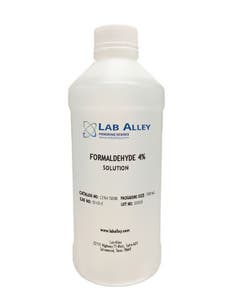
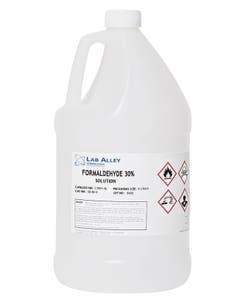
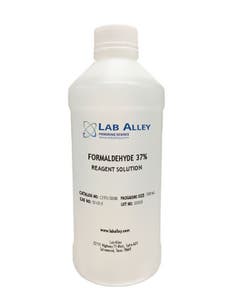
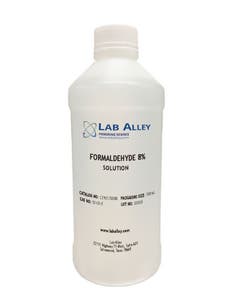
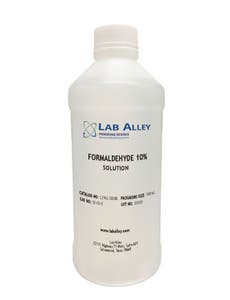
Formaldehyde sold by Lab Alley comes in Lab and Reagent Grades, with concentrations from 4% to 37%, and sizes ranging from 500 mL bottles to 55-gallon drums.
Applications & Benefits
Formaldehyde's widespread industrial and scientific use stems from its exceptional reactivity, cross-linking capabilities, and antimicrobial properties. Despite requiring stringent safety controls due to its carcinogenic classification, it remains indispensable for applications where its unique chemistry delivers results unmatched by alternative compounds.
Industrial Applications
Production of phenol-formaldehyde and urea-formaldehyde resins represents formaldehyde's largest industrial use. These thermosetting resins provide the adhesive properties essential for plywood, particleboard, oriented strand board, and other composite materials used extensively in construction and furniture manufacturing.
Manufacturing of polyoxymethylene (POM) plastics and other polymers utilizes formaldehyde as a key raw material. These engineering plastics offer high strength, stiffness, and dimensional stability for automotive components, mechanical parts, and precision molded products.
Textile treatment applications employ formaldehyde for wrinkle resistance and permanent press finishes that maintain fabric appearance through repeated washing and wearing. The paper industry uses formaldehyde-based wet-strength additives and coating chemicals that prevent paper degradation when exposed to moisture.
Scientific & Laboratory Uses
Tissue fixation and preservation in histology and pathology laboratories depend fundamentally on formaldehyde's ability to cross-link proteins while preserving cellular architecture. This application makes formaldehyde the gold standard for preparing tissue specimens for microscopic examination and diagnostic procedures.
Cell fixation for microscopy and research applications relies on formaldehyde's rapid penetration and effective preservation of cellular structures at the molecular level. Chemical synthesis and analytical chemistry utilize formaldehyde as both a reagent and starting material for creating more complex compounds.
Reference standards and calibration solutions employ formaldehyde's well-characterized properties for validating analytical methods and ensuring measurement accuracy across laboratory procedures.
Specialized Applications
Vaccine production for pathogen inactivation in pharmaceutical manufacturing represents a critical specialized use. Formaldehyde inactivates viruses and bacteria while preserving the antigenic properties necessary for immune system recognition, making it essential for producing killed or inactivated vaccines.
Wood preservation and treatment protect lumber and wood products against decay organisms, termites, and other wood-destroying pests. Disinfection and sterilization in healthcare settings utilize formaldehyde's broad-spectrum antimicrobial activity for equipment and surface treatment.
Agricultural applications for soil sterilization eliminate plant pathogens, nematodes, and weed seeds before planting high-value crops sensitive to soil-borne diseases.
Fight Your Kidney Stone with This Natural Product Hack
Fight kidney stones. Discover how citric acid naturally prevents stone formation.

Is Lactic Acid Bad? A Look at the Health Science
Is lactic acid bad for you? Debunking myths and revealing its vital role in your body & beyond.
Hospitality Without Hitchhikers: Boric Acid’s Role in Bed Bug Prevention
Protect your hospitality business. Boric acid is key to preventing bed bug infestations.
Harnessing Silica Sulfuric Acid to Enhance Concrete Durability
Enhance concrete longevity. Silica sulfuric acid improves strength and chemical resistance.
Safety Information
Working with formaldehyde requires a comprehensive understanding of its serious health hazards and implementation of rigorous safety measures. As a known human carcinogen with significant acute toxicity, formaldehyde demands the highest level of safety consciousness and regulatory compliance.
Hazards & Precautions
Formaldehyde is highly toxic by inhalation, ingestion, and skin contact, causing severe respiratory and eye irritation at concentrations well below those detectable by odor. The compound is classified as a human carcinogen (Group 1) with documented potential for causing nasopharyngeal cancer and leukemia from chronic exposure.
The substance can cause allergic sensitization and contact dermatitis, with sensitivity often developing after repeated exposures. Once sensitized, individuals may react to extremely low formaldehyde concentrations that don't affect non-sensitized people.
As a flammable gas, formaldehyde forms explosive vapor-air mixtures across a wide concentration range, creating fire and explosion hazards wherever vapors can accumulate.
Personal Protective Equipment (PPE)
Chemical-resistant gloves made of nitrile or neoprene provide essential hand protection, as formaldehyde penetrates standard latex gloves. Safety goggles protect eyes from splashes and vapor exposure that can cause severe corneal damage.
Lab coats or protective clothing prevent skin contact with this carcinogenic compound. Respiratory protection becomes necessary when adequate ventilation cannot maintain exposure below permissible limits.
All formaldehyde handling must occur in well-ventilated areas or under fume hoods with demonstrated capture velocity. Emergency eyewash and shower facilities must be readily accessible in all areas where formaldehyde is used or stored.
Storage Guidelines
Store formalin solutions in tightly sealed containers in cool, well-ventilated areas, maintaining a temperature between 15 °C and 25 °C (59°F and 77°F). Containers must have vapor-tight closures to prevent the release of carcinogenic vapors.
Protect from light and heat to prevent polymerization reactions. Keep away from strong oxidizers, acids, and bases that can trigger violent reactions or hazardous polymerization.
Use methanol or other stabilizers to prevent polymerization in storage. Regular container inspection identifies leaks or degradation before they create safety hazards.
Spill & Disposal Procedures
Evacuate the area immediately upon discovering formaldehyde spills and ensure adequate ventilation before cleanup begins. Use appropriate absorbent materials and neutralizing agents designed for aldehyde compounds.
Dispose of formaldehyde and contaminated materials as hazardous chemical waste according to EPA and local regulations (waste code U122). Never pour formaldehyde down drains or release it to the environment, as this violates environmental regulations and creates serious contamination risks.

How to Safely Dispose of Sulfuric Acid
Sulfuric acid is one of the most common acidifying reagents and sulfur sources, essential across multiple industries. At the same time, it is also a toxic and highly hazardous chemical reagent, requiring safe handling and disposal by trained personnel.
How To Use Nitric Acid Safely
Nitric acid is a corrosive chemical and harmful to humans. Its contact with skin and eyes can cause serious burns. Affected skin will require flushing with soap and lukewarm water for at least 30 minutes.

Acetone Safety: Proper Storage and Disposal Methods
Acetone is a staple chemical solvent in most laboratories. It is also perhaps one of the most recognizable chemicals to the layperson, best known as the pungent solvent comprising nail polish remover.

How to Use Potassium Iodide Safely and Where to Buy it Online
Potassium Iodide Powder, also known as Potassium Salt of Hydriodic Acid, Iodic Acid Potassium Salt, Potassium Monoiodide, and Knollide, has the chemical formula KI. It appears as a white crystalline powder, odorless, and is soluble in water at ambient conditions.

Medicinal Oils Derived From Plants
You can order food-grade ethanol, extraction-grade ethanol, ACS-grade ethanol, FCC-grade ethanol, USP grade ethanol, HPLC-grade ethanol and kosher ethanol from Lab Alley. Perform ethanol (EtOH) extraction at ultra-low temperatures for the best yields.
Ethanol extraction is a cost-effective way to use ethanol as an industrial solvent to produce high-quality botanical extracts from large volumes of medicinal herbs or plants.
Available Grades and Packaging Options
Formaldehyde is available through chemical suppliers in various grades and container sizes, accommodating different application requirements and usage volumes. The selection of appropriate grades depends on purity specifications, intended use, and regulatory compliance requirements.
Standard Grade Classifications
- ACS (American Chemical Society) Grade: Conforms to American Chemical Society specifications for analytical and research applications requiring consistent purity levels and comprehensive analysis certificates. Typically supplied as a 37-40% aqueous solution stabilized with methanol.
- USP (United States Pharmacopeia) Grade: Meets pharmaceutical standards for vaccine manufacturing and pharmaceutical synthesis applications, with strict limits on impurities and other contaminants.
- Pharmaceutical Grade: Specialized grade meeting FDA requirements for pharmaceutical manufacturing, with enhanced purity requirements and contamination controls for critical medical applications.
- Industrial/Technical Grade: Cost-effective option suitable for resin production, textile treatment, and manufacturing applications where ultra-high purity specifications are not critical. Typically, 37-50% concentration.
- Electronic Grade: Ultra-high purity formaldehyde with extremely low metal ion content for semiconductor manufacturing and electronics applications requiring minimal contamination.
Container Sizes and Bulk Options
- Small quantities: Laboratory bottles from 500mL to 4L for research, educational, and small-scale applications requiring minimal formaldehyde volumes.
- Medium quantities: Containers of 5 gallons (approximately 20L) for pilot-scale operations, medium-volume laboratory use, and regular industrial applications.
- Bulk options: Large containers of 55 gallons for high-volume applications, commercial operations, and manufacturing processes requiring consistent supply chains.
- Concentration options: Typical formaldehyde concentrations include 4%, 8%, 10% buffered, 30%, and 37% aqueous solutions in Lab Grade and Reagent Grade formulations to meet diverse application requirements.
For reliable formaldehyde in various grades and packaging configurations, Lab Alley offers laboratory-tested products with complete documentation, including certificates of analysis and safety data sheets. Our technical support team can assist with grade selection, concentration requirements, and packaging decisions to meet your specific application needs while ensuring regulatory compliance and worker safety.
Contact our experienced sales team for current pricing, availability information, and technical specifications to fulfill your formaldehyde requirements.