


-
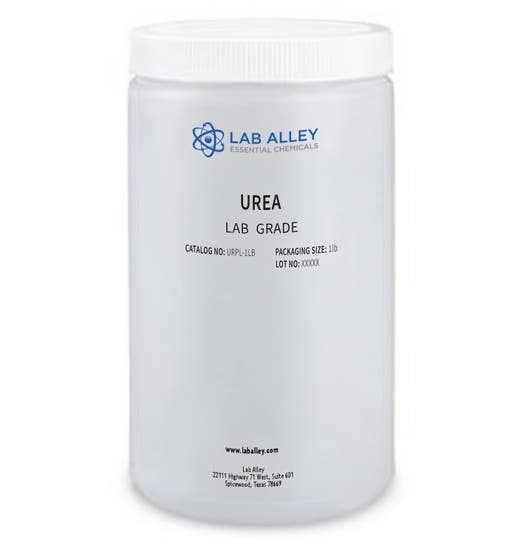
Urea, also known as Carbamide, Carbonyldiamide, and Isourea, has the chemical formula CH4N2O or CO(NH2)2. It appears as colorless to white prills, granules, pellets, or crystals with no odor, but can gradually develop a slight Ammonia odor in the presence of moisture. It possesses a cooling saline taste and is freely soluble in Water and Alcohol at ambient conditions. When heated to decomposition, it emits toxic fumes of Nitrogen Oxides. Commercially, it is produced by reacting Ammonia, Carbon Monoxide, and Sulfur in Methanol. It is also produced by combining liquid Ammonia and liquid Carbon Dioxide under a pressure of 1750-3000 psi and a temperature of 160- 200 °C to form Ammonium Carbamate (NH4CO2NH2). Ammonium Carbamate undergoes decomposition at lower pressure to Urea and Water.
Chemically pure or Laboratory Reagents are the two terms often used to describe Lab Grade chemicals. Lab Grade chemicals do not meet any accepted quality or purity requirements such as the ACS Grade, the USP Grade, and the FCC Grade, despite their acceptable purity.
-
- Reagent
- Chemical precursor
- Fertilizers
- Synthesis of dyes
- Synthesis of urea-formaldehyde resin
-
Product Information
| CAS | 57-13-6 |
|---|---|
| Assay | 99.0-100.5% |
| Grade | Lab Grade |
| Color | As reported |
| Physical form | Solid |
| Appearance | White |
| Odor | Ammonia-like |
| pH | 7 - 10 (10% solution) |
| Melting point | 132°-135°C |
| Boiling Point | Decomposes below BP |
| Vapor pressure | 0.002 hPa (750°C) |
| Solubility | 590 g/l (20°C) |
| Molecular formula | CH4N2O |
| Molecular weight | 60.06 |
| Ammonium (NH4) | <150 ppm |
| Autoship Available | Yes |
| Chloride (Cl) | 0.01% |
| Heavy metals | 0.00% |
| Iron (Fe) | <2 ppm |
| Nitrogen Compounds | >46.0 wt% |
| Residue after evaporation | <20 ppm |
| Silica (SiO2) | <10 ppm |
| Sulfate (SO4) | 0.01% |