





How to Safely Dispose of n-Hexane: Environmental and Safety Guidelines
Responsible disposal of n-hexane serves a critical role in environmental stewardship, workplace safety, and regulatory compliance. This widely used solvent is used in laboratory extractions, oilseed processing, paint thinning, and industrial solvent operations, making proper disposal knowledge essential for professionals across diverse sectors.
n-Hexane disposal presents significant challenges due to its extreme flammability, neurotoxic properties, and classification as hazardous waste. Learning appropriate disposal techniques protects workers from fire hazards and chronic exposure while ensuring compliance with strict regulatory frameworks.
This guide examines n-hexane disposal essentials, addressing regulatory obligations, fire and explosion prevention, neurotoxicity concerns, and disposal options appropriate for different operational settings.


In this article, we’ll review:
1. Why Proper Disposal Matters
2. How to Dispose of n-Hexane
3. Special Considerations for n-Hexane
Why Proper Disposal Matters
n-Hexane disposal carries serious implications that reach beyond standard waste handling. Understanding these consequences clarifies why regulatory agencies and facilities have developed specific protocols for managing this volatile solvent.
Environmental Protection
Environmental considerations from n-hexane occur when disposal practices ignore the compound's behavior in natural systems:
-
n-Hexane volatilizes rapidly to the atmosphere, where it reacts with photochemically produced hydroxyl radicals with a half-life of approximately three days. This atmospheric degradation represents the predominant environmental fate process.
-
While biodegradable by Pseudomonas bacteria under aerobic conditions, volatilization occurs much faster than biological breakdown. The compound's high vapor pressure drives rapid evaporation from surfaces.
-
n-Hexane is toxic to aquatic organisms with long-lasting effects. Releases to water bodies harm fish and other aquatic species, though the compound's volatility limits persistence in aquatic environments.
-
Its high mobility in soil and low adsorption mean it readily volatilizes from dry and moist surfaces rather than persisting in sediments. However, releases can contaminate soil and groundwater before volatilization occurs.
-
Appropriate disposal prevents these environmental impacts and supports responsible chemical management that protects ecosystem health.
Health & Safety
Human health and safety concerns make n-hexane disposal a workplace priority with particular attention to chronic exposure risks:
-
n-Hexane has relatively low acute toxicity with an oral LD50 of 28,710 mg/kg in rats, but poses serious chronic health risks that distinguish it from many other solvents.
-
Prolonged or repeated exposure causes peripheral neuropathy with numbness and muscle weakness in the extremities. This nerve damage can develop gradually and may become permanent with continued exposure.
-
The compound may cause central nervous system depression, dizziness, drowsiness, and headache upon inhalation. These acute effects warn of exposure levels requiring immediate intervention.
-
n-Hexane is an aspiration hazard and may be fatal if swallowed and enters the airways. Even small amounts entering the lungs during ingestion can cause severe respiratory damage.
-
The compound is suspected of damaging fertility, creating reproductive health concerns for workers of childbearing age. Pregnant workers face particular risks requiring exposure minimization.
-
Direct contact causes skin irritation, and prolonged exposure leads to drying and dermatitis. Dermal absorption contributes to systemic exposure.
-
Workers handling n-hexane for disposal face hazards from fire, vapor inhalation, aspiration risks, and chronic neurotoxic exposure. Establishing proper disposal procedures with suitable protective equipment is essential for preventing these health incidents.
Legal Compliance
The regulatory structure governing n-hexane disposal creates enforceable responsibilities based on its hazardous waste classification:
-
n-Hexane is classified as D001 ignitable characteristic hazardous waste under EPA RCRA regulations due to its extremely low flashpoint of -22°C (-7°F). This classification is mandatory and applies to all n-hexane waste regardless of source or concentration.
-
All waste n-hexane must be managed as RCRA Subtitle C hazardous waste from generation through final disposal. This cradle-to-grave management requirement creates comprehensive obligations.
-
Generators must comply with hazardous waste regulations, including waste characterization, storage time limits, manifesting requirements, and disposal at permitted facilities. Non-compliance brings substantial penalties.
-
Generator status determines specific requirements. Conditionally exempt small quantity generators (less than 100 kg/month) face fewer requirements than small quantity generators (100 to 1,000 kg/month) or large quantity generators (over 1,000 kg/month).
-
Transportation requires DOT compliance as UN1208, Hexane, Class 3, Packing Group II. Improper shipping documentation or packaging creates regulatory violations.
-
Violations bring substantial penalties, including fines, corrective action orders, and potential criminal liability for knowing violations. Compliance costs significantly less than enforcement actions and remediation expenses.
How to Dispose of n-Hexane
Effective n-hexane disposal starts with understanding hazardous waste classification and connecting waste to appropriate disposal methods while meeting all regulatory requirements.
Characterize the Waste
Waste characterization forms the foundation of compliant n-hexane disposal under hazardous waste regulations.
n-Hexane waste is classified as D001 ignitable hazardous waste due to flashpoint below 60°F (15.6°C). This classification is automatic and applies to all n-hexane-containing waste unless proven otherwise through testing.
Document waste source, concentration, and potential contaminants from use. Characterization records support proper handling and demonstrate regulatory compliance.
Pure n-hexane and contaminated n-hexane from extractions or cleaning operations are hazardous waste. Source or purity does not exempt material from hazardous waste classification when flashpoint criteria are met.
Mixtures containing n-hexane may be ignitable depending on concentration and flashpoint. Test mixed waste streams to determine if they meet D001 criteria requiring hazardous waste management.
Review RCRA regulations at 40 CFR Part 261 for hazardous waste determination. Understanding federal criteria ensures proper classification and management decisions.
Check Applicable Regulations
Regulatory compliance verification establishes the groundwork for legally sound disposal operations.
Verify federal EPA RCRA regulations governing hazardous waste management. n-Hexane's D001 classification triggers comprehensive regulatory requirements throughout the waste lifecycle.
Examine state environmental agency requirements, which may exceed federal standards. Some states impose additional restrictions on ignitable waste storage, transportation, or disposal.
Research local disposal ordinances. Municipal regulations may contain prohibitions or notification requirements for hazardous waste activities.
Determine generator status based on monthly hazardous waste generation volumes. Status determination affects storage time limits, manifesting requirements, and facility obligations.
Consult the Safety Data Sheet (SDS) information for product-specific disposal recommendations. Manufacturers provide guidance based on formulation and intended use.
Review laboratory or facility chemical waste management plans. Institutional protocols often exceed regulatory minimums to ensure consistent waste handling.
Never Pour Down Drains
Drain disposal of n-hexane is absolutely prohibited due to multiple serious hazards:
-
n-Hexane is prohibited from drain disposal due to hazardous waste classification under RCRA. Federal regulations explicitly forbid discharge of ignitable hazardous waste to sewer systems.
-
High volatility creates explosion hazards in sewer systems. The compound rapidly evaporates in drains, creating flammable vapor accumulations in collection infrastructure.
-
Vapors are heavier than air and travel to distant ignition sources. Sewer systems provide pathways for vapor movement to areas containing electrical equipment, water heaters, or other ignition sources.
-
Never dispose of through sinks, floor drains, or sanitary sewers under any circumstances. Even small quantities create unacceptable fire and explosion risks.
-
Local wastewater discharge regulations strictly prohibit flammable materials. Violations can result in substantial fines from both EPA and local sewer authorities, plus liability for any resulting fires, explosions, or treatment plant damage.
Use Designated Waste Disposal Methods
Proper disposal pathways depend on waste quantity, contamination status, and generator requirements.
Laboratory Quantities: Collect in compatible containers, including glass, metal, or high-density polyethylene (HDPE). Select containers designed for flammable liquid storage with proper closures that prevent vapor release.
Label with hazardous waste tags including contents ("n-Hexane" or "Hexane"), accumulation date, and hazard classification (D001 Ignitable). Complete labeling meets regulatory requirements and protects waste handlers.
Store in designated satellite accumulation areas or central accumulation areas following time limits. Satellite areas allow up to 55 gallons at the point of generation without time restrictions, while central accumulation areas face 275-day limits for small quantity generators or 90-day limits for large quantity generators.
Arrange pickup through institutional environmental health and safety departments. Academic and research institutions typically provide dedicated collection services with trained personnel managing waste streams.
Industrial Quantities: Use bulk solvent waste collection in approved containers designed for flammable liquids. Drums must meet DOT specifications and maintain proper closures.
Keep separate from non-halogenated and halogenated solvents for potential recycling. Segregation preserves recycling value and simplifies waste characterization.
Follow DOT regulations for waste transportation as UN1208, Class 3, Packing Group II. Proper classification ensures safe transport and regulatory compliance.
Contract licensed hazardous waste transporters and treatment facilities. Verify transporter EPA identification numbers and facility permits before arranging waste shipment.
Oil Extraction Operations: Food processing facilities generating spent n-hexane from seed oil extraction must manage as hazardous waste despite its food-grade source material.
Implement closed-loop recovery systems where possible. On-site distillation reduces waste generation and disposal costs while recovering valuable solvent.
Dispose of through permitted hazardous waste contractors holding appropriate licenses. Facilities handling oil extraction waste need specialized permits for this waste stream.
Contaminated Materials: Rags, absorbents, and materials saturated with n-hexane are hazardous waste. The D001 classification extends to materials contaminated with ignitable substances.
Collect in closed metal containers to prevent vapor release and fire hazards. Never use plastic containers for saturated materials that might generate static sparks.
Do not mix with incompatible wastes. Maintain segregation from oxidizers, acids, and reactive chemicals to prevent reactions.
Understanding Extreme Flammability Hazards
n-Hexane creates extreme fire and explosion hazards requiring constant attention during waste handling and storage.
Fire and Explosion Prevention: n-Hexane is extremely flammable with a flashpoint of -22°C (-7°F), autoignition temperature of 224°C (435°F), and explosive limits of 1.1% to 7.5% in air. These parameters indicate exceptional fire danger.
Vapors are heavier than air with a vapor density of 2.97, meaning they travel considerable distances along floors to ignition sources and flash back. This behavior creates fire risks far beyond immediate storage areas.
Remove all ignition sources, including heat, sparks, open flames, and hot surfaces. Use only non-sparking tools and explosion-proof equipment in areas where n-hexane vapors may be present.
Ground and bond containers during transfer to prevent static discharge. Even small static sparks can ignite n-hexane vapors, triggering fires or explosions.
Store in cool, well-ventilated areas away from oxidizing agents. Temperature control and ventilation prevent vapor accumulation, while separation from incompatible materials prevents reactions.
Vapor Control: Ensure adequate ventilation when handling waste n-hexane. Proper air circulation prevents flammable atmosphere development and reduces inhalation exposure.
Vapors may accumulate in low-lying areas, confined spaces, ducts, and sewers, creating explosion hazards. Monitor these areas carefully and implement vapor detection where accumulation risks exist.
Use fume hoods for laboratory-scale handling. Local exhaust ventilation captures vapors at the source before they enter the general work environment.
Implement vapor recovery systems for industrial operations. These systems capture and recycle vapors, reducing both fire hazards and air emissions.
Never allow vapors to accumulate in closed or poorly ventilated spaces. Vapor accumulation creates explosive atmospheres that can ignite from minimal energy sources.
Approved Disposal Methods
Several disposal methods provide compliant pathways for n-hexane hazardous waste.
Incineration: n-Hexane waste is typically incinerated at permitted hazardous waste incinerators or waste-to-energy facilities with appropriate air pollution controls.
This is the most common disposal method for waste n-hexane that cannot be recycled. High-temperature combustion destroys the compound while recovering energy value.
Licensed incineration facilities maintain appropriate air permits and pollution control equipment to manage combustion byproducts. Verify facility permits before arranging disposal.
Fuel Blending: Waste n-hexane meeting specifications may be used as fuel in industrial boilers or cement kilns at permitted facilities.
Must comply with RCRA fuel specifications and emissions standards. Facilities burning hazardous waste fuels need specific permits and must demonstrate compliance with air quality requirements.
This option provides energy recovery while destroying the waste compound. However, not all n-hexane waste meets fuel specifications due to contamination.
Solvent Recovery and Recycling: Pure or lightly contaminated n-hexane can be recovered through distillation at permitted recycling facilities.
Large-volume users should implement on-site solvent recovery systems to minimize waste generation and disposal costs. Industrial distillation equipment allows continuous solvent recycling.
Recycling represents the most environmentally preferable option when available. Reclaimed n-hexane reduces demand for virgin production and diverts waste from disposal facilities.
Licensed Hazardous Waste Facility: All n-hexane waste must ultimately be disposed at RCRA-permitted treatment, storage, and disposal facilities with authorization to handle D001 ignitable wastes.
Facilities must demonstrate appropriate permits and capabilities. Verify acceptance criteria before shipping waste to ensure compliance with facility restrictions.
Never Mix Chemicals
Chemical compatibility concerns can transform routine disposal into dangerous situations.
Avoid mixing n-hexane waste with strong oxidizing agents, including chlorine, concentrated oxygen, sodium hypochlorite, calcium hypochlorite, or dinitrogen tetraoxide. These combinations may cause violent reactions or explosions.
Keep separate from halogenated solvents, acids, and reactive chemicals. Segregation prevents incompatible reactions and maintains recycling potential for non-halogenated solvent waste.
Maintain segregation of ignitable wastes from other hazard classes during storage. Never store flammable liquids near oxidizers or reactive materials.
Mixed chemical wastes often require disposal as unidentified or incompatible waste mixtures, substantially increasing disposal costs and creating additional hazards for waste handlers.
Follow PPE Guidelines
Worker protection during n-hexane disposal requires appropriate personal protective equipment:
-
Wear nitrile or chemical-resistant gloves when handling n-hexane waste. Select gloves providing adequate protection while maintaining dexterity for safe waste handling.
-
Use safety goggles to protect eyes from splashes during waste transfers or container handling. n-Hexane causes eye irritation requiring immediate flushing.
-
Don protective clothing to prevent skin contact. Laboratory coats or coveralls protect from splashes while minimizing contamination of personal clothing.
-
Use respiratory protection in poorly ventilated areas or when vapor concentrations may exceed permissible exposure limits (NIOSH REL 50 ppm TWA, OSHA PEL 500 ppm TWA). Half-face respirators with organic vapor cartridges provide adequate protection for most operations.
-
Ensure eyewash stations and safety showers are accessible within 10 seconds of work areas. Emergency decontamination equipment must remain functional and unobstructed.
-
Eliminate ignition sources and use explosion-proof electrical equipment in areas where n-hexane vapors may be present. Standard electrical equipment can provide ignition sources for flammable vapors.
Special Considerations for n-Hexane
n-Hexane creates unique disposal considerations based on neurotoxic properties, reproductive concerns, and extreme flammability.
Neurotoxicity from Chronic Exposure
n-Hexane causes peripheral neuropathy with prolonged or repeated exposure, distinguishing it from many other common solvents.
Workers involved in waste handling should minimize vapor exposure through engineering controls and proper ventilation. Reduce exposure time and implement job rotation where feasible.
Monitor workplace air concentrations and implement exposure reduction measures. Regular air sampling verifies that ventilation systems maintain concentrations below permissible exposure limits.
Medical surveillance programs may be appropriate for workers with regular n-hexane exposure. Periodic neurological examinations can detect early signs of peripheral neuropathy requiring intervention.
Train workers on neurotoxicity symptoms, including numbness, tingling, or weakness in hands and feet. Early recognition allows prompt medical evaluation and exposure elimination.
Laboratory and Research Applications
n-Hexane, used for extractions, refractive index determinations, and chromatography, generates waste streams that must be collected through institutional hazardous waste programs.
Do not accumulate more than 55 gallons at satellite accumulation areas without a permit. Exceeding satellite accumulation limits triggers central accumulation area requirements with strict time limits.
Consolidate compatible waste streams to reduce disposal costs. Combining similar non-halogenated solvent wastes reduces container quantities and disposal frequency.
Label satellite accumulation containers clearly with contents and accumulation start dates. Maintain accurate records of waste generation for compliance documentation.
Reproductive Toxicity Concerns
n-Hexane is suspected of damaging fertility, creating reproductive health concerns for workers handling the compound.
Pregnant workers and workers planning pregnancy should minimize exposure. Consider temporary reassignment away from n-hexane handling for workers attempting conception or during pregnancy.
Ensure proper ventilation and PPE use during waste handling operations. Engineering controls provide primary protection, with PPE serving as supplemental protection.
Implement exposure monitoring for workers of reproductive age. Regular air sampling demonstrates that exposure remains below levels associated with reproductive effects.
Emergency Spills and Response
n-Hexane spills create immediate fire and explosion hazards requiring rapid response.
Contain spills with absorbent materials such as vermiculite or sand using non-sparking tools. Metal tools can create sparks that ignite vapors, so use brass or bronze implements.
Eliminate all ignition sources immediately. Turn off electrical equipment, remove smoking materials, and extinguish any flames in the immediate area.
Evacuate the area and prevent vapor accumulation in low-lying spaces. Restrict access until vapors disperse and fire hazards diminish.
Collect contaminated absorbent in closed metal containers as hazardous waste. Saturated materials are D001 ignitable waste requiring the same management as liquid n-hexane.
Report spills exceeding the reportable quantity of 5,000 pounds to the National Response Center at (800) 424-8802. Federal reporting requirements apply immediately upon reaching this threshold.
Storage and Accumulation Requirements
Store waste n-hexane in tightly closed containers in cool, well-ventilated areas away from heat and ignition sources.
Use only approved safety containers and cabinets for flammable liquids. Equipment must meet NFPA and OSHA requirements for flammable liquid storage.
Ground metal containers to prevent static buildup during filling and transfers. Bonding and grounding prevent static discharge ignition.
Inspect containers regularly for leaks and deterioration. Damaged containers must be immediately overpacked or contents transferred to sound containers.
Follow generator accumulation time limits strictly to maintain compliance. Exceeding time limits creates regulatory violations requiring corrective action.
Transportation Requirements
n-Hexane waste shipped off-site must be transported as UN1208, Hexane, Class 3, Packing Group II per DOT regulations.
Use only licensed hazardous waste transporters holding appropriate EPA identification numbers and state permits. Verify transporter credentials before releasing waste.
Complete uniform hazardous waste manifests and maintain copies for three years. Manifests track waste from generation through final disposal.
Properly label containers with DOT shipping information and hazardous waste labels. Labels must meet size, color, and placement requirements.
Waste Minimization Strategie
Implement source reduction strategies, including solvent recovery, process modifications, and substitution with less hazardous alternatives where feasible.
Large-volume users should evaluate on-site distillation for n-hexane recovery from extraction operations. Industrial distillation equipment pays for itself through reduced disposal costs and solvent purchases.
Consider closed-loop systems in oil processing to reduce waste generation. Continuous recovery extends solvent life indefinitely while eliminating disposal needs.
Evaluate alternative solvents with lower toxicity and flammability. Substitution provides the most effective exposure reduction when feasible.
Documentation and Recordkeeping Requirements
Maintain hazardous waste manifests, waste characterization records, training documentation, and disposal certificates for a minimum of three years.
Document generator status determinations and waste quantity records. Monthly tracking supports accurate status classification and demonstrates compliance with generation limits.
Keep emergency response plans and spill records current. Review and update plans annually or when operations change.
Retain transporter and disposal facility permits, verifying authorized waste handling. Documentation demonstrates proper contractor selection and facility authorization.
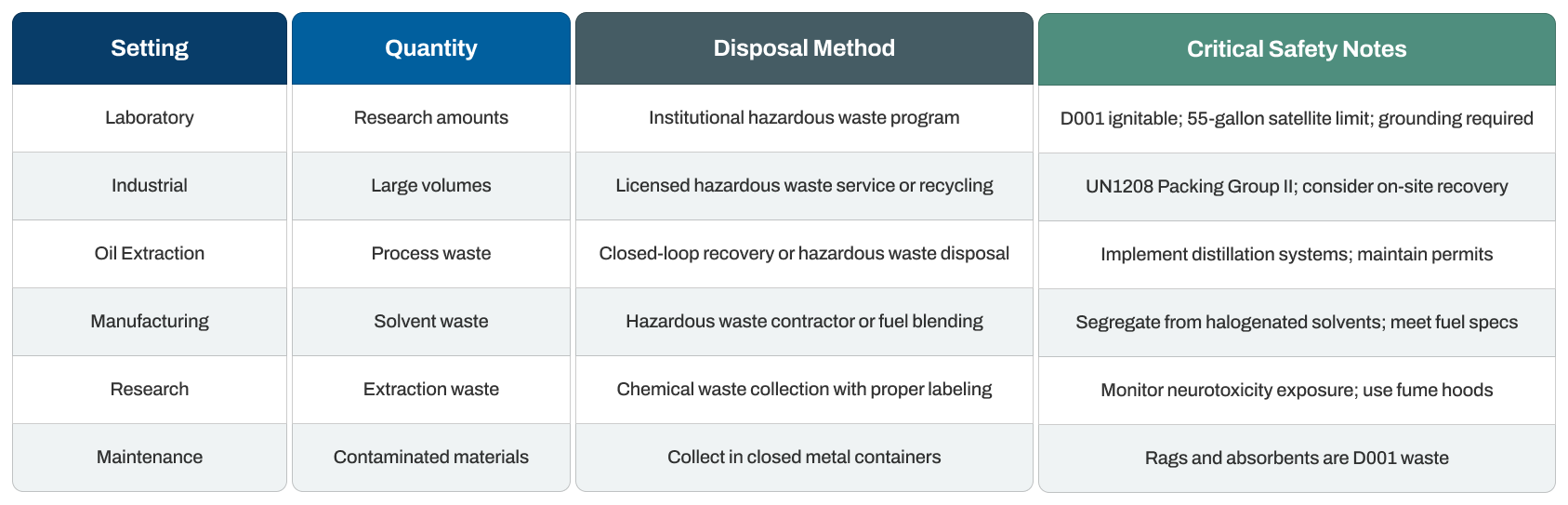
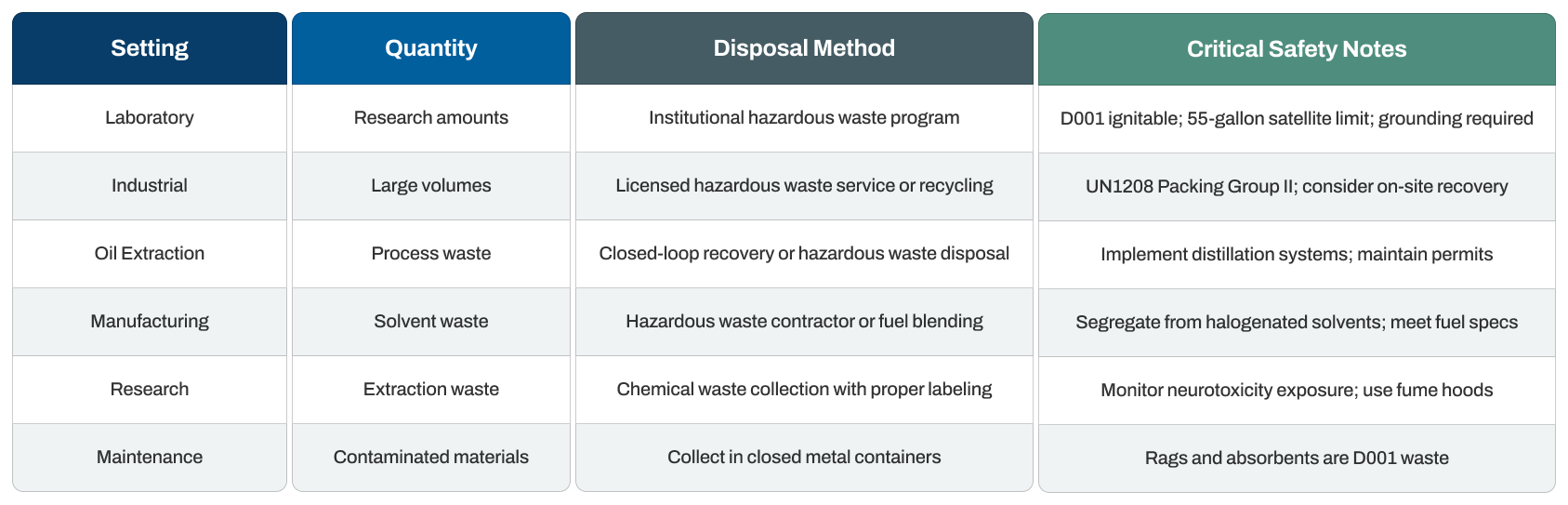
Quick Reference: Disposal Methods and Safety Requirements
Final Note
n-Hexane's classification as D001 ignitable hazardous waste requires strict disposal protocols regardless of application, quantity, or source. Understanding federal RCRA requirements, extreme flammability hazards, neurotoxicity risks, and proper fire safety procedures promotes compliant, safe disposal operations.
For safe, regulatory-compliant disposal of n-hexane and expert guidance on hazardous waste management, solvent recovery options, and neurotoxicity protection, contact licensed hazardous waste disposal contractors or environmental consulting services. Always consult current Safety Data Sheets (SDS) for specific handling and disposal information related to your particular n-hexane product and application, and follow all applicable institutional, company, federal, state, and local regulations for hazardous waste management.
When uncertain about disposal procedures, waste characterization, or exposure control, consult environmental health professionals or hazardous waste disposal specialists for guidance specific to your waste volume, contamination status, and jurisdiction.
For more detailed guidance, explore our Resource Library
Our Customer Care team is also available for more information and documentation, including chemical Safety Data Sheets.
Need n-Hexane You Can Trust?
If you are looking for high-quality n-Hexane for your lab, product line, or research facility, be sure to visit our store to explore our trusted selection and request a quote.
As your trusted partner in chemical supply, Lab Alley is always striving to meet the growing demands of our customers. We want you to be able to access all of your chemical needs in one place, along with streamlined online ordering and fast shipping.
Due to popular demand from our valued clientele, Lab Alley's n-Hexane is available in a range of purities and packaging options to suit various commercial, laboratory, and personal needs.