





Shelf Life & Expiration of n-Hexane: Storage and Stability Guide
n-Hexane is a critical hydrocarbon solvent used in extraction, degreasing, chromatography, and various industrial and laboratory applications. Understanding how long it remains pure and suitable for use helps you maintain product quality and ensure reliable results in analytical work. Because n-Hexane is highly volatile and extremely flammable, proper storage practices serve dual purposes: preserving chemical purity and preventing serious fire, explosion, and vapor accumulation hazards.
The stability of n-Hexane centers on controlling evaporative loss and preventing contamination rather than chemical breakdown. Analytical and high-purity grades require careful handling to maintain specifications, while the compound's extreme flammability demands rigorous safety protocols. This guide provides essential recommendations for maximizing n-Hexane shelf life while ensuring safe handling and storage.


In this article, we’ll review:
-
How Long Does n-Hexane Last?
-
Signs That n-Hexane Has Expired or Degraded
-
What to Do If n-Hexane Is Expired
How Long Does n-Hexane Last?
n-Hexane longevity depends on purity grade, container integrity, and storage practices. Understanding these variables helps you manage inventory effectively and maintain quality for critical applications.
Shelf Life Duration
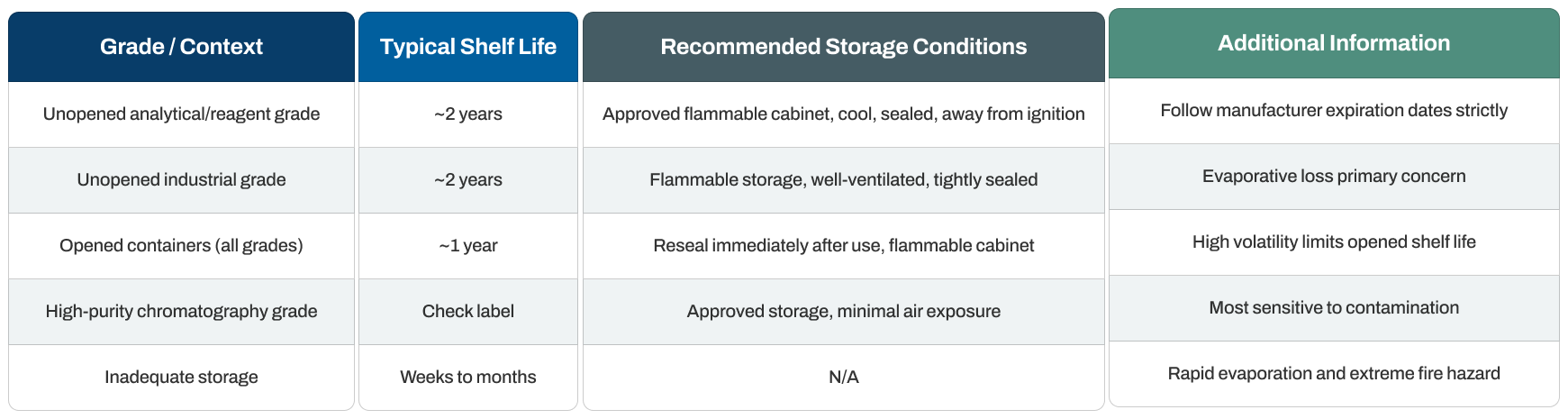
Unopened containers: Generally retain quality for approximately 2 years when stored under recommended conditions in original manufacturer packaging. This timeframe applies across purity grades when containers remain sealed.
Opened containers: Should be used within approximately 1 year due to n-Hexane's high volatility. The compound's rapid evaporation rate makes extended storage of opened bottles impractical for maintaining accurate concentrations.
Analytical and reagent grades: Typically carry manufacturer-specified expiration dates on labels due to the importance of maintaining purity for precise applications. These dates reflect the stringent quality requirements for analytical work.
Industrial grades: May show longer practical usability for less critical applications, though evaporative loss remains a concern regardless of purity level.
Chemical Stability
n-Hexane exhibits excellent chemical stability under normal conditions, though physical properties create unique storage challenges:
Baseline stability: The compound is chemically stable under normal storage and handling conditions. It does not form peroxides and hazardous polymerization will not occur, eliminating concerns common with other organic solvents.
Thermal stability: Thermal-oxidation degradation can produce carbon oxides when heated to decomposition, making exposure to heat or ignition sources a critical safety concern rather than just a quality issue.
Volatility characteristics: n-Hexane is highly volatile, with a boiling point of 68°C (150°F) and an evaporation rate approximately 7 to 9 times faster than butyl acetate. This exceptional volatility makes evaporative loss the primary quality concern during storage.
Moisture resistance: Not hygroscopic and doesn't absorb moisture from the air, eliminating water contamination as a degradation pathway. This characteristic simplifies certain aspects of storage compared to hygroscopic solvents.
Vapor pressure: High vapor pressure means evaporative concentration loss represents a significant concern. Product loss occurs rapidly from poorly sealed containers, affecting both quantity and potentially altering residue profiles.
Purity & Packaging
Grade specifications and container selection significantly affect how well n-Hexane maintains its quality:
Purity sensitivity: Higher-purity analytical and reagent grades are more sensitive to contamination and evaporative loss than lower-purity industrial grades. These precision products typically have a shorter effective shelf life once opened due to their stringent purity requirements.
Container materials: Original manufacturer containers made from compatible materials such as glass, HDPE, or approved metal drums provide optimal protection. n-Hexane can attack certain plastics, rubber, and coatings, making container compatibility verification essential before transferring to alternative containers.
Seal integrity: Keep containers tightly sealed at all times to minimize evaporative loss. Even brief periods of poor sealing allow significant vapor escape due to the compound's extreme volatility.
Original packaging advantage: Manufacturer containers offer superior protection because they're engineered specifically for volatile hydrocarbon storage and equipped with appropriate sealing mechanisms.
Static hazards: Ground and bond all containers and receiving equipment when transferring to prevent static discharge. This safety requirement affects how material can be handled and stored.
Storage Conditions
Creating appropriate storage environments is fundamental to preserving n-Hexane quality and ensuring safety:
Flammable liquid storage: n-Hexane is classified as an extremely flammable liquid with a flash point of -22°C (-7°F). It must be stored exclusively in approved flammable liquids storage cabinets or rooms, separate from oxidizing materials. This isn't optional—it's a mandatory safety requirement.
Temperature management: Store in a cool area, away from heat sources, hot surfaces, and direct sunlight. Elevated temperatures increase vapor pressure and evaporation rate, accelerating product loss and increasing fire and explosion risk.
Ventilation requirements: Store in a well-ventilated area. n-Hexane vapors are heavier than air (vapor density approximately 3.0 relative to air) and can accumulate in low-lying areas, ducts, and below-ground spaces. Adequate ventilation prevents dangerous vapor buildup that could lead to explosion hazards.
Ignition source elimination: No smoking, open flames, or ignition sources are permitted in any area where n-Hexane is stored, handled, or used. Use only non-sparking tools and explosion-proof equipment to prevent ignition of vapors.
Light protection: Store away from direct sunlight to prevent heat buildup and potential photochemical effects, though evaporative loss and fire hazards represent more immediate concerns than photodegradation.
Equipment requirements: All equipment in storage areas must be explosion-proof, reflecting the serious fire and explosion hazards associated with this solvent.
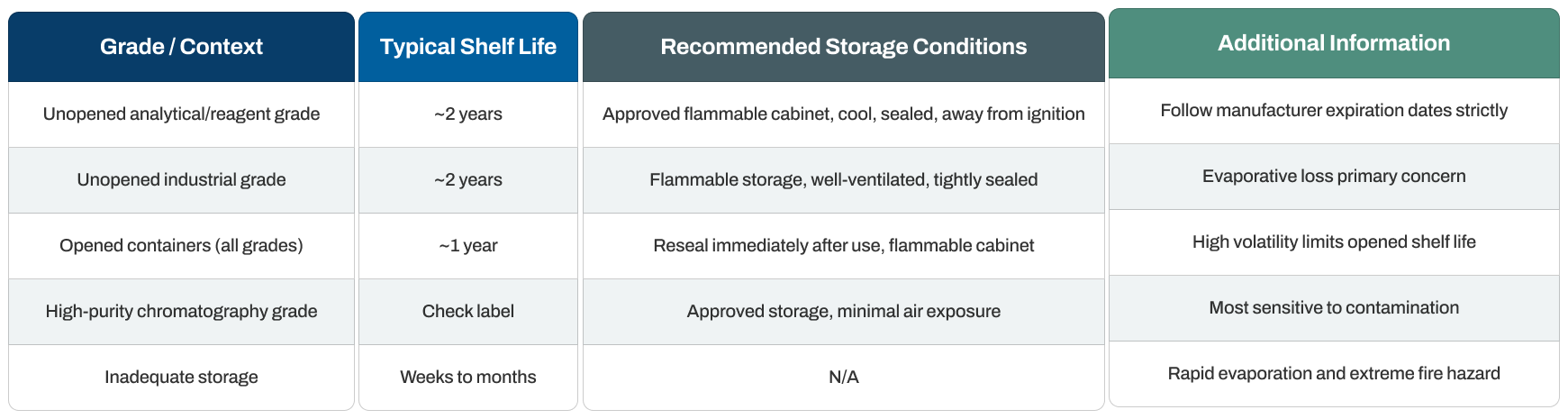
Quick Reference: Shelf Life and Storage
Signs That n-Hexane Has Expired
Observable changes indicate when n-Hexane has deteriorated beyond acceptable limits. Recognizing these signs protects analytical accuracy and process reliability.
Reduced Volume or Concentration: Due to the very high evaporation rate, noticeable product loss from the container is the most common sign of degradation or improper storage. This becomes particularly evident in open containers where significant volume reduction indicates extended air exposure.
Discoloration: n-Hexane should be a clear, colorless liquid. Any yellowing or discoloration may indicate oxidation or contamination and the product should not be used for analytical or precision applications where purity directly affects results.
Odor Changes: Fresh n-Hexane has a mild, gasoline-like odor. A significantly stronger or different odor may indicate decomposition or contamination, signaling that the product should be discarded.
Failure to Meet Purity Specifications: For analytical and reagent-grade n-Hexane, the most reliable indicator of expiration is failure to meet Certificate of Analysis (CoA) purity specifications upon retesting. This becomes especially important for chromatography and quantitative analysis applications where trace impurities affect results.
Exceeded Expiration Date: Always check the manufacturer-provided expiration or retest date on the container label. Do not use n-Hexane past the printed expiration date without re-qualification testing confirming it still meets purity specifications.
Container Damage: Dents, corrosion, or seal deterioration in metal containers may indicate compromised integrity, allowing evaporative loss or contamination entry.
What to Do If n-Hexane Is Expired
Discovering expired n-Hexane requires immediate action to protect analytical integrity, maintain safety, and ensure regulatory compliance.
Check Manufacturer Guidelines
Review the expiration or retest date on the container or the accompanying Certificate of Analysis. If the product has exceeded its expiration date, do not use it for analytical or precision applications without verified retest results confirming it still meets purity specifications.
Analytical and chromatography applications demand strict adherence to expiration dates because even minor impurities affect separation, detection, and quantification. Industrial applications may tolerate slightly aged material for non-critical uses, but testing should confirm suitability.
Manufacturer guidelines provide the foundation for quality decisions. When in doubt, replace rather than risk compromising analytical results or process outcomes.
Dispose of as Hazardous Waste
n-Hexane must be disposed of as hazardous waste in accordance with local, state, and federal regulations. This requirement reflects both its flammability and environmental toxicity. Do not discharge into drains, sewers, or waterways under any circumstances.
n-Hexane is toxic to aquatic life with long-lasting effects, making environmental release particularly harmful. Collect and dispose of through a licensed hazardous waste disposal contractor experienced with flammable solvents.
Label waste containers clearly as "Hazardous Waste - Flammable" and store in approved flammable storage until pickup. Maintain proper documentation of waste disposal to satisfy regulatory requirements and environmental compliance programs.
Handle expired n-Hexane with the same safety precautions as fresh material: no ignition sources, adequate ventilation, proper grounding, and appropriate personal protective equipment.
Replace with Fresh Stock
For applications requiring consistent purity — particularly chromatography, extraction, and analytical testing—replace expired n-Hexane with fresh product bearing a valid Certificate of Analysis to ensure accurate and reliable results.
Source replacement material from established suppliers who provide comprehensive documentation, including recent CoA data, purity specifications, and appropriate expiration dates. Verify that grade and purity match your application requirements.
Inspect incoming shipments for container integrity, proper labeling, and seal quality. Confirm that containers show no damage, discoloration, or signs of leakage before accepting delivery. Check that CoA specifications align with your analytical or process needs.
Proper Storage Extends Shelf Life
Implementing rigorous storage practices from the outset maximizes usability and ensures safety:
Flammable liquid storage requirements: n-Hexane must be stored exclusively in approved flammable liquids storage cabinets or rooms, separate from oxidizing materials. This represents a non-negotiable safety requirement due to the extremely flammable nature of the solvent.
Container requirements: Store in original manufacturer containers made from compatible materials such as glass, HDPE, or approved metal drums. Verify container compatibility before transferring to alternative containers, as n-Hexane can attack certain plastics, rubber, and coatings. Keep containers tightly sealed at all times to minimize evaporative loss.
Static protection: Ground and bond all containers and receiving equipment when transferring to prevent static discharge. Static electricity poses a serious ignition hazard with this volatile, flammable solvent.
Temperature management: Store in a cool area, away from heat sources, hot surfaces, and direct sunlight. Elevated temperatures increase vapor pressure and evaporation rate, accelerating product loss while increasing fire and explosion risk.
Ventilation requirements: Store in a well-ventilated area to prevent vapor accumulation. n-Hexane vapors are heavier than air (vapor density approximately 3.0) and can accumulate in low-lying areas, ducts, and below-ground spaces. Adequate ventilation prevents dangerous vapor buildup that could reach explosive concentrations.
Ignition source elimination: No smoking, open flames, or ignition sources are permitted in any area where n-Hexane is stored, handled, or used. Use only non-sparking tools and explosion-proof equipment to prevent accidental ignition.
Equipment specifications: All equipment in storage areas must be explosion-proof, including lighting, ventilation systems, and electrical outlets. This requirement reflects the serious explosion hazards associated with n-Hexane vapors.
Proper labeling: Label all containers with the chemical name, date received, date opened, and expiration date. This proves critical for inventory management and ensures the product is used within its validated shelf life, particularly for high-purity analytical grades.
Immediate resealing: Reseal containers immediately after each use to minimize evaporative loss and vapor release. The compound's extreme volatility makes every moment of air exposure costly in terms of product loss and vapor hazards.
Inventory rotation: Use older stock first through organized tracking systems. Monitor dates carefully to ensure analytical-grade material gets used while still within manufacturer-specified shelf life.
Separation from incompatibles: Keep separate from oxidizing materials, strong acids, and other incompatible substances. Store in dedicated flammable liquid areas away from reactive chemicals.
Conclusion
n-Hexane demonstrates excellent chemical stability, with unopened containers retaining quality for approximately 2 years and opened containers remaining suitable for about 1 year when stored correctly. Primary concerns include rapid evaporative loss due to extreme volatility (evaporation rate 7-9 times faster than butyl acetate), maintaining purity specifications for analytical applications, and managing serious fire and explosion hazards from its extremely flammable nature (flash point -22°C).
Appropriate storage in approved flammable liquid cabinets with proper ventilation, tight sealing, and complete elimination of ignition sources preserves quality while ensuring safety. Following manufacturer guidelines and implementing rigorous storage protocols ensures dependable performance in extraction, chromatography, and analytical applications while protecting personnel and facilities from fire and explosion hazards.
Note: Fresh n-Hexane stored under proper flammable liquid storage conditions provides consistent purity and performance throughout its shelf life when handled according to manufacturer specifications and strict safety protocols for your specific application.
For more detailed guidance, explore our Resource Library for comprehensive storage and handling information.
Our Customer Care team is also available for more information and documentation, including chemical Safety Data Sheets.
Need n-Hexane You Can Trust?
If you are looking for high-quality n-Hexane for your lab, product line, or research facility, be sure to visit our store to explore our trusted selection and request a quote.
As your trusted partner in chemical supply, Lab Alley is always striving to meet the growing demands of our customers. We want you to be able to access all of your chemical needs in one place, along with streamlined online ordering and fast shipping.
Due to popular demand from our valued clientele, Lab Alley's n-Hexane is available in a range of purities and packaging options to suit various commercial, laboratory, and personal needs.