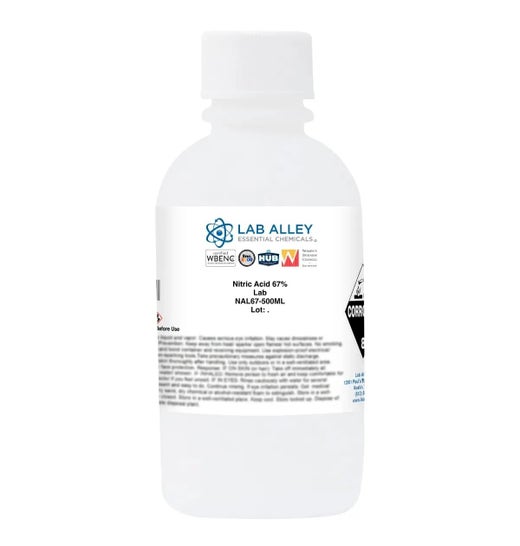



Nitric Acid (HNO3) is a highly corrosive and strong mineral acid and it is distinguished by its potent antioxidant property. Like other Nitric Acid percentages of concentration, in its pure form appears colorless but, over time, tends to acquire a yellow cast due to the decomposition of the nitrate; it has a sour odor.
Nitric acid is commonly used in various industrial and laboratory applications due to its strong oxidizing properties.
-
Chemical Manufacturing: Nitric acid is a key ingredient in the production of fertilizers, explosives (such as dynamite), and various organic and inorganic nitrogen compounds.
-
Metal Processing: It is used in metal etching, metal cleaning, and metal polishing processes. Nitric acid can remove oxide layers from metals, making it useful in surface treatment and preparation.
-
Laboratory Applications: It is commonly employed in laboratory settings for analytical chemistry, where it is used as a reagent or solvent for various experiments and reactions.
-
Cleaning and Passivation: Nitric acid can be used to clean and passivate stainless steel and other metals, removing contaminants and creating a protective oxide layer on the surface.
Nitric Acid (HNO3) is a highly corrosive and strong mineral acid and it is distinguished by its potent antioxidant property. Like other Nitric Acid percentages of concentration, in its pure form appears colorless but, over time, tends to acquire a yellow cast due to the decomposition of the nitrate; it has a sour odor.
Nitric acid is commonly used in various industrial and laboratory applications due to its strong oxidizing properties.
-
Chemical Manufacturing: Nitric acid is a key ingredient in the production of fertilizers, explosives (such as dynamite), and various organic and inorganic nitrogen compounds.
-
Metal Processing: It is used in metal etching, metal cleaning, and metal polishing processes. Nitric acid can remove oxide layers from metals, making it useful in surface treatment and preparation.
-
Laboratory Applications: It is commonly employed in laboratory settings for analytical chemistry, where it is used as a reagent or solvent for various experiments and reactions.
-
Cleaning and Passivation: Nitric acid can be used to clean and passivate stainless steel and other metals, removing contaminants and creating a protective oxide layer on the surface.
-
- Strong oxidizing agent
- Nitration of chemicals
- Dyes intermediates
- Fertilizer industry
- Nylon precursors
- Synthesis of explosives
Product Information
| CAS | 7697-37-2 |
|---|---|
| Synonyms | Hydrogen nitrate, Aqua fortis, Azotic acid, Salpetersaeure, Nitrooxidanyl |
| Assay | <65% |
| PubChem ID | 944 |
| Grade | Lab Grade |
| Color | Max 100 |
| Physical form | Liquid |
| Appearance | Clear to Pale Yellow |
| Odor | Strong Acrid |
| pH | 0.1 (1.0N solution) |
| Melting point | -41°C |
| Boiling Point | 120.5°C |
| Solubility | Fully Miscible in Water |
| Molecular formula | HNO3 |
| Molecular weight | 63.013 |
| Autoship Available | Yes |
| Chloride (Cl) | Max 10 ppm |
| Iron (Fe) | <=10 ppm |
| Nitrogen Compounds | Max 100 ppm |
| Viscosity | 2.0 cPs |
| Water | 30-35% |