











Polyethylene Glycol, (C2nH4n+2On+1), is synthesized by ring-opening polymerization of ethylene oxide. This synthesis process gives PEG a range of molecular weights and distributions from 300 grams per mole to 10,000,000 grams per mole.
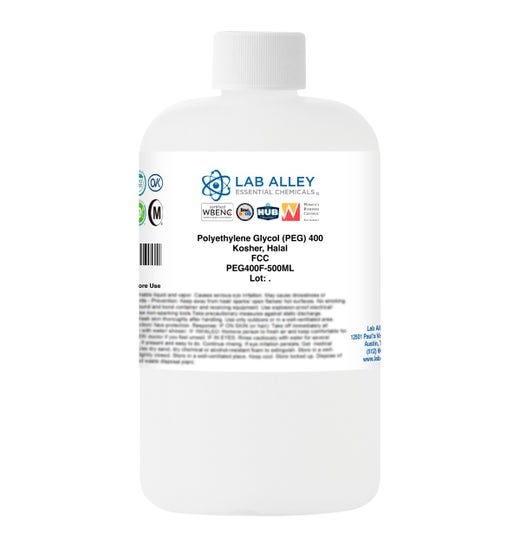
PEG 400 has a molecular weight of 400 and is a clear, colorless, viscous liquid. Polyethylene Glycol is colorless, inert, odorless, and non-volatile. PEG is biocompatible (it won’t damage tissues or cells), hydrophilic, dissolves readily in water without changing the color odor or taste, and is nontoxic. Due to the high purity of Polyethylene Glycol 400, it is certified by the United States Pharmacopeia (USP) grade and the Food Chemicals Codex (FCC) grade.
Polyethylene Glycol, (C2nH4n+2On+1), is synthesized by ring-opening polymerization of ethylene oxide. This synthesis process gives PEG a range of molecular weights and distributions from 300 grams per mole to 10,000,000 grams per mole.
PEG 400 has a molecular weight of 400 and is a clear, colorless, viscous liquid. Polyethylene Glycol is colorless, inert, odorless, and non-volatile. PEG is biocompatible (it won’t damage tissues or cells), hydrophilic, dissolves readily in water without changing the color odor or taste, and is nontoxic.
- Used in personal care products that need to remain viscous
- Used as a food additive and to preserve moisture
- Used to readily dissolve hydrophobic drugs
- Used to make viscous lubricants
Product Information
| CAS | 25322-68-3 |
|---|---|
| Grade | NF/FCC (Food) Grade |
| Color | Passes Test |
| Physical form | Liquid |
| Appearance | Clear Liquid |
| Odor | Slight |
| pH | 4.5-7.5 (5% solution) |
| Melting point | 8°C (46.4°F) |
| Density | 1.128 g/mL at 25 °C (77 °F) |
| Solubility | Fully Miscible in Water |
| Molecular formula | C2nH4n+2On+1 |
| Molecular weight | 380 - 420 |
| Autoship Available | Yes |
| Clarity of Solution | Pass |
| Diethylene Glycol | 0.25 max |
| Evaporation rate | 0.01 (Butyl Acetate = 1.0) |
| Flash Point | 176 °C (348.8 °F) |
| Heavy metals | Max 5ppm |
| Pillar | Natural |
| Viscosity | 6.8 - 8.0cst, at 98.9±0.3°C |
| Water | Max 0.500% |