





How to Safely Dispose of Acetone
Acetone (C₃H₆O) is a flammable organic solvent with broad industrial, laboratory, and consumer applications, including pharmaceutical manufacturing, coatings production, chemical synthesis, and laboratory cleaning. Responsible disposal is essential to protect workers, prevent fires, and avoid environmental contamination.
What makes acetone require particular care during disposal is the combination of its extremely low flash point of -18°C (0°F), its vapor density greater than air, and its classification as a federally regulated hazardous waste. These properties create ignition risks during handling and impose specific legal requirements that vary based on how the acetone was used and in what quantities it is generated.
Acetone waste arises in nearly every sector that uses solvents, from university research labs and hospital pharmacies to paint manufacturers and electronics fabricators. The disposal pathway for each setting differs based on waste classification, generator status, and the condition of the material being discarded.


In this article we’ll review:
-
Why Proper Disposal Matters
-
How to Dispose of Acetone
-
Ignitability and Vapor Hazards
-
Special Considerations
Why Proper Disposal Matters
Environmental Protection
Acetone is fully miscible with water and moves readily through soil and aquatic environments. Although it biodegrades relatively quickly under aerobic conditions, discharging large quantities into surface waterways increases biochemical oxygen demand (BOD) and depletes dissolved oxygen, with potential harm to aquatic organisms.
Improper disposal also creates risk of groundwater contamination in areas where acetone reaches subsurface soils. Because it is mobile and fast-spreading, even quantities that seem manageable above ground can travel significant distances through drainage systems.
Health & Safety
Acetone's flash point of -18°C (0°F) places it among the most flammable solvents in common use. During disposal, vapors released from open or improperly sealed containers can accumulate in enclosed spaces and travel to ignition sources at a distance from the disposal point, since acetone vapors are denser than air and settle near floor level.
At high concentrations, inhalation causes dizziness, headaches, and central nervous system depression. These hazards require ventilation controls, ignition source elimination, and appropriate personal protective equipment throughout the disposal process.
Legal Compliance
Acetone is subject to federal hazardous waste regulations under the Resource Conservation and Recovery Act (RCRA). Unused or off-specification acetone discarded without use is classified as a U002 listed waste. Acetone spent as a solvent in certain industrial processes may carry an F-listed waste code. In either case, it also exhibits the ignitability characteristic (D001) due to its flash point below 60°C (140°F).
Disposal must conform to applicable RCRA generator requirements, which differ by generator status: Conditionally Exempt Small Quantity Generator (CESQG), Small Quantity Generator (SQG), or Large Quantity Generator (LQG). State hazardous waste programs and local wastewater discharge permits impose additional requirements that may be more stringent than the federal baseline. Acetone spills of 5,000 pounds or more trigger mandatory reporting to the EPA under CERCLA Section 103(a).
How to Dispose of Acetone
Check Applicable Regulations
Before disposing of acetone waste, determine whether the material is classified as U002-listed waste, an F-listed spent solvent, or a D001 characteristic hazardous waste based on its origin and use. Review RCRA generator requirements that apply to your facility's generator status and verify state and local regulations governing ignitable and flammable chemical waste. Check local wastewater authority discharge limits before considering any drain disposal, and consult your institutional environmental health and safety (EHS) office if one is available.
Use Designated Waste Disposal Methods
Non-Hazardous Disposal
Acetone must not be discharged to sewer systems in significant quantities. Its flash point creates explosion hazards in enclosed sewer infrastructure, and even dilute solutions can present ignition risks in poorly ventilated pipe networks. Acetone is not classified as a priority pollutant under the Clean Water Act, but local pretreatment standards and discharge permits may still prohibit or restrict its disposal to the drain. Always contact your local wastewater treatment authority to confirm allowable discharge limits before considering drain disposal of any quantity.
Hazardous Waste Disposal
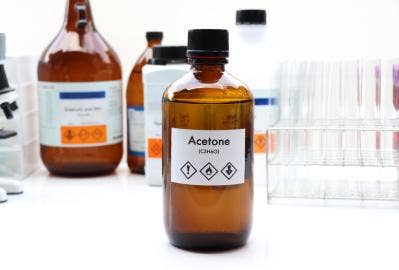
Acetone waste must be collected in tightly sealed, properly labeled containers compatible with flammable organic solvents. Glass or high-density polyethylene (HDPE) containers are appropriate; avoid reactive metals. Containers must be kept away from heat sources, sparks, and direct sunlight at all times. Disposal must be arranged through an institutional chemical waste program or a licensed hazardous waste contractor. Complete waste manifests and retain disposal records in accordance with RCRA and applicable state regulations.
Industrial Quantities
Large volumes of acetone waste must be collected by licensed hazardous waste disposal contractors and transported to permitted treatment, storage, and disposal facilities (TSDFs) in compliant, properly labeled containers. Where possible, solvent recovery is the preferred option over outright disposal. Spent acetone is well-suited for reclamation through distillation, which reduces disposal costs and raw material demand.
Any recovery process must comply with RCRA recycling provisions, and recovered acetone must meet applicable quality standards before reuse. Acetone contaminated with other hazardous substances must be segregated from incompatible waste streams and managed with full documentation.
Laboratory & Institutional Waste
Research institutions, universities, and healthcare facilities typically require all acetone waste to be collected through formal chemical waste programs regardless of quantity, given its ignitability classification and listed waste status. Follow institutional EHS protocols for container labeling, storage location, and pickup scheduling. Maintain chemical waste logs and document all disposal activities as required for ignitable and listed waste materials.
Never Mix Chemicals
Acetone must be kept strictly segregated during storage, handling, and disposal. Mixing with the following creates serious hazards:
-
Strong oxidizers (hydrogen peroxide, nitric acid, permanganates): risk of violent reaction or fire
-
Strong acids or bases in concentrated form: exothermic reactions that increase hazard and disposal complexity
-
Chlorinated or halogenated solvents create hazardous mixed waste streams with more complex disposal requirements and regulatory classification
-
Other ignitable solvents: increase overall flammability and complicate waste code determination
Follow PPE Guidelines
When handling acetone for disposal, wear chemical-resistant gloves (nitrile or neoprene), safety goggles, and protective clothing. Perform all disposal activities away from open flames, sparks, and hot surfaces. Work under strong mechanical ventilation or within a fume hood to prevent flammable vapor accumulation. Use only non-sparking tools and ensure containers are bonded and grounded to prevent static discharge during transfer. A dry chemical or CO₂ fire extinguisher must be readily accessible, and eyewash stations must be available in all areas where acetone is handled.
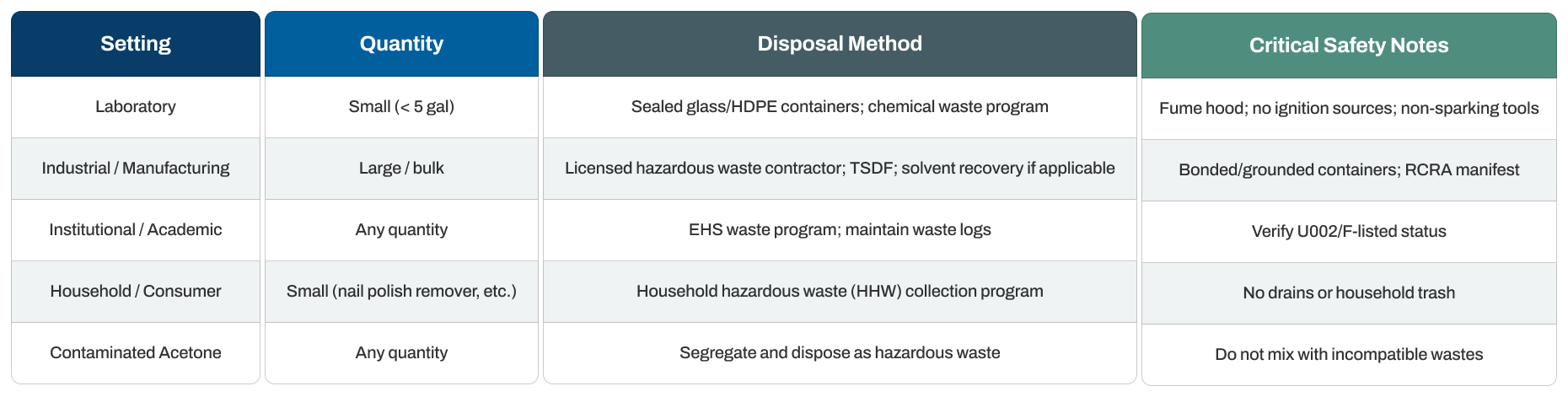
Quick Reference: Acetone Disposal by Setting
Ignitability and Vapor Hazards
Flash Point and Storage
Acetone's flash point of -18°C (0°F) makes it one of the most flammable solvents in routine use. Disposal containers must be stored and handled well away from heat sources, direct sunlight, electrical equipment, and all potential ignition sources. Containers must remain sealed except during active transfer, and transfers must be conducted in ventilated areas using grounded equipment.
Vapor Accumulation
Because acetone vapors are heavier than air, they settle and accumulate near floor level rather than dispersing upward. In enclosed disposal areas, vapors can travel along floors to reach ignition sources at considerable distances from where the acetone is being handled. Adequate ventilation is required in all disposal areas, with particular attention to enclosed spaces, basement-level storage rooms, and any area near floor drains connected to sewer systems.
RCRA Waste Classification
The correct RCRA waste code for acetone depends on how it was used. Unused or off-specification acetone that is being discarded is classified as U002. Acetone that was used as a solvent in certain manufacturing or industrial cleaning operations may carry an F-listed waste designation. If there is any uncertainty about the applicable waste code, consult your EHS office or a licensed hazardous waste consultant before labeling containers or arranging disposal.
Incineration
Acetone is an acceptable candidate for disposal through incineration at licensed hazardous waste facilities. Its high heat of combustion allows it to function as supplemental fuel in permitted waste-to-energy incineration systems, making incineration both a compliant and resource-efficient disposal pathway for waste streams where recovery is not feasible.
Special Considerations
Clean Air Act Exemption
The EPA has determined that acetone has negligible potential to form ground-level ozone and has exempted it from the definition of volatile organic compound (VOC) for air quality regulatory purposes. Acetone was also removed from the Toxic Release Inventory (TRI). These exemptions reduce the air permitting burden associated with acetone use and disposal in many facilities, but they have no bearing on its classification as a hazardous waste under RCRA or its flammability hazard during disposal.
Small-Scale and Household Quantities
Consumer-grade acetone products such as nail polish remover are generated in small quantities that fall outside RCRA generator thresholds for most households. These can typically be disposed of through local household hazardous waste (HHW) collection programs. Do not pour consumer acetone down household drains or place it in regular household trash in significant quantities, as both practices create safety and environmental risks.
Transportation
Acetone is regulated by the U.S. Department of Transportation as a flammable liquid under Class 3, UN1090. Any shipment for disposal must be transported in containers that meet DOT specifications, with correct labeling, placarding, and shipping documentation in place. Facilities arranging pickup by a licensed hazardous waste contractor should confirm that the contractor's transport documentation covers the applicable waste codes and quantities.
Conclusion
Acetone waste disposal requires a clear understanding of its RCRA classification, ignitability hazard, and the setting in which it is generated. Whether the material is unused stock classified as U002, spent solvent potentially carrying an F-listing, or contaminated waste requiring additional handling, the disposal pathway must be matched to the waste's regulatory status and quantity. Ignition source control and vapor management are non-negotiable throughout the process.
For any disposal scenario, consult your institutional EHS office, licensed hazardous waste contractor, or local wastewater authority as applicable, and reference the product Safety Data Sheet to confirm the correct waste code and applicable regulatory requirements. Maintaining accurate waste logs and manifests from collection through final disposal ensures compliance and protects personnel and the environment.
For more detailed guidance, explore our Resource Library
Our Customer Care team is also available for more information and documentation, including chemical Safety Data Sheets.
Need Acetone You Can Trust?
If you are looking for high-quality acetone for your lab, product line, or research facility, be sure to visit our store to explore our trusted selection and request a quote.
As your trusted partner in chemical supply, Lab Alley is always striving to meet the growing demands of our customers. We want you to be able to access all of your chemical needs in one place, along with streamlined online ordering and fast shipping.
Due to popular demand from our valued clientele, Lab Alley's acetone is available in a range of purities and packaging options to suit various commercial, laboratory, and personal needs.