






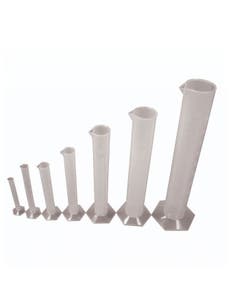
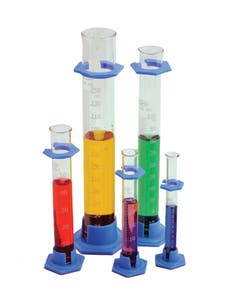
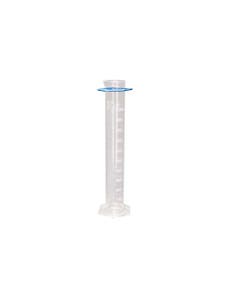
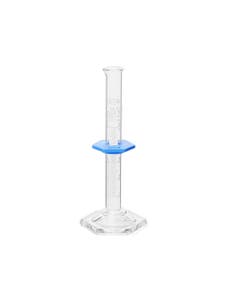
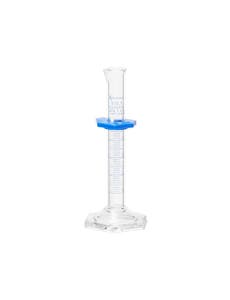
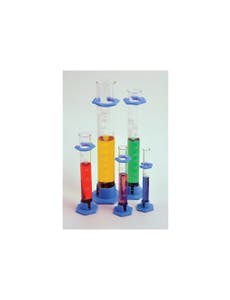
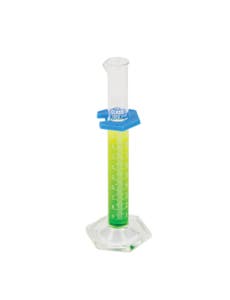
A graduated cylinder looks like the simplest piece of glassware on the bench. It's also the one most often used for the wrong job. Here's what to know before you buy.
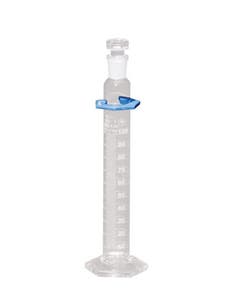
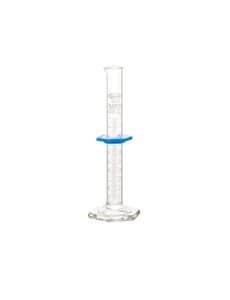
Most of the cylinders here are borosilicate glass, and the product names say so. Borosilicate handles temperature swings far better than ordinary glass and stays clear through repeated washing. The Class A double scale cylinders have heavy, uniform walls and a hexagonal base, which keeps a tall, narrow cylinder from tipping. The individually certified Class A cylinder with a stopper also comes with a hollow glass stopper and a polypropylene bumper guard.
The scale is the part you read, so it's worth knowing what it means. A double metric scale runs in both directions, so you can read the volume sitting in the cylinder or the volume you've poured out. Cylinders marked to contain hold the stated volume when filled to the line. Cylinders marked to deliver allow for the thin film of liquid that stays on the wall when you pour. The Class A double scale cylinders here are calibrated to contain, and the individually certified listing with a stopper notes that calibrated to deliver options are available.
Glass isn't right for every chemical. Hydrofluoric acid attacks it, and strong bases like sodium hydroxide and potassium hydroxide can etch it over time. Our Chemical Storage Compatibility Chart points to HDPE containers for all three. Cylinders are for measuring, not for heating or storing, so keep them off the hot plate and don't leave a solution sitting in one. Check the rim and base for chips before each use. If your method needs more accuracy than a cylinder gives you, step up to a volumetric flask or a burette.