





Types of Acetone
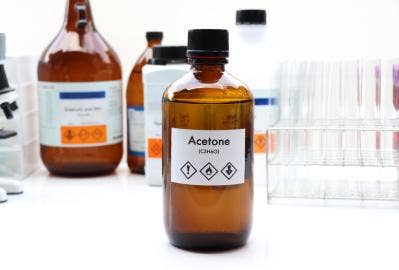
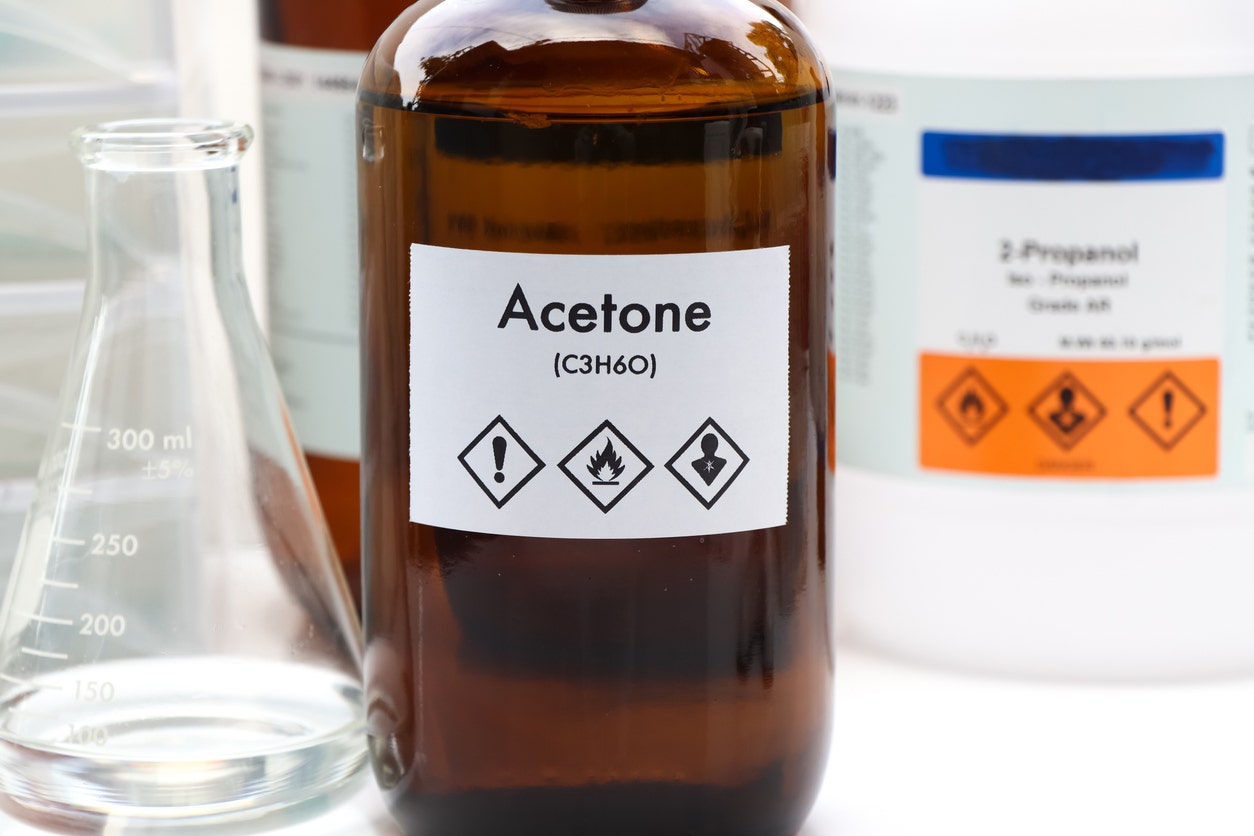
Acetone (C₃H₆O), also known by its IUPAC name propan-2-one and as dimethyl ketone, is a clear, colorless, volatile, and highly flammable organic solvent. It is the simplest ketone, consisting of two methyl groups joined to a central carbonyl group. Acetone is miscible with water and most common organic solvents, has a boiling point of 56°C, and evaporates rapidly at room temperature. It is commercially available in several grades differentiated by purity level and intended use, including Lab/Technical, ACS Reagent, HPLC, and Semiconductor/Electronic, as well as in a solvent blend formulation. These distinctions determine suitability across general laboratory, analytical chemistry, electronics manufacturing, pharmaceutical processing, and food contact applications.
Grade selection directly affects performance, regulatory compliance, and analytical validity. The key factors are purity specification, grade designation, UV absorbance limits, trace metal content, applicable regulatory and quality system requirements, and compatibility with other formulation components. Choosing the wrong grade risks invalid analytical data, failed quality audits, or contamination of sensitive manufacturing processes.
In this article, we'll explore:
-
Common Grades & Purities
-
Certifications & Standards
-
Chemical Forms & Variants
-
Applications Based on Type
-
How to Choose the Right Type
Common Grades & Purities
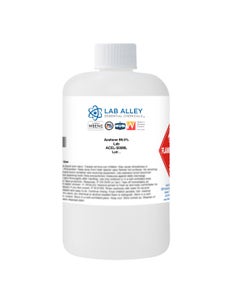
Acetone, Lab/Technical Grade (99.5%)
General-purpose grade for non-pharmaceutical, non-food applications. Suitable for laboratory research, training, industrial cleaning, degreasing, and general solvent use where defined trace impurity limits are not required.
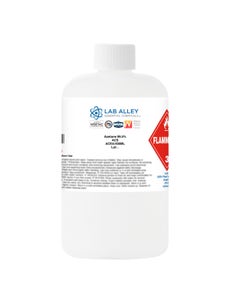
Acetone, ACS Reagent Grade (99.5%)
Meets all specifications in the ACS Reagent Chemicals monograph, including strict limits on water, non-volatile residue, titratable acid, APHA color, and trace metals. Required for analytical chemistry, standardized testing, and pharmaceutical-support applications where impurity control must be documented.
Acetone, HPLC Grade
Meets purity and UV absorbance specifications required for use as a mobile phase in HPLC analysis. Provides a low UV cutoff and minimal background absorbance, making it the appropriate choice for UV-sensitive detection methods.
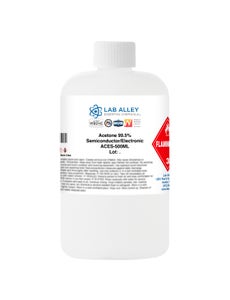
Acetone, Semiconductor/Electronic Grade (99.5%)
Meets ultra-high purity requirements for semiconductor and microelectronics manufacturing, including extremely low trace metal and particle count specifications that exceed ACS Reagent Grade in critical parameters.
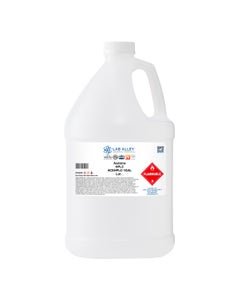
Acetone-IPA 50%/50% Blend, Lab Grade
A pre-mixed formulation of acetone and isopropyl alcohol in equal volumetric proportions. Combines the fast-evaporating, strong-dissolving action of acetone with the residue-free cleaning performance of IPA for electronics cleaning and precision surface preparation.
Certifications & Standards
- ACS Reagent Grade Monograph Compliance: ACS Reagent Grade acetone must meet all specifications in the ACS Reagent Chemicals monograph, including assay, water content, residue after evaporation, titratable acid, APHA color, and heavy metals.
- HPLC Grade Specification: Meets UV absorbance cutoff and purity requirements for chromatographic mobile phase use, including limits on UV absorbance at specified wavelengths.
- Semiconductor/Electronic Grade Specification: Meets trace metal and particle count specifications required for microelectronics manufacturing processes where metallic contamination would compromise device performance.
- Certificate of Analysis (COA): Documents assay, appearance, and lot-specific compliance with the applicable grade specification. Required documentation for analytical, pharmaceutical, and quality-system-governed applications.
Chemical Forms & Variants
Acetone is commercially available exclusively as a liquid at room temperature. All grades are clear, colorless, highly mobile liquids with a characteristic sharp, penetrating solvent odor. Specific gravity is approximately 0.79, boiling point is 56°C, and acetone is completely miscible with water, ethanol, ether, and most organic solvents.
100% Acetone (All Grades)
The neat solvent at stated purity. The standard commercial form across all grade designations, used wherever a single-component solvent with defined purity is required.
Acetone-IPA 50%/50% Blend
A formulated mixture of acetone and isopropyl alcohol in equal volumetric proportions. Used where the combined solvent profile of both components delivers better cleaning or surface preparation performance than neat acetone alone, particularly in electronics cleaning and precision optics work.
Applications Based on Type
Laboratory & Analytical
ACS and HPLC-grade acetone are used as a solvent, mobile phase component, and reagent in chromatography, sample preparation, and standardized testing. Lab Grade is appropriate for general-purpose laboratory solvent applications where formal trace impurity documentation is not required.
Industrial & Manufacturing
Lab/Technical Grade is used to remove oils, greases, adhesive residues, and contaminants from metal surfaces before painting, welding, or soldering, and in textile processing to remove oils from raw fabrics. Also used as a paint thinner and remover, and for surface preparation before adhesive bonding or coating application.
Pharmaceutical & Healthcare
Acetone serves as a process solvent in pharmaceutical synthesis and is not present in the final product due to its rapid evaporation. ACS Reagent Grade is appropriate for applications where impurity control must be documented against a recognized standard.
Cosmetics & Personal Care
Lab-grade acetone is widely used as a nail polish and gel nail remover and as a fast-evaporating solvent component in personal care formulations.
Electronics
Semiconductor/Electronic Grade is required for cleaning silicon wafers, removing photoresist residues, and degreasing precision electronic components during fabrication. The Acetone-IPA 50%/50% blend is used for electronics cleaning and precision optics applications where the combined solvent properties of both components are beneficial.
Food & Beverage
FDA permits acetone as an indirect food additive in adhesives and food contact coatings per 21 CFR 175.105 and 175.300, and in solvent extraction of spice oleoresins and vegetable oils at defined residual limits. Grades selected for these applications must meet the relevant FDA regulatory requirements for the specific use.
How to Choose the Right Type
Selecting the right acetone grade requires matching the grade's specifications to the performance and documentation requirements of the intended application.
Match Grade to Application
Use Lab Grade for general laboratory, industrial cleaning, and degreasing. Use ACS Grade for analytical chemistry, standardized testing, and any application requiring documented trace impurity control. Use HPLC Grade for chromatographic mobile phase applications requiring a low UV background. Use Semiconductor/Electronic Grade for wafer cleaning, photoresist removal, and electronic component degreasing in fabrication environments.
Verify Required Certifications
Confirm the selected grade meets any applicable FDA, ACS, SEMI, or quality system requirements before procurement. Verify that the supplier provides a Certificate of Analysis and Safety Data Sheet for each lot.
Select Appropriate Concentration or Form
HPLC Grade is the only appropriate choice for reversed-phase HPLC with UV detection; no other grade meets the UV absorbance specification. The Acetone-IPA 50%/50% blend is preferred over neat acetone for electronics and precision surface cleaning applications where IPA's residue-free evaporation profile is required alongside fast solvent action.
Common Mistakes
Substituting Lab Grade for ACS Grade in analytical or standardized testing applications where trace impurity control is required. Using any grade other than HPLC Grade as a chromatographic mobile phase. Selecting Semiconductor Grade based on the 99.5% purity figure alone, without verifying that trace metal and particle specifications meet the specific fabrication process requirements.
Key Takeaways
Acetone is available in four grades and one blend formulation, each suited to a specific range of applications and purity requirements. Lab/Technical, ACS Reagent, HPLC, and Semiconductor/Electronic grades address needs from general cleaning and degreasing to sensitive chromatographic analysis and semiconductor fabrication. The pre-blended Acetone-IPA 50%/50% formulation extends that range to applications where the combined solvent properties of both acetone and isopropyl alcohol deliver better performance than either solvent alone.
Selecting the correct grade starts with matching the purity specification and any required certifications to the demands of the intended use. Confirming lot-specific compliance through a Certificate of Analysis ensures the selected grade performs as required and satisfies any applicable regulatory or quality system documentation requirements. Lab Alley offers all four grades and the IPA blend across a full range of pack sizes to support laboratory, industrial, and high-volume production needs.
For more detailed guidance, explore our Resource Library.
Our Customer Care team is also available for more information and documentation, including chemical Safety Data Sheets.
Find Acetone You Can Trust
If you are looking for high-quality acetone for your lab, product line, or research facility, be sure to visit our store to explore our trusted selection and request a quote.
As your trusted partner in chemical supply, Lab Alley is always striving to meet the growing demands of our customers. We want you to be able to access all of your chemical needs in one place, along with streamlined online ordering and fast shipping.
Due to popular demand from our valued clientele, Lab Alley's acetone is available in a range of purities and packaging options to suit various commercial, laboratory, and personal needs.