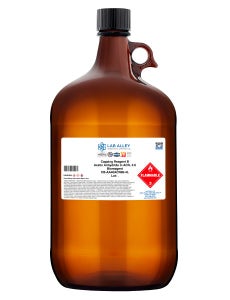
Capping Reagents
Premixed Cap A and Cap B solutions in Bioreagent Grade, in 4 L bottles ready for your synthesizer.
You've got a synthesizer ready, a sequence queued up, and no patience for a reagent that shows up late or in the wrong ratio. Capping reagents are the step people forget about until a run goes sideways. It's a small step with an outsized effect on the purity of what comes off the synthesizer. After every coupling, a small share of chains don't react. Capping reagents acetylate those unreacted hydroxyl groups so they can't join in at the next cycle and leave you with deletion sequences to purify out later. Choose the wrong formulation, or a solution that picked up moisture on a shelf, and you'll see it in your yield. You shouldn't have to wait on a sales rep to find out what's in stock or what a bottle costs, either. You need the right solution, at a fair price, at your door.
Our capping reagents are premixed Bioreagent Grade solutions in 4 L bottles. There's no weighing acetic anhydride, no measuring solvent, and no guessing at ratios. You can pick THF based Cap A blends with pyridine or lutidine, a 1 methylimidazole in acetonitrile solution, or acetic anhydride in acetonitrile at 1:9 or 4:6. Each product page lists the formulation, CAS numbers and hazmat details before you check out, so you know what's arriving. Every bottle is Bioreagent Grade and every size is 4 L, which makes comparing options quick. THF based and acetonitrile based blends aren't interchangeable, so match the formulation to your synthesizer's protocol before you add anything to your cart. Order online in minutes, with no sales call and no quote request, and set up Autoship if you'd rather not think about reordering. If you're stocking the whole cycle, activator and oxidation solutions sit in the same Biological & Life Science Chemicals category.
256,000+
customers served
99.5%
of orders ship in 1–2 business days
98.9%
inventory accuracy
SDS + COA
available online, every product
Capping Reagents - 1 products All Filters
Capping Reagents - 1 products About Capping Reagents
Capping reagents are premixed liquids, and most buyers order them as a pair. Acetic anhydride does the acetylating. A base such as 1 methylimidazole, pyridine or lutidine helps drive the reaction, and the carrier is either tetrahydrofuran (THF) or acetonitrile. Each product page spells out the exact blend. Our 1 methylimidazole solution, for example, is 20% v/v 1 methylimidazole in 80% v/v acetonitrile.
Two things matter at the bench. First is moisture. Acetic anhydride breaks down in water, so you want a dry solution and a tightly closed bottle. The 1 methylimidazole solution lists water at no more than 50 ppm on its product page. Second is flammability. These are Class 3 liquids that ship as hazardous materials. The THF blend we checked ships under UN2056 and the acetonitrile solution under UN1648, so read the DOT line and the SDS on each product before you decide where to store it.
COMMON APPLICATIONS
Capping reagents belong to the capping step of automated solid phase DNA and RNA synthesis, which runs on phosphoramidite chemistry. Each cycle moves through deblock, couple, cap and oxidize. Capping comes right after coupling, and it keeps chains that missed their base from picking one up later. Most buyers use these for research scale synthesis of standard DNA and RNA oligonucleotides, restocking a synthesizer that runs most days, or switching formulations when a protocol changes.
The other steps in the cycle have their own reagents. You'll find Activator Solutions and Oxidation Solutions in the same parent category, plus anhydrous acetonitrile for washes.
GRADES EXPLAINED
Every capping reagent in this category is Bioreagent Grade. We use that grade for solutions prepared for biological and oligonucleotide synthesis work. It isn't a pharmacopeia standard like USP and it isn't ACS. It tells you the solution was made for synthesis rather than general bench use. What backs it up is the lot documentation, so read the Certificate of Analysis for water content and assay before you load a bottle.
If your protocol names a different grade, ask us before you swap anything. For a plain language look at how grades compare, read our Chemical Grades guide, or see everything we sell in Bioreagent Grade.
TYPES & GRADES AT A GLANCE
A simple one bottle Cap A for synthesizers that run THF/Acetonitrile based capping.
WHY BUY FROM LAB ALLEY
Trusted by 256,000+ customers. Labs, schools and production teams keep coming back for Biological & Life Science Chemicals, so you're ordering from a supplier that knows how to get this done.
99.5% of orders ship in 1 to 2 business days. Your synthesis schedule shouldn't wait on a truck.
98.9% inventory accuracy. The size you see is the size you get, with no backorder surprise after checkout.
Certified quality. Lab Alley is ISO 9001 certified for quality management.
Frequently Asked Questions
What's the difference between THF based and acetonitrile based capping reagents?
It comes down to the carrier solvent your synthesizer protocol expects. THF based Cap A blends mix acetic anhydride with THF, and some add pyridine or lutidine as the base. Acetonitrile based products use acetonitrile as the carrier, like our 1 methylimidazole solution and the acetic anhydride options. Neither is better in general. Pick the one your platform's chemistry calls for, because swapping carriers can change how the whole cycle behaves.
What do ratios like 1:9, 2:8 and 4:6 mean?
They're parts by volume. On our 1 methylimidazole product, 2:8 means 20% v/v 1 methylimidazole in 80% v/v acetonitrile, and the Assay line on the page confirms it. Read the other ratios the same way, with the first number as the active component, and check each product's Assay line. A higher first number means a stronger solution. Three part blends like 1:1:8 list each component in order. Match the ratio to your protocol exactly.
Do I need a permit to buy capping reagents?
Our product pages don't list a permit requirement for these reagents, and no category wide permit like a TTB permit applies. That said, acetic anhydride is a federally listed chemical in the United States, so record keeping rules can come into play. If your institution asks for paperwork, or you're unsure, contact customer care before you order so nothing slows your checkout.
Which capping reagents are Kosher, Halal or otherwise certified?
None of the capping reagents are listed as Kosher, Halal, USDA Organic or RSPO certified, so we won't claim it. What they do carry is the Bioreagent Grade designation and the documentation on each product page. If you need certified products elsewhere in the parent category, use the Kosher and Halal filters on the Biological & Life Science Chemicals page.
Can capping reagents ship to a home address?
Plan on a business, school or laboratory address. These are flammable liquids that ship as hazardous materials, and the product page shows a hazmat fee before you check out. Some chemicals are pulled from orders sent to residential addresses, so confirm your delivery address first. If you're not sure your address qualifies, contact customer care before you place the order.
Which capping reagent should I choose for my synthesizer?
Start with your synthesizer's protocol or manual and match the composition it lists, not just the letter on the bottle. Cap A and Cap B naming isn't consistent across platforms, so our product names spell out the full formulation. Check the carrier solvent, the base and the ratio, then confirm bottle size and fit. Our pages describe compatibility with commercial DNA and RNA platforms, but your instrument's specs have the final say.
Should I buy premixed capping reagents or mix my own?
Premixed bottles save you the weighing and measuring, and they give you the same ratio every time. Mixing your own gives you flexibility, but a little stray moisture can cost you yield, and you'll be handling acetic anhydride yourself. If you also need a dry wash solvent, our Acetonitrile page has options, including anhydrous grades.
Can I buy capping reagents in bulk or set up a repeat order?
Every capping reagent here comes in a 4 L bottle, and Autoship is available so bottles arrive on your schedule. For multiple cases, recurring volume or a custom size, visit Bulk & Custom Chemicals or request a quote. Tell us what you use in a month and we'll price it.
Where can I find the SDS and COA for a capping reagent?
Check the product page first. Some list the Safety Data Sheet, a technical data sheet and a lot Certificate of Analysis right there. Others ask you to contact us for the SDS and COA, so ask before you order if you need them for a qualification or an audit. You can also browse our Certificates of Analysis and Safety Data Sheets pages.
Industries That Use Capping Reagents
Life Sciences & Biotech
Explore high-purity chemicals for life sciences and biotech research including solvents, reagents, acids, bases, enzymes, buffers and molecular biology grade solutions.
Learn more →R&D/Laboratory
Explore ACS, HPLC and LC/MS grade chemicals for R&D and laboratory use including solvents, acids, bases, buffers and standardized solutions for research and QC.
Learn more →Pharmaceuticals & Nutraceuticals
Explore USP and NF grade chemicals for pharma and nutraceuticals including solvents, excipients, propylene glycol, glycerin and HPLC reagents.
Learn more →