


Chemical Grades
What are chemical grades?
Chemical grades are a way of quantifying the purity of a particular chemical. There are several different standards set by various organizations, such as the American Chemical Society and the United States Pharmacopeia, alongside industry-specific designations for fields like electronics, biotechnology, and cosmetics.
What are the different grades of chemicals?
There are many different grades in use today. Some are standardized, like ACS and USP, while others, like Lab Grade or Technical Grade, are more subjective and not tied to a single governing body. Here's a rundown of the grades Lab Alley carries.
Lab Grade
Lab Grade chemicals are relatively pure, but the exact level and nature of their impurities isn't specified or guaranteed the way it is for ACS or Certified grades. Also known as LR grade, they're a step below reagent-quality chemicals in documentation, though still consistent enough for routine lab work.
Applications: Educational and general laboratory use; not suitable for food, drug, or medicinal use.
ACS Reagent Grade
ACS Reagent Grade chemicals meet or exceed the purity standards published by the American Chemical Society's Committee on Analytical Reagents, which sets specifications for more than 400 common reagents. Purity is typically at least 95%, and every lot ships with a certificate of analysis showing the measured values against those published limits. Worth noting: the ACS itself doesn't test or verify each batch. Suppliers self-certify against the published spec, which is why the certificate of analysis matters.
Applications: Any application requiring stringent, externally referenced quality specifications.
Bioreagent Grade
Bioreagent Grade at Lab Alley covers the reagents used in solid-phase oligonucleotide (DNA/RNA) synthesis: capping reagents, activator solutions, and oxidation solutions used on automated DNA synthesizers. These reagents need tightly controlled purity and moisture content, since trace impurities or water can interrupt the chemical coupling steps that build a DNA strand and reduce yield or introduce errors in the finished sequence.
Applications: Solid-phase DNA and oligonucleotide synthesis.
USP Grade
USP Grade chemicals meet or exceed the standards set by the United States Pharmacopeia, the organization responsible for setting purity requirements for chemicals used in pharmaceutical products in the US. It's effectively the pharmaceutical-grade benchmark.
Applications: Pharmaceutical, personal care, medical and first aid.
FCC Food Grade
FCC Food Grade chemicals meet the standards published in the Food Chemicals Codex, the reference used to set purity and identity requirements for substances added to food. This covers both ingredients meant for consumption and chemicals used to clean surfaces and equipment that come into contact with food.
Applications: Food and beverage production, and cleaning of food-contact surfaces and cookware.
HPLC Grade
HPLC Grade chemicals are manufactured specifically for use as a mobile phase or solvent in high performance liquid chromatography, with purity typically above 99.9%. Low UV absorbance and low viscosity matter here because impurities can distort a chromatogram's baseline or interfere with detection.
Applications: Mobile phase and solvent use in HPLC analysis.
Reagent Grade
Reagent Grade at Lab Alley covers standardized laboratory solutions, such as normality solutions of sulfuric acid, potassium hydroxide, and EDTA, made to a known, consistent concentration but without certification against the full ACS specification book. It's the working grade for solution-based lab procedures rather than the highest achievable purity.
Applications: General lab use, titrations, buffer preparation, and routine analysis.
NF Grade
NF Grade is a standard set by the National Formulary, which co-publishes a joint compendium of purity standards with the United States Pharmacopeia each year, known as the USP-NF. NF grade chemicals are typically comparable to USP grade in purity, though the exact requirements can vary by compound and are worth checking in the current year's compendium.
Applications: Personal care, Non-API, Excipients
LC-MS Grade
LC-MS Grade chemicals are formulated for liquid chromatography-mass spectrometry, and are chemically cleaner than HPLC grade solvents. Mass spectrometry is highly sensitive to trace impurities and metals, which can create analytical interference and shorten the lifespan of expensive instrumentation, so this grade holds impurity levels lower than HPLC grade does. It's also used in some techniques with less demanding purity needs, like HPLC paired with UV-vis detection.
Applications: Liquid chromatography-mass spectrometry, pharmaceutical and drug discovery testing, academic research, and food and beverage quality control
Technical & Industrial Grade
Technical & Industrial Grade chemicals are of high enough quality for industrial and commercial manufacturing, but carry a level of impurity that makes them unsuitable for food, drug, or medicinal use.
Applications: Industrial use, commercial manufacturing.
Electronic & Semiconductor Grade
Electronic & Semiconductor Grade chemicals are formulated for the electronics industry, where particle and metal ion content has to be kept extremely low, often to parts per billion or trillion, since these impurities interfere with the performance of finished electronic products. This grade supports both direct manufacturing steps, like etching and metal treatment, and cleaning or degreasing of equipment and parts, such as silicon wafers.
Applications: Manufacturing and maintaining electronics and semiconductors, including wafer cleaning, etching, and surface treatment.
Cosmetic Grade
Cosmetic Grade chemicals meet the purity and safety profile needed for personal care formulations, where the finished product is applied directly to skin or hair. At Lab Alley, this covers ingredients like sodium hyaluronate and glycolic acid solutions used in skin care, along with soap-grade sodium and potassium hydroxide used in soapmaking.
Applications: Skin care, hair care, soapmaking, and other cosmetic products.
HPLC Preparative Grade
HPLC Preparative Grade chemicals are bulk solvents, such as methanol, acetonitrile, and hexane, purified for preparative HPLC, where the goal is isolating and collecting a target compound in usable quantity rather than just detecting and quantifying it. Because preparative runs process far larger sample volumes than analytical HPLC, these solvents are supplied in bulk quantities like 55-gallon drums.
Applications: Purification and scale-up of target compounds in pharmaceutical, biotech, and specialty chemical production.
Certified Grade
Certified Grade chemicals are standardized volumetric solutions, such as sodium hydroxide and hydrochloric acid, at specific, verified normalities (0.5N, 1N, and so on), where the exact concentration has been confirmed and documented on the certificate of analysis. This grade is about certifying the precise strength of a solution rather than the purity of a raw chemical.
Applications: Titration and volumetric analysis, where an exactly known concentration is required for accurate results.
What is AR/OR?
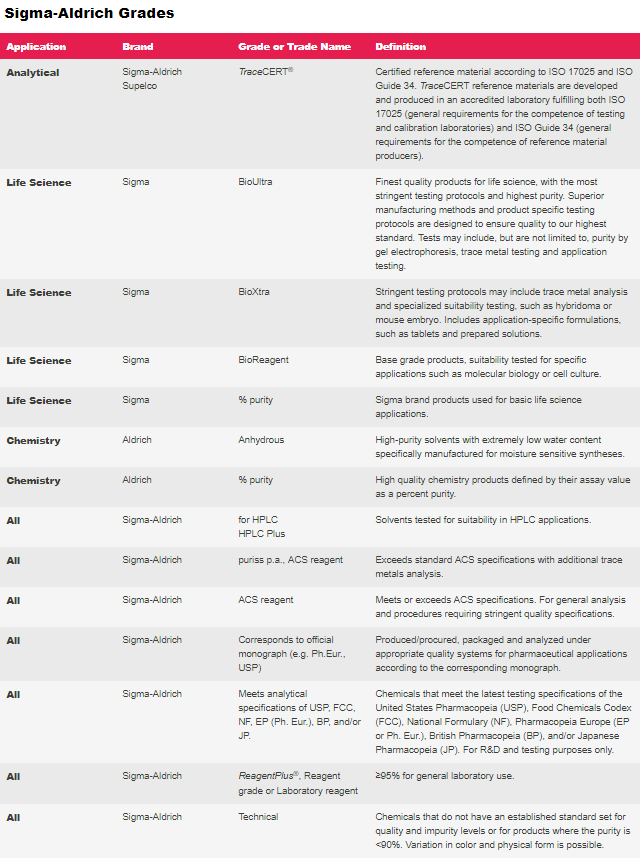
AR grade is the standard Macron Fine Chemicals™ grade of analytical reagents; suitable for laboratory and general use," and OR grade signifies organic reagents suitable for research applications. These are good examples of trademarked grades. A lot of companies make their own designations for chemical purity, like VWR's Macron Fine Chemicals™ grades (AR, AR Select, ChromAR, etc.) and Sigma Aldrich's BioXtra and BioReagent grades. The easiest way to find out about these sorts of specific grades is to use the company's own guideline to them. Most companies have some sort of chart or table available: for example, you can find Sigma Aldrich's grades here and Fisher Scientific's here.
What is a reagent? How many types of reagents are there?
A reagent is a substance that causes a chemical reaction. Reagents are typically divided into organic (those which contain carbon-hydrogen bonds) and inorganic (those which do not), although there are other categories based on your intended field of use. For example, in organic chemistry, reagents are typically classified as nucleophiles and electrophiles.
What is the most acceptable chemical grade?
There is no universally acceptable chemical grade. As you've seen, there are more than a dozen categories, each with their own specifications and uses. When deciding which is best for you, take your exact situation into consideration. Do you need a very high purity chemical, or is lower okay? What kind of budget are you working with? How readily available are chemicals in your area? These are all questions to consider when picking a chemical grade to use.
What do some of LabAlley’s chemical grades mean?
Lab Alley has a few exclusive grades. Extraction grade means the chemical is suitable as a solvent for medicinal plant, herbal, and botanical extraction processes. Gradient grade means that the chemical is suitable for use in HPLC with gradient analysis.
What are some recommended grades for non-commercial or industrial use?
Lab Grade, Technical & Industrial Grade, or even ungraded chemicals are less expensive than high-purity grades like ACS Reagent and USP, and are therefore more suitable for general purposes. These grades are often bought in 1-gallon bottles, 5-gallon pails, 55-gallon drums, 250- and 270-gallon totes, and pallet sizes. We've provided the most widely accepted definitions of chemical grading terminology above, but they aren't universal, so check individual product pages for exact specifications.