




Nitric Acid (HNO3) is a highly corrosive and strong mineral acid and it is distinguished by its potent antioxidant property. Like other Nitric Acid percentages of concentration, in its pure form appears colorless but, over time, tends to acquire a yellow cast due to the decomposition of the nitrate; it has a sour odor.
Nitric acid is commonly used in various industrial and laboratory applications due to its strong oxidizing properties.
-
Chemical Manufacturing: Nitric acid is a key ingredient in the production of fertilizers, explosives (such as dynamite), and various organic and inorganic nitrogen compounds.
-
Metal Processing: It is used in metal etching, metal cleaning, and metal polishing processes. Nitric acid can remove oxide layers from metals, making it useful in surface treatment and preparation.
-
Laboratory Applications: It is commonly employed in laboratory settings for analytical chemistry, where it is used as a reagent or solvent for various experiments and reactions.
-
Cleaning and Passivation: Nitric acid can be used to clean and passivate stainless steel and other metals, removing contaminants and creating a protective oxide layer on the surface.
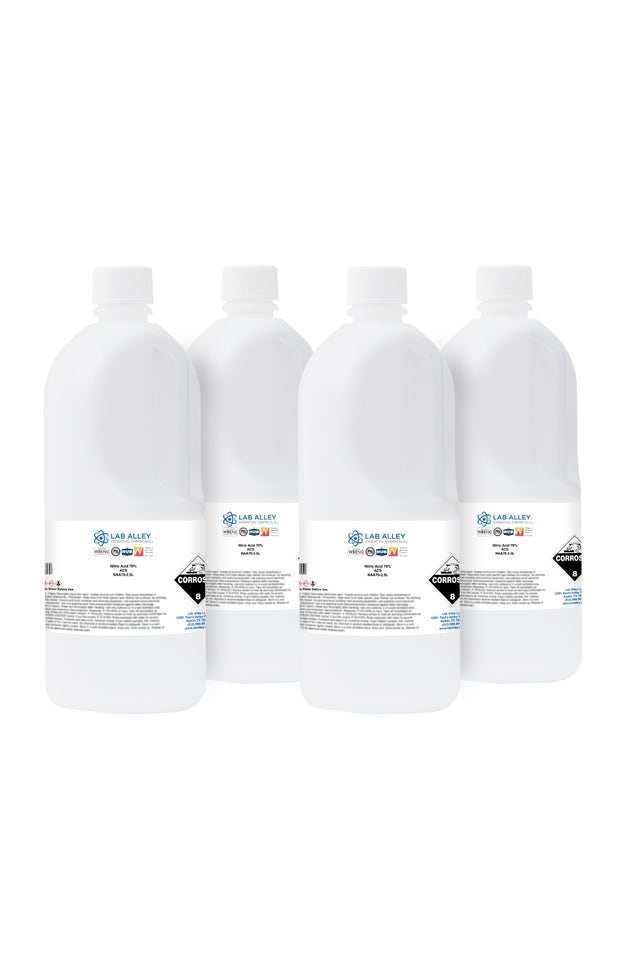
Lab Alley's Nitric Acid 70%, ACS Reagent Grade (CAS 7697-37-2, HNO3, molecular weight 63.013) is a strong mineral acid and powerful oxidizing agent supplied as a 70% solution in water, with a water content of 30–32%. It is a colorless liquid with a strong, acrid odor, free from suspended matter and sediment, and fully miscible in water. It boils at 120.5°C and melts at −41°C. The ACS specification sets low impurity limits: chloride max 0.5 ppm, sulfate max 1 ppm, iron and heavy metals max 0.2 ppm each, arsenic max 0.01 ppm, and mercury max 0.005 ppm. The Safety Data Sheet, Technical Data Sheet, lot Certificates of Analysis, and Allergen, BPA, PFAS/PFOS Free, TSE/BSE and No Animal Testing statements are all in the Product Manuals tab.
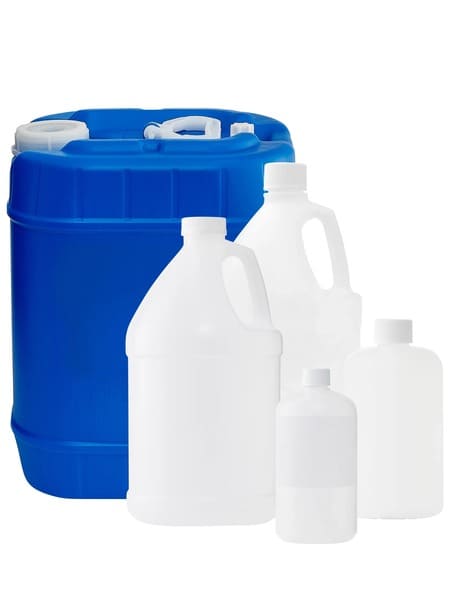
Labs use ACS reagent nitric acid to digest samples ahead of metals analysis, prepare standards, acid-clean glassware, and make aqua regia with hydrochloric acid. Plants use it for stainless steel passivation, metal etching, and nitrate synthesis. In that work the acid itself can become the problem: stray chloride, sulfate or metals show up in results, paperwork is missing at audit time, or a supplier can't ship a Class 8 corrosive in the size you need. Lab Alley removes those variables with ACS-specified acid, lot Certificates of Analysis online, sizes from 500 mL bottles to full pallets, and hazmat transport handled end to end. Choose your size, set up Autoship for recurring use, or request a quote for pallet volumes, and get the acid you need on budget, on time, every time.
-
-
Sample digestion for metals analysis
-
Analytical reagent and standard preparation
-
Laboratory glassware acid cleaning
-
Aqua regia preparation with hydrochloric acid
-
Stainless steel passivation
-
Metal etching and surface cleaning
-
Nitrate compound synthesis
-
Oxidizing agent
-
Q: What is Nitric Acid 70%, ACS Reagent Grade used for?
A: Labs use it for sample digestion before metals analysis, standard preparation, glassware acid cleaning, and preparing aqua regia with hydrochloric acid. In industry it is used for stainless steel passivation, metal etching and cleaning, and nitrate compound synthesis.Q: What does ACS Reagent Grade mean, and is it suitable for trace metals work?
A: ACS Reagent Grade means the acid meets American Chemical Society specifications, including chloride max 0.5 ppm, iron and heavy metals max 0.2 ppm, arsenic max 0.01 ppm, and mercury max 0.005 ppm. That suits most digestion and analytical work. For ultra-trace methods such as ICP-MS, compare the lot Certificate of Analysis with your method's blank requirements.Q: What concentration is this product?
A: It is a 70% solution of nitric acid in water, with a water content of 30–32%. The exact values for each lot are on its Certificate of Analysis in the Product Manuals tab.Q: Why does nitric acid turn yellow over time?
A: Light and heat slowly break nitric acid down into nitrogen dioxide, which dissolves back into the acid and gives it a yellow tint. Keeping the container tightly closed in a cool, dark place slows this down.Q: How should Nitric Acid 70% be stored?
A: Keep it in its original, tightly closed container in a cool, well-ventilated area, away from organic materials, bases, reducing agents, and metal powders, and follow the storage section of the SDS. See How to Store Nitric Acid for more detail.Q: What sizes are available, and does it ship as hazmat?
A: It comes in 500 mL and 2.5 L bottles, 6 x 500 mL and 4 x 2.5 L cases, and pallets of 36 cases of 4 x 2.5 L. It ships as a regulated hazardous material (DOT: Nitric Acid, 8, UN2031, PG II, A), and a hazmat fee applies.Q: How do I get the SDS and Certificate of Analysis?
A: Both are available now in the Product Manuals tab on this page, along with the Technical Data Sheet and the product's compliance statements. No request is needed.
Product Information
| CAS | 7697-37-2 |
|---|---|
| Synonyms | Hydrogen nitrate, Aqua fortis, Azotic acid, Salpetersaeure, Nitrooxidanyl |
| Assay | 69.20% |
| PubChem ID | 944 |
| Grade | ACS Grade |
| Color | Max 10 |
| Physical form | Liquid |
| Appearance | Colorless, Free from Suspended Matter/Sediment |
| Odor | Strong Acrid |
| pH | 0.1 (1.0N solution) |
| Melting point | -41°C |
| Boiling Point | 120.5°C |
| Solubility | Fully Miscible in Water |
| Molecular formula | HNO3 |
| Molecular weight | 63.013 |
| Arsenic (As) | Max 0.01 ppm |
| Autoship Available | Yes |
| Chloride (Cl) | Max 0.5 ppm |
| Heavy metals | Max 0.2 ppm |
| Iron (Fe) | Max 0.2 ppm |
| Mercury (Hg) | Max 0.005 ppm |
| Pillar | High Purity |
| Sulfate (SO4) | Max 1 ppm |
| Viscosity | 2.0 cPs |
| Water | 30-32% |