





Dimethyl Sulfoxide (DMSO) Safety & Hazards
Dimethyl sulfoxide (DMSO) is a polar aprotic solvent widely used across laboratory, pharmaceutical, and industrial applications for its exceptional solvency and low acute toxicity. Its hazard profile is classified as Skin Irrit. 2 and Eye Irrit. 2A under GHS, and it is treated as a combustible liquid due to a flash point in the 87 to 95°C range.
The primary concern with DMSO is not its toxicity but its permeability. It penetrates intact skin rapidly and can carry dissolved substances along with it, which means anyone handling DMSO alongside other chemicals needs to think about combined exposure risk, not just DMSO alone. Laboratory personnel, safety officers, and anyone involved in bulk storage or transport should be familiar with its combustibility and reactivity profile as well.


In this article, we'll explore:
-
Chemical Hazards Overview
-
Exposure Risks & Health Effects
-
First Aid Measures
-
Handling & Storage Precautions
-
Spill & Leak Procedures
-
Fire & Explosion Hazards
-
Regulatory & Compliance Information
-
Technical Documents & References
Chemical Hazards Overview
DMSO carries a hazard classification of Skin Irrit. 2 and Eye Irrit. 2A, and its flash point places it in GHS Category 4 for flammable liquids, meaning it is treated as combustible rather than highly flammable under standard handling conditions. Its NFPA 704 rating reflects a moderate but manageable hazard profile across health, flammability, and reactivity.
-
GHS Hazard Pictograms: GHS07 (irritant)
-
NFPA Hazard Rating: Health 1, Flammability 1, Reactivity 0
-
Primary Risks: Skin absorption of dissolved solutes, eye and skin irritation, inhalation of vapors at elevated temperatures
Exposure Risks & Health Effects
Inhalation Risks
DMSO has a low vapor pressure at room temperature, which limits how much vapor accumulates in typical ambient conditions. At higher concentrations, such as when the liquid is heated or used in enclosed spaces, inhalation can lead to headache, dizziness, and nausea. Adequate ventilation reduces this risk significantly in most working environments.
Skin Contact Risks
DMSO is rapidly absorbed through intact skin, more so than most common laboratory solvents. Contact typically produces mild irritation and a transient burning sensation, and many people notice a garlic-like taste or odor on their breath shortly after skin exposure, a direct result of systemic absorption. This absorption characteristic is the main reason DMSO requires more careful glove selection than its otherwise mild toxicity profile would suggest.
Eye Contact Risks
Direct eye contact with DMSO causes irritation, redness, pain, and blurred vision. Chronic or repeated exposure has been associated with changes to the cornea, which makes consistent eye protection important even in settings where splash risk seems minor.
Ingestion Risks
DMSO has low acute oral toxicity, with reported LD50 values in rats ranging from 14,500 to 28,300 mg/kg. Ingestion may still cause nausea, vomiting, and abdominal discomfort, and should be treated as a genuine exposure event even though the toxicity threshold is high.
Chronic Effects
DMSO is not classified as a carcinogen by IARC, NTP, OSHA, or ACGIH. The main chronic concern identified in available data is repeated eye exposure, which has been linked to corneal effects over time, reinforcing the importance of routine eye protection during regular handling.
First Aid Procedures
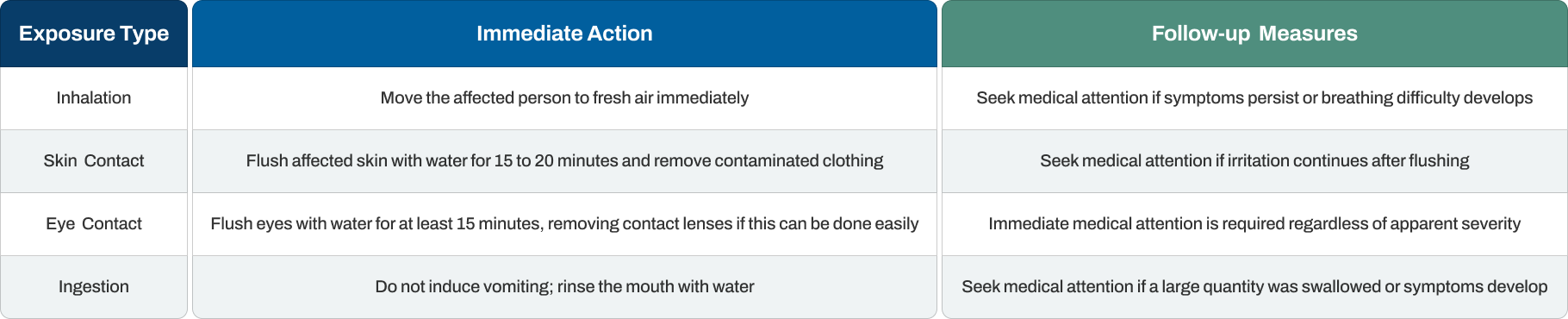

Across all exposure routes, prompt action matters more than the specific technique used. If symptoms are severe or the exposure involved DMSO mixed with another substance, contact poison control or emergency services and provide the SDS on hand so responders understand the full exposure picture.
Handling & Storage Precautions
Safe handling of DMSO centers on glove selection and ventilation, given its ability to move through skin quickly. Nitrile or butyl rubber gloves are appropriate; natural rubber and latex gloves should be avoided since DMSO permeates them readily. Safety goggles and adequate ventilation round out standard PPE, and any ignition sources should be kept well away from work areas given DMSO's combustibility.
Storage conditions are straightforward but should not be overlooked. DMSO should be kept at room temperature in tightly sealed containers, since it is hygroscopic and will absorb moisture from the air if left exposed.
-
Incompatible Substances: Strong oxidizers, acyl halides, boron hydrides, alkali metals, and isocyanates
Spill & Leak Procedures
Responding to a DMSO spill starts with basic containment discipline before cleanup begins.
-
Emergency Response Steps: Ventilate the area, eliminate any nearby ignition sources, and put on appropriate PPE before approaching the spill
-
Containment Methods: Absorb the spill with an inert material such as sand or vermiculite, and avoid letting DMSO reach floor drains given its miscibility with water
Proper disposal involves collecting absorbed material for hazardous waste disposal in accordance with local regulations. DMSO should not be discharged to sewer systems in bulk quantities, even though it is water miscible.
Fire & Explosion Hazards
Flammability
DMSO has a flash point between 87 and 95°C (189 to 203°F) and an autoignition temperature of 215°C (419°F), with flammable limits ranging from 2.6 percent to 42 percent. These values place it solidly in the combustible liquid category rather than the highly flammable range, but heated processes or confined spaces can still bring it within its flammable range.
Extinguishing Media
-
Carbon dioxide
-
Dry chemical
-
Alcohol-resistant foam
-
Water spray, which is effective given DMSO's miscibility with water
Firefighting Precautions
Self-contained breathing apparatus is recommended when fighting fires involving DMSO, since combustion can release irritating sulfur oxide fumes. DMSO vapors are heavier than air and can travel along surfaces toward ignition sources, which is worth keeping in mind when assessing fire spread in enclosed spaces.
Regulatory Information & Compliance
OSHA Regulations
No specific OSHA permissible exposure limit or time-weighted average has been established for DMSO, which means general laboratory ventilation and PPE practices remain the primary control measures.
EPA & Environmental Impact
DMSO is not listed under CERCLA or SARA Sections 302 or 313 reporting requirements, and it does not appear on California's Proposition 65 list of chemicals known to cause cancer or reproductive harm.
DOT Transportation Regulations
DMSO carries the proper shipping name Combustible Liquid, n.o.s. under DOT regulations, but this designation applies only to bulk shipments exceeding 3,500 gallons. In typical non-bulk pack sizes used across laboratory and industrial supply, DMSO is not regulated as a DOT hazardous material.
FDA/USP/ACS Compliance
DMSO is available in USP grade, meeting the purity and identity specifications outlined in the USP monograph for laboratories and applications that require pharmacopeial grade material.
Technical Documents & Resources
-
Safety Data Sheets are available for all grades and concentrations of DMSO, covering hazard classification, handling precautions, and first aid measures.
-
Certificates of Analysis are available upon request and verify purity and compliance with applicable USP grade standards.
Final Note
DMSO's safety profile is defined less by acute toxicity and more by its unusual ability to penetrate skin and carry other substances along with it, combined with a combustibility profile that requires standard fire precautions during handling and storage. Proper glove selection, ventilation, and attention to incompatible substances address the majority of practical risks associated with routine use.
Following the handling, storage, and first aid guidance outlined here helps ensure DMSO is used safely across laboratory and industrial settings, whether it's being applied as a solvent, a reaction medium, or a component in downstream formulations.
Explore our Resource Library for more information.
Our Customer Care team is also available for more information and documentation, including chemical Safety Data Sheets.
Need Dimethyl Sulfoxide You Can Trust?
If you are looking for high-quality dimethyl sulfoxide for your lab, product line, or research facility, be sure to visit our store to explore our trusted selection and request a quote.
As your trusted partner in chemical supply, Lab Alley is always striving to meet the growing demands of our customers. We want you to be able to access all of your chemical needs in one place, along with streamlined online ordering and fast shipping.
Due to popular demand from our valued clientele, Lab Alley's dimethyl sulfoxide is available in a range of purities and packaging options to suit various commercial, laboratory, and personal needs.