





How to Safely Dispose of Dimethyl Sulfoxide
Dimethyl sulfoxide (DMSO) is a highly polar, water-miscible solvent valued for its ability to dissolve a wide range of organic and inorganic compounds. That same property is what complicates its disposal: DMSO readily penetrates skin and can carry dissolved contaminants into the body, so spent DMSO waste often carries risks that go beyond the solvent itself.
DMSO is not listed as a RCRA hazardous waste under the P, F, or K series, and it is not classified as Dangerous Goods for transport by DOT, IATA, or IMDG. But laboratory and industrial DMSO waste rarely stays pure. Dissolved reagents, trace metals, or reaction byproducts left in the waste stream can shift its regulatory status and introduce reactivity concerns that require careful handling before disposal.


In this article, we'll explore:
-
Why Proper Disposal Matters
-
How to Dispose of Dimethyl Sulfoxide
-
Reactive Decomposition Hazard in Waste Streams
-
Special Considerations
Why Proper Disposal Matters
Environmental Protection
DMSO is fully miscible with water, which means any contaminants dissolved in it move with it once released into wastewater. Pouring spent DMSO down a drain does not just introduce the solvent into the water system; it introduces whatever reagents, metals, or byproducts were dissolved in it during use. This is the primary environmental concern with DMSO waste, and it is why drain disposal is treated as prohibited regardless of the solvent's own relatively low aquatic toxicity.
Health & Safety
DMSO's defining hazard is its ability to penetrate skin rapidly and carry dissolved substances along with it. During disposal, this means personnel handling spent DMSO are exposed not only to the solvent but potentially to any chemicals it has dissolved over its use. Inhalation and eye contact also irritate, so ventilation and eye protection remain necessary even though DMSO is not classified as a severe acute toxin on its own.
Legal Compliance
DMSO does not appear on the RCRA P, F, or K hazardous waste lists, so the chemical itself does not automatically trigger hazardous waste rules. Its regulatory status at disposal depends on what has been dissolved or mixed into it during use. Facilities must evaluate the full waste stream, not just the base solvent, to determine whether state or local hazardous waste requirements apply.
How to Dispose of Dimethyl Sulfoxide
Check Regulations
Generator status under RCRA should be determined by evaluating the complete waste stream rather than DMSO in isolation. Because DMSO is not itself a listed hazardous waste, its classification hinges on the reagents, metals, or byproducts present in a given batch. It is also worth noting that DMSO is not classified as Dangerous Goods by DOT, IATA, or IMDG, which simplifies transport documentation compared to solvents that carry a hazard classification.
Use Designated Waste Disposal Methods
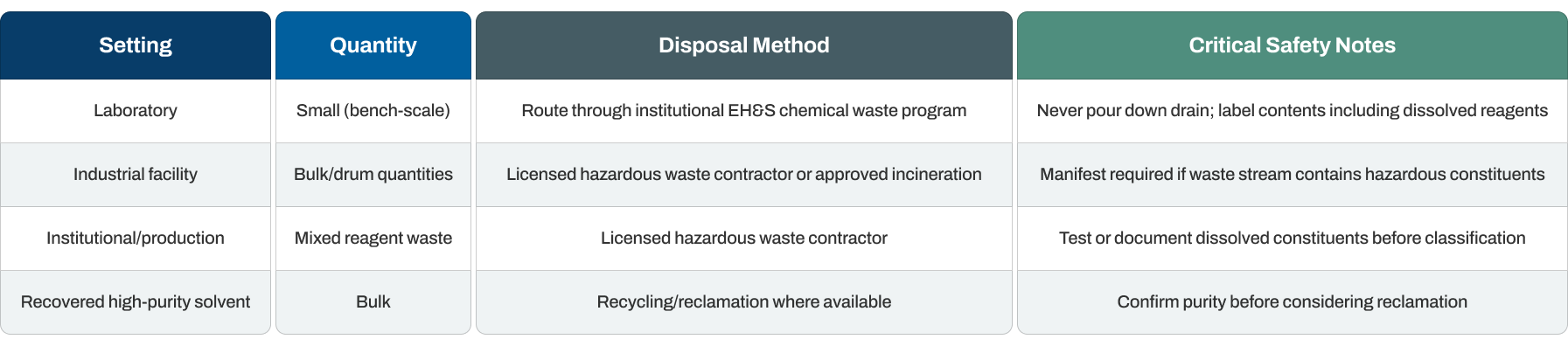
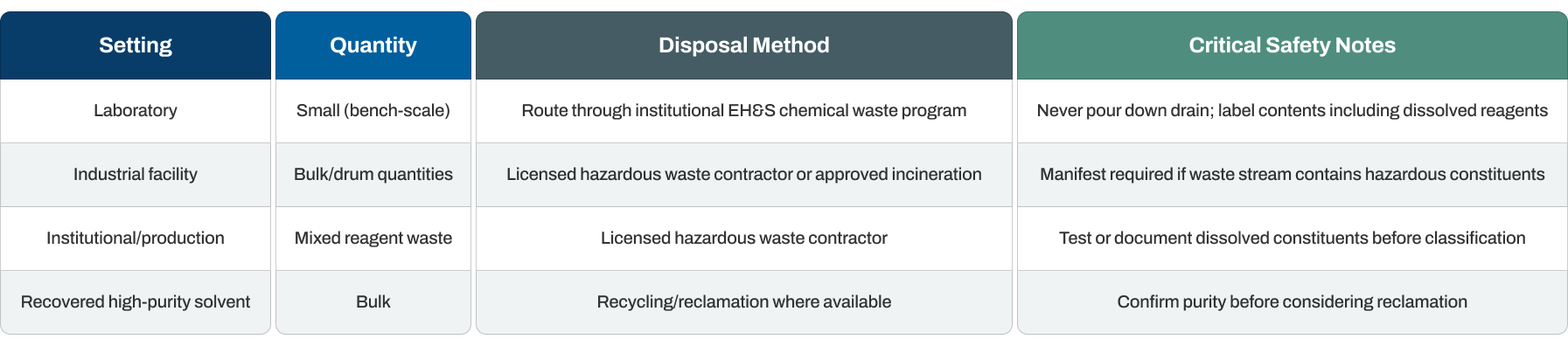
Disposal method depends on the scale of the waste stream and the setting in which it was generated.
Non-Hazardous Disposal
Drain disposal of DMSO is not permitted under institutional or manufacturer guidance, even when the solvent appears uncontaminated. Sink and sewer disposal are explicitly prohibited in standard operating procedures across laboratory and industrial settings, and this restriction should be treated as a baseline rule rather than something to be evaluated case by case.
Hazardous Waste Disposal
Spent DMSO should be collected in closed, clearly labeled containers pending disposal. If the waste contains dissolved hazardous constituents, it must go to a licensed hazardous waste contractor, and a manifest is required to document the chain of custody for regulated waste. Container labeling should reflect the actual contents of the mixture, not just the base solvent.
Industrial Quantities
Bulk DMSO waste is typically sent to an approved incineration facility, where controlled combustion handles both the solvent and its dissolved constituents. In some cases, recovered high-purity solvent can be reclaimed or recycled rather than destroyed, which may be a cost-effective option for facilities generating consistent, well-characterized waste streams.
Laboratory & Institutional Waste
Laboratory quantities of spent DMSO should be routed through the institution's environmental health and safety office or chemical waste management program. Waste should be double-bagged or sealed in containers according to facility protocol before pickup, particularly when the solvent has been used to dissolve other laboratory reagents.
Never Mix Chemicals
DMSO waste should never be combined with strong oxidizers such as nitric acid, perchlorates, periodic acid, or potassium permanganate, as these combinations can react violently. Acyl and sulfonyl halides, including acetyl chloride and thionyl chloride, present similar risks. Strong acids, alkali metals, and metal halide salts should also be kept separate from DMSO waste streams, since all of these can trigger dangerous reactions or accelerate decomposition.
Follow PPE Guidelines
Nitrile or butyl rubber gloves are required when handling DMSO waste; latex gloves should not be used, since DMSO degrades latex and compromises the barrier. Chemical splash goggles and a lab coat are standard protection, and disposal work should take place in a ventilated area or fume hood to limit vapor exposure.
Reactive Decomposition Hazard in Waste Streams
Contamination-Driven Instability
Waste DMSO is rarely just the solvent alone, and that matters because trace acids, metals, or oxidizers left in the mixture can catalyze autocatalytic thermal decomposition. This is not a hazard associated with pure DMSO under normal conditions, but accumulated contamination in a waste container changes that picture. Waste streams should be treated with more caution than the base solvent's safety profile would suggest.
Heat and Concentration Risk
Concentrated or heated waste DMSO can begin decomposing at temperatures above approximately 150°C, releasing sulfur oxides in the process. Waste containers should be kept away from heat sources and should not be stored in confined spaces where decomposition products could accumulate. This risk increases with the concentration of contaminants and the volume of waste held in a single container.
Special Considerations
Waste Stream Classification
The regulatory status of spent DMSO is determined by what has been dissolved or mixed into it, not by the solvent itself. Facilities should test or document the contents of a given waste batch before assigning a disposal classification, since two batches of DMSO waste from different processes may require entirely different handling.
Documentation for Non-Hazardous Determination
Retaining safety data sheets and use records for each waste stream supports a non-hazardous determination when one applies, and gives waste haulers and regulators the documentation they need to process the material correctly. This is particularly relevant for facilities generating DMSO waste from varied processes, where contents can differ significantly from batch to batch.
Conclusion
Safe disposal of dimethyl sulfoxide comes down to treating the waste stream, not just the solvent, as the object of concern. DMSO's ability to penetrate skin and carry dissolved contaminants, combined with its potential for contamination-driven decomposition, means disposal decisions should be based on what has been dissolved in a given batch rather than assumptions about the base chemical. Following designated disposal channels, keeping incompatible substances separate, and documenting waste contents ensures compliant, low-risk handling from generation through final disposal.
For more detailed guidance, explore our Resource Library
Our Customer Care team is also available for more information and documentation, including chemical Safety Data Sheets.
Need Dimethyl Sulfoxide You Can Trust?
If you are looking for high-quality dimethyl sulfoxide for your lab, product line, or research facility, be sure to visit our store to explore our trusted selection and request a quote.
As your trusted partner in chemical supply, Lab Alley is always striving to meet the growing demands of our customers. We want you to be able to access all of your chemical needs in one place, along with streamlined online ordering and fast shipping.
Due to popular demand from our valued clientele, Lab Alley's dimethyl sulfoxide is available in a range of purities and packaging options to suit various commercial, laboratory, and personal needs.