





How to Store Xylenes
Xylenes are a group of aromatic hydrocarbon solvents, most commonly supplied as a mixture of ortho-, meta-, and para-isomers, used widely across laboratory, industrial, and manufacturing settings. As a Class IC flammable liquid with a flash point in the range of 77 to 90°F (25 to 32°C), xylenes present a genuine ignition hazard, and their vapors are heavier than air, meaning they can travel and accumulate in low-lying or poorly ventilated spaces.
Because of this combination of flammability, vapor behavior, and chemical reactivity with strong oxidizers, storing xylenes safely is not a matter of convenience but a regulatory and operational requirement. Facilities handling xylenes need to account for temperature control, container selection, segregation from incompatible chemicals, and compliance with OSHA and NFPA storage standards to prevent fire, vapor exposure, and environmental release.
This guide walks through the practical storage requirements for xylenes, from ideal environmental conditions to regulatory documentation, so that laboratory and facility personnel can maintain compliant, low-risk storage practices.


In this article, we'll review:
-
Recommended Storage Conditions
-
Container & Packaging Requirements
-
Segregation & Compatibility
-
Safe Handling in Storage Areas
-
Regulatory Compliance & Labeling
-
Environmental & Safety Considerations
-
Special Considerations
Recommended Storage Conditions
Temperature
Xylenes should be stored in a cool area, away from heat sources. With a closed-cup flash point of 77 to 90°F (25 to 32°C), even moderate ambient heat can create ignitable vapor concentrations.
Humidity Control
Xylenes are not moisture-reactive, so humidity itself does not pose a chemical hazard during storage. Containers should still be kept tightly sealed, primarily to prevent vapor loss and air or moisture ingress that could affect product purity.
Light Exposure
Xylenes should be stored away from direct sunlight. Heat gain from sun exposure raises container internal pressure and increases vapor generation.
Ventilation
Well-ventilated storage is required for xylenes because their vapors are heavier than air and can accumulate in low-lying or confined spaces. This accumulation can create explosive concentrations.
Storage Duration
Xylenes remain chemically stable when stored under the recommended conditions. Personnel should periodically inspect stored containers for discoloration or off-odor, either of which may indicate degradation or contamination.
Container & Packaging Requirements
Compatible Materials
Xylenes should be stored in containers made of metal, such as steel or stainless steel, or in glass. Certain plastics and rubber gaskets are not suitable for xylene storage, since the solvent can degrade or permeate these materials.
Sealing Requirements
Containers must remain tightly closed to limit vapor release and contamination. Secondary containment is recommended for bulk or multi-container storage areas.
Labeling Requirements
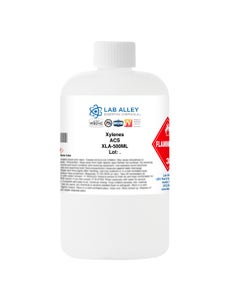
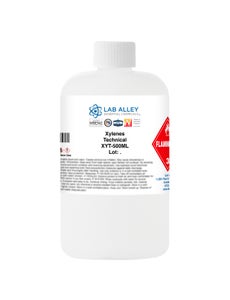
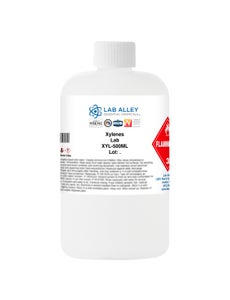
Every container should carry a GHS-compliant label that includes the flammable liquid pictogram, the signal word "Danger," and the applicable hazard statements. Labels should also identify the specific xylene isomer blend or grade and include lot tracking information.
Bulk Storage
Bulk xylene storage tanks should be grounded and bonded, and equipped with appropriate venting. Tanks must be located in accordance with NFPA 30 flammable liquid storage requirements.
Segregation & Compatibility
Incompatible Substances
Xylenes react with strong oxidizers, strong acids, and strong bases, creating a fire or reactive hazard when stored in proximity to these materials. Substances to store separately from xylenes include:
-
Strong oxidizers
-
Strong acids
-
Strong bases
Storage Grouping
Xylenes should be kept in a dedicated flammable liquids storage cabinet or room, separated from oxidizer and corrosive storage groups. This grouping reduces the chance of accidental contact between incompatible materials during routine handling.
Flammability & Reactivity Precautions
Xylenes are classified as an OSHA and NFPA Class IC flammable liquid and must be kept away from ignition sources, open flames, and sparks. Facilities should follow the storage cabinet design and container quantity limits established under OSHA 1910.106.
Safe Handling in Storage Areas
PPE Requirements
Personnel working in xylene storage areas should wear chemical-resistant gloves along with safety goggles or a face shield. Protective clothing appropriate to the task helps prevent skin and eye contact.
Transfer & Dispensing
Transferring xylenes between containers should involve proper grounding and bonding to prevent static discharge ignition. Splash-filling should be avoided during transfer operations.
Spill Containment
Spills should be contained and collected using inert absorbent materials kept readily available in the storage area. Spilled xylene must never be allowed to reach floor drains or sewer systems.
Emergency Equipment
Storage areas should be equipped with an eyewash station and safety shower. A dry chemical, carbon dioxide, or foam fire extinguisher should also be on hand, since water spray is generally ineffective at extinguishing a xylene fire.
Regulatory Compliance & Labeling
OSHA Regulations
Xylene storage falls under OSHA's flammable liquids standard, 29 CFR 1910.106, which governs container types, cabinet design, and storage room requirements. Workplace exposure is separately regulated under 29 CFR 1910.1000 Table Z-1, which establishes the permissible exposure limit for airborne xylene.
GHS Requirements
GHS-compliant labeling for xylenes includes the flame pictogram and health hazard pictogram alongside the signal word "Danger." Hazard statements must address flammability, irritation, and aspiration risk.
NFPA & DOT
Storage facilities should follow NFPA 30, the Flammable and Combustible Liquids Code, for cabinet, room, and quantity requirements. For transport, xylenes are classified as a DOT Class 3 flammable liquid.
Industry-Specific Compliance
Facilities in regulated industries, such as pharmaceutical or food-related operations, may require additional handling documentation, such as GMP records, beyond standard storage practices depending on the specific grade of xylene in use. Requirements vary by grade and intended application.
SDS Requirements
A current Safety Data Sheet for the specific xylene product should be maintained and accessible at both the storage location and the point of use. Personnel should be able to reference the SDS quickly in the event of a spill, exposure, or other storage-related incident.
Environmental & Safety Considerations
Fire Suppression
Storage areas housing xylenes should have fire suppression systems appropriate for a Class IC flammable liquid, consistent with NFPA 30 guidance.
Secondary Containment
Bulk xylene storage requires diking or another form of secondary containment. This containment is required to prevent a spill from migrating beyond the immediate storage area.
Wastewater & Environmental Impact
Xylenes are listed as a hazardous air pollutant and as a hazardous substance under the Clean Water Act. Storage areas should be designed to prevent release to sewers, soil, or nearby waterways.
Electrical Equipment Standards
Indoor storage rooms housing xylenes require explosion-proof electrical equipment under OSHA 1910.106. This applies to lighting, switches, and other electrical components located within or near the storage room.
Special Considerations
Isomer and Grade Variability
Mixed xylene products contain varying ratios of ortho-, meta-, and para-isomers and ethylbenzene, depending on the specific grade. Flash point can shift slightly by grade, so container labeling should specify the exact grade in use.
Conclusion
Storing xylenes safely comes down to controlling three interconnected risks: fire, vapor accumulation, and reactivity with incompatible materials. Facilities that maintain cool, well-ventilated storage areas, use compatible containers, and keep xylenes segregated from oxidizers, acids, and bases significantly reduce their exposure to both safety incidents and regulatory non-compliance.
Consistent application of OSHA and NFPA storage standards, paired with proper labeling and accessible SDS documentation, gives laboratory and facility personnel a reliable framework for handling xylenes day-to-day.
For more detailed guidance, explore our Resource Library.
Our Customer Care team is also available for more information and documentation, including chemical Safety Data Sheets.
Need Xylenes You Can Trust?
If you are looking for high-quality xylenes for your lab, product line, or research facility, be sure to visit our store to explore our trusted selection and request a quote.
As your trusted partner in chemical supply, Lab Alley is always striving to meet the growing demands of our customers. We want you to have all your chemical needs in one place, with streamlined online ordering and fast shipping.
Due to popular demand from our valued clientele, Lab Alley's xylenes is available in a range of purities and packaging options to suit various commercial, laboratory, and personal needs.