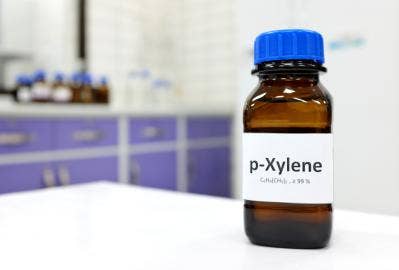






Xylenes Overview
Xylenes, also known as dimethylbenzene, are a group of three closely related aromatic hydrocarbon isomers used as an industrial solvent in paints, coatings, adhesives, and printing inks. The compound exists as ortho-, meta-, and para-xylene, each sharing the same molecular formula but differing in the position of two methyl groups on the benzene ring.
What makes xylenes valuable across such a wide range of industries is their strength as a nonpolar solvent combined with a low cost of production. Manufacturers rely on xylenes to dissolve resins, oils, and rubber compounds that water-based alternatives cannot touch, while laboratories depend on the same chemical properties to clear and process tissue samples.
Xylenes carry a flammable liquid classification and require specific storage and handling precautions, but their safety profile is well documented and their regulatory standing is stable across industrial and laboratory use. Grade selection, from ACS to electronic/cleanroom purity, allows buyers to match the chemical to the sensitivity of their application.
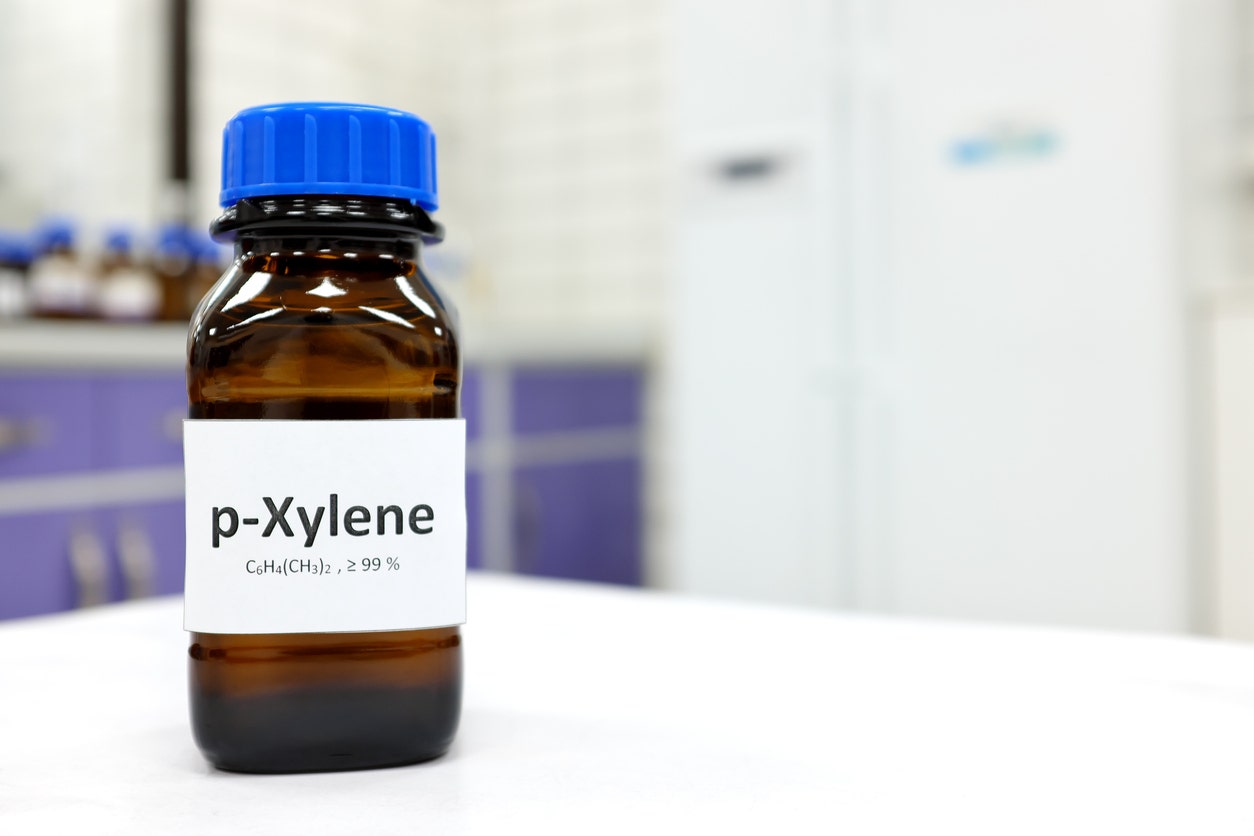
Properties of Xylenes
Key Facts
-
Compound Name: Xylene (dimethylbenzene); a mixture of ortho-, meta-, and para-isomers
-
Synonyms/Common Names: Xylol, dimethylbenzene, methyltoluene
-
Chemical Formula: C8H10 / C6H4(CH3)2
-
CAS Number: 1330-20-7 (mixed isomers); 95-47-6 (ortho), 108-38-3 (meta), 106-42-3 (para)
-
Molar Mass: Approximately 106.16 to 106.17 g/mol
-
Appearance: Colorless liquid with a sweet, aromatic odor
Density and Behavior Relative to Water
Xylenes have a density of approximately 0.86 to 0.88 g/cm³ at 20 to 25°C, making the liquid noticeably lighter than water. Because of this, xylenes float on the surface when mixed with water rather than sinking or dispersing evenly. This behavior is a key consideration during spill response and storage near aqueous systems.
Xylenes are a clear, colorless, sweet-smelling aromatic solvent widely used in industrial, laboratory, and electronics manufacturing applications. They function as a solvent, thinner, and cleaning agent in paints, coatings, adhesives, tissue processing, and semiconductor cleaning. U.S. laboratories and manufacturers sourcing xylenes by grade and purity contact Lab Alley at 512-668-9918 for product selection and ordering support.
Boiling Point, Freezing Point, and Volatility
Mixed xylenes boil in a range of approximately 137 to 140°C (279 to 284°F), with individual isomers varying only slightly within that band. The mixture freezes around -34°C (-29°F), staying liquid across most standard storage and handling conditions. This narrow boiling range reflects the close physical similarity between the three isomers.
Solubility in Water and Organic Solvents
Xylenes are essentially insoluble in water, with a solubility of roughly 0.02%, which reinforces their behavior as a nonpolar hydrocarbon. They are fully miscible with ethanol, ether, and most other organic solvents, which is part of what makes them so effective as an industrial thinner and cleaning agent. This solubility profile also explains why xylenes are ineffective for aqueous cleanup and require organic-compatible containment methods.
Reactivity and Flammability
Xylenes are classified as a flammable liquid under GHS Category 3 and NFPA Class IC, with vapors that are heavier than air and capable of traveling to distant ignition sources. The compound is incompatible with strong oxidizers and strong acids, and containers can rupture or explode if exposed to sustained heat. These reactivity characteristics drive most of the storage and handling requirements covered later in this article.
Xylenes from Lab Alley are available as a high-purity liquid in grades suited to industrial, laboratory, histological, and electronics manufacturing applications. Packaging ranges from small laboratory containers to bulk drums to support research, manufacturing, and commercial supply needs.
Common Uses & Applications
Industrial Applications
Xylenes serve as a primary solvent in paints, coatings, adhesives, rubber compounding, and printing inks, where their strong dissolving power handles resins and oils that water-based solvents cannot. The chemical also functions as a feedstock in the production of terephthalic acid and dimethyl terephthalate, both essential raw materials for polyethylene terephthalate (PET) plastics. In fuel production, xylenes are blended into gasoline as an octane-boosting component. These combined uses make xylenes one of the higher-volume industrial solvents in regular commercial use.
Scientific and Laboratory Uses
In histology and pathology laboratories, xylenes are a standard clearing agent used to prepare tissue specimens for coverslipping after staining. The solvent also plays a role in tissue processing and in removing residual paraffin wax from slides before microscopic examination. Outside of histology, xylenes see broader use as a general-purpose laboratory solvent for extractions and sample preparation. Their consistency and purity at ACS and laboratory grades make them a dependable choice for these repeated, precision-dependent tasks.
Specialized Applications
Electronic and semiconductor manufacturing relies on high-purity xylenes for cleaning wafers and chips during production, where trace contamination can compromise device performance. This specialized use requires a level of purity well above standard industrial or technical grades. Xylenes also serve as an intermediate in various organic synthesis pathways where their aromatic ring structure supports further chemical modification. These applications depend on tightly controlled grade specifications to meet manufacturing tolerances.
Safety & Handling
Hazards and Precautions
Xylenes are classified as a flammable liquid under GHS Category 3 and are also recognized as a skin, eye, and respiratory irritant on contact or inhalation. At elevated exposure levels, the compound can produce central nervous system effects including headache and dizziness. Workers handling xylenes should be aware that both the liquid and its vapor present hazards, and that adequate ventilation is necessary to limit airborne exposure. Following posted exposure limits and using the correct PPE reduces these risks significantly.
Personal Protective Equipment
Chemical-resistant gloves made from nitrile are recommended for handling xylenes, since natural rubber does not provide adequate protection against this solvent. Safety goggles or a face shield should be worn to prevent eye contact, particularly during transfer or pouring operations. Respiratory protection becomes necessary in poorly ventilated spaces or when working with larger volumes where vapor concentration can build quickly. Selecting PPE rated specifically for aromatic hydrocarbon exposure is essential rather than relying on general-purpose chemical gloves.
Storage Guidelines
Xylenes should be stored in a cool, dry, well-ventilated area that is kept away from any source of ignition, sparks, or open flame. A dedicated flammable liquids storage cabinet is the appropriate choice for most laboratory and industrial settings. Containers must remain tightly closed when not in use to prevent vapor accumulation and to limit degradation from air or moisture exposure. Storage areas should also be checked periodically to confirm containers are intact and free of leaks.
Spill and Disposal Procedures
Small spills should be contained using an inert absorbent material while all nearby ignition sources are immediately removed. Because xylenes are a flammable liquid, standard spill kits designed for aqueous chemicals are not sufficient for proper containment. Disposal must follow hazardous waste regulations, as xylenes are classified under RCRA as an ignitable characteristic waste with the code D001. Facilities should confirm local and state disposal requirements in addition to federal guidelines before disposing of any xylene waste.
Xylenes Grades and Pack Sizes
Lab Alley offers xylenes in multiple grades to match the purity and application requirements of different industries, from general industrial solvent use to electronics manufacturing.
Available Grades & Concentrations
-
ACS Grade: Formulated for use as a solvent, thinner, and cleaning agent
-
Technical Grade: Suited for general industrial applications
-
Histological Lab Grade: Developed specifically for medical laboratory studies
-
99.9+% Electronic/Cleanroom Grade: Synthesized for the manufacturing of electronics
Pack Sizes & Industrial Availability
-
ACS Grade: 500mL, 1L, 1gal, 4L, 5gal, and 55gal, with case quantities available
-
Histological Lab Grade: 500mL, 1L, 1gal, 4L, 5gal, 55gal, and 270gal, with case quantities available
-
99.9+% Electronic/Cleanroom Grade: 1qt, 1gal, 5gal, and 55gal, with case quantities available
All Lab Alley xylenes containers are UN-approved and DOT-compliant, shipping with proper Class 3 flammable liquid labeling. Contact Lab Alley directly to confirm current grade availability, request a Certificate of Analysis or Safety Data Sheet, or discuss bulk and case pricing for your application.
FAQs
What is xylene and how is it produced?
What are the potential side effects of xylene exposure?
How should xylene be stored to prevent degradation?
Xylene should be stored in a cool, dry, well-ventilated area away from ignition sources, ideally in a dedicated flammable liquids cabinet. Containers should remain tightly sealed between uses to prevent vapor loss and to limit exposure to air and moisture. Following these storage practices helps preserve the chemical's purity and performance over time.
Does xylene have an expiration date?
What is the difference between ortho-, meta-, and para-xylene isomers?
The three xylene isomers differ only in the position of the two methyl groups attached to the benzene ring, which is reflected in the ortho, meta, and para naming convention. Despite these structural differences, the isomers behave very similarly as solvents and are commonly used interchangeably in most industrial applications. Certain specialized uses, such as PET plastic production, rely specifically on the para-isomer due to its role as a precursor to terephthalic acid.