





How to Safely Dispose of Xylenes
Xylenes are flammable organic solvents found in paints, coatings, adhesives, and laboratory applications throughout production and research settings. Because they ignite easily and are federally regulated as hazardous waste, improper disposal creates real fire, environmental, and compliance risks.
These solvents are listed under RCRA as F003 waste and also meet the criteria for D001 ignitability, which means disposal falls under strict federal hazardous waste management rules regardless of how small the quantity is. Generators handling xylenes must treat them accordingly from the moment the waste is created, not just when it's ready to leave the facility.


In this article, we'll explore:
-
Why Proper Disposal Matters
-
How to Dispose of Xylenes
-
Flammability Hazard
-
Special Considerations
Why Proper Disposal Matters
Environmental Protection
Xylenes that enter soil or groundwater persist and resist natural breakdown, creating long-term contamination risks. They are toxic to aquatic life, so any release into waterways or storm drains can harm surrounding ecosystems. Xylenes also volatilize readily at room temperature, meaning improperly stored or disposed waste can contribute to air contamination well before it ever reaches soil or water.
Health & Safety
As a flammable liquid with a flash point below 140°F, xylene waste presents an immediate fire and explosion risk if handled carelessly during disposal. Inhaling xylene vapors can cause respiratory irritation and other health effects, and direct contact irritates skin and eyes. These risks are heightened in disposal settings, where waste may be transferred, consolidated, or staged in less controlled conditions than routine use.
Legal Compliance
Xylene waste is listed as F003 hazardous waste, the EPA's designation for spent non-halogenated solvents, and is separately regulated as D001 ignitable waste. Both classifications trigger the full set of federal hazardous waste management requirements under 40 CFR Parts 260 through 273. State and local regulations may impose additional requirements on top of these federal baselines, so generators should confirm requirements specific to their jurisdiction before disposal.
How to Dispose of Glycerin
Check Regulations
The F003 listing applies to xylene waste regardless of concentration, meaning even dilute waste streams remain subject to hazardous waste rules. Generator status, whether a facility qualifies as a Very Small Quantity Generator, Small Quantity Generator, or Large Quantity Generator, determines how long waste can be accumulated on-site and what reporting obligations apply. For transport, the Department of Transportation classifies xylene as a Class 3 flammable liquid, which affects packaging, labeling, and shipping paperwork.
Confirm Neutralization Requirements
Xylenes are neutral organic solvents and do not require pH adjustment or chemical neutralization before disposal. This step, common for acidic or basic waste streams, does not apply here.
Use Designated Waste Disposal Methods
Non-Hazardous Disposal
Drain or sewer disposal is not permitted for xylene waste under any circumstances. Its flammability and F003/D001 classification make this disposal route both illegal and dangerous.
Hazardous Waste Disposal
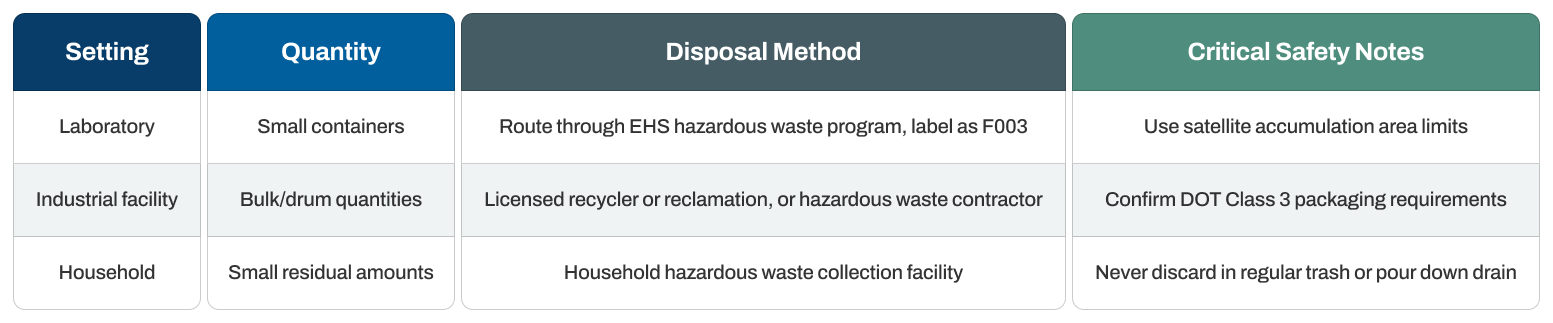
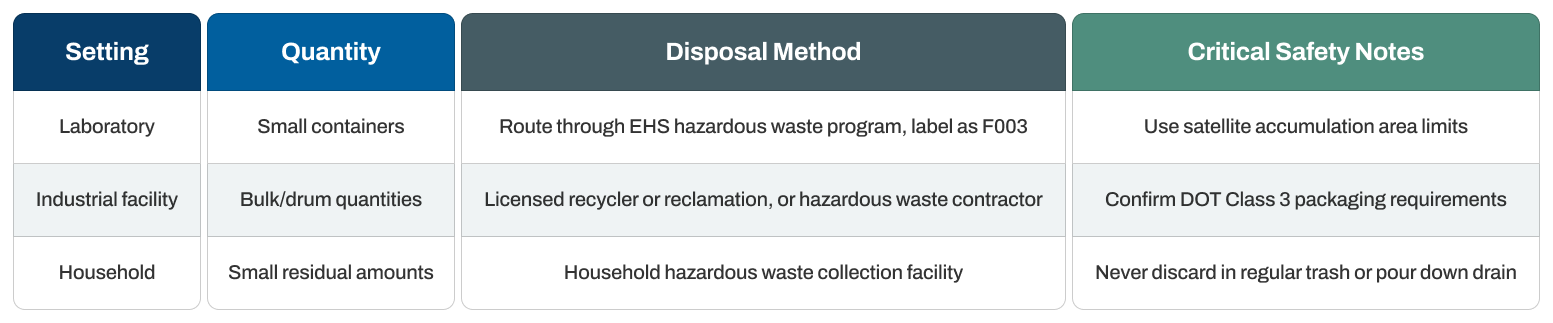
Xylene waste must be kept in closed, clearly labeled, DOT-approved containers until pickup. Disposal requires a licensed hazardous waste transporter and disposal facility. Every shipment must be documented with a hazardous waste manifest, which tracks the waste from the point of generation through final disposal.
Industrial Quantities
Facilities generating bulk xylene waste may have the option to send it to licensed industrial recyclers for solvent recycling or reclamation rather than standard disposal. This approach can reduce both disposal costs and overall waste volume compared to standard hazardous waste disposal.
Laboratory & Institutional Waste
Laboratory and institutional generators should route xylene waste through their EHS or hazardous waste program rather than handling it independently. Waste should be labeled as F003 at the point of generation, and any satellite accumulation areas must follow applicable time and quantity limits.
Never Mix Chemicals
Xylene waste should never be combined with strong oxidizers, which can trigger violent reactions or fire. Contact with strong acids should also be avoided. Because xylene waste streams are chemically distinct, they should not be combined with other halogenated or non-halogenated solvent wastes unless compatibility has been confirmed in advance.
Follow PPE Guidelines
Personnel handling xylene waste should wear chemical-resistant gloves, such as nitrile or neoprene, along with safety goggles or a face shield. Flame-resistant clothing is recommended given the flammability risk. Disposal work should take place in a well-ventilated area or under local exhaust ventilation, away from any ignition sources, with spill containment materials and fire suppression equipment readily accessible.
Flammability Hazard
Ignition Source Control
Xylene waste should be stored and staged away from open flames, sparks, and heat sources at every point in the disposal process. Even brief exposure to an ignition source can trigger a fire given the low flash point.
Vapor Accumulation
Disposal areas should be well-ventilated to prevent flammable vapor concentrations from building up in enclosed spaces. Poor ventilation increases both fire risk and exposure to airborne xylene.
Special Considerations
Waste Stream Documentation
Generators should maintain thorough records of waste generation dates, accumulation start dates, and manifests. This documentation is essential for demonstrating RCRA compliance during inspections or audits.
Small/Household Quantities
Households with leftover xylene-containing products, such as certain paints or solvents, should not discard them in regular trash. Instead, these items should be brought to a local household hazardous waste collection facility for proper handling.
Conclusion
Safe xylene disposal starts with recognizing its dual hazards: flammability and RCRA-regulated toxicity as F003 waste. From proper container labeling to licensed transport and disposal, every step exists to prevent fire risk and environmental contamination.
Generators who document their waste streams and route materials through appropriate hazardous waste channels, whether laboratory, industrial, or household, stay compliant while protecting the people and environments around them.
For more detailed guidance, explore our Resource Library
Our Customer Care team is also available for more information and documentation, including chemical Safety Data Sheets.
Need Xylenes You Can Trust?
If you are looking for high-quality xylenes for your lab, product line, or research facility, be sure to visit our store to explore our trusted selection and request a quote.
As your trusted partner in chemical supply, Lab Alley is always striving to meet the growing demands of our customers. We want you to be able to access all of your chemical needs in one place, along with streamlined online ordering and fast shipping.
Due to popular demand from our valued clientele, Lab Alley's xylenes is available in a range of purities and packaging options to suit various commercial, laboratory, and personal needs.