Denatured Ethanol
140–200 proof denatured alcohol, Kosher and Halal certified, in stock and ready to ship — no permit required.
Lab Alley's denatured ethanol is priced and in stock online, in 140, 190, and 200 proof, from a 500 mL bottle up to a 270 gallon tote, so you can order without a quote call. It's completely denatured rather than specially denatured, so there's no TTB Industrial Alcohol User Permit required, just an SDS and COA with every shipment.
Three denaturant options cover most solvent, reagent, and fuel blending needs: a standard denatured grade, a heptane denatured formulation for extraction work, and an isopropanol/MIBK blend for industrial coatings and cleaning. Kosher and Halal certification is available on the standard and heptane denatured grades.
256,000+
customers served
99.5%
of orders ship in 1–2 business days
98.9%
inventory accuracy
SDS + COA
available online, every product
Denatured Ethanol - 1 products All Filters
Denatured Ethanol - 1 products About Denatured Ethanol
Denatured ethanol contains toxic additives and/or bitter tastants to deter human ingestion. Sometimes, dyes are added to denatured ethanol to visually distinguish it from potable ethanol. While drinkable ethanol is subject to excise taxes to discourage excessive drinking, denatured ethanol can be sold more cheaply. The criteria for denatured ethanol are specifically laid out by the government to ensure that repurification is not feasible. As Methanol is the most common additive at concentrations up to 10%, denatured ethanol is sometimes called “methylated spirits.” Other additives have a disagreeable taste, such as diethyl phthalate and denatonium benzoate (Bitrex). Within government criteria, manufacturers can select denaturants based upon their product; for example, tert-butyl alcohol is commonly used in cosmetics because studies show that it has low toxicity in topical applications.
In the United States, the practice of adding mixing toxins into ethanol intended for non-food purposes was first implemented in the early 1900s, and amped up during prohibition because “renaturing” (re-purifying via distillation to restore drinkability) was common and successful – that is, successful in the sense that the re-natured ethanol was safe and nontoxic. As a result, the government called for the addition of more deadly toxins in higher concentrations, resulting in thousands of deaths from bootlegged alcohol.
It is important to note that the additives do not modify the actual chemical structure of ethanol, in order that denatured ethanol may still be used in the same way as unadulterated ethanol – for example, as lighter fuel or as a solvent. However, in this impure form, it remains inappropriate for all food and many non-food applications, since the additives may interfere in chemical reactions, assays, or instrumental analyses.
Denatured Ethanol Offerings at Lab Alley
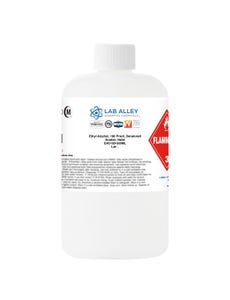
Denatured ethanol is available in all sizes ranging from 500 ml to 270 gallons for quick shipping to your facility.
Industries that Use Denatured Ethanol
Common Uses and Applications for Denatured Ethanol
- Fuel
- Solvent
- Reagent
- Shampoo and soap making
- Petrochemical industry
About Denatured Ethanol
Denatured ethanol is ethanol (C₂H₆O) with a denaturant added to make it unfit for drinking, which is what exempts it from federal beverage alcohol excise tax. Adding the denaturant doesn't change ethanol's underlying chemistry. It's still flammable, water miscible, and works the same as a solvent, but it does mean the product can no longer go into food, beverage, or other applications where any denaturant contact is unacceptable. Lab Alley carries three denaturant profiles at 140, 190, and 200 proof: a standard reagent grade denaturant, a heptane based denaturant built for extraction work, and an isopropanol/MIBK blend for industrial solvent use.
COMMON APPLICATIONS
Denatured ethanol is used as a fuel and fuel additive, a general industrial and laboratory solvent, a reagent in chemical processing, a base for shampoo and soap manufacturing, and a processing solvent in the petrochemical industry.
GRADES EXPLAINED
Proof tells you the ethanol concentration: 200 proof is 100% ethanol, 190 proof is 95%, and 140 proof is 70%, with water making up the remainder. Lower proofs suit disinfecting and general cleaning, while 190 to 200 proof suits solvent extraction and reagent use where water content needs to stay minimal. The denaturant, not the proof, decides what the finished product is fit for. The standard and heptane denatured grades carry Kosher and Halal certification and work across general industrial and extraction use, while the isopropanol/MIBK blend is formulated for coatings, cleaning, and other industrial solvent applications rather than certified end uses. All of Lab Alley's denatured ethanol is completely denatured (CDA type), not Specially Denatured Alcohol (SDA), a distinction covered in the FAQ below.
TYPES & GRADES AT A GLANCE
Is the most requested proof, for general reagent and solvent use.
Works for processes where a small water fraction doesn't affect performance.
Is a diluted strength for disinfecting and general cleaning use.
Is built for extraction workflows where a heptane denaturant is acceptable.
Is an industrial solvent blend for coatings and cleaning applications.
WHY BUY FROM LAB ALLEY
256,000+ customers already order their ethanol from Lab Alley.
99.5% of orders ship within 1–2 business days, so a stockout doesn't stall your bench or your line.
98.9% inventory accuracy means the proof and grade you see in stock is the proof and grade that ships.
SDS and COA are available online for every denatured ethanol product, and select grades carry Kosher or Halal certification — check each product page for which apply.
Frequently Asked Questions
What's the difference between denatured and undenatured ethanol?
Undenatured ethanol has no additives and is approved for food, beverage, and pharmaceutical use; denatured ethanol has a denaturant — heptane, isopropanol/MIBK, or a standard blend — added specifically to make it unfit to drink, which exempts it from federal excise tax. The two are chemically the same ethanol; the denaturant is what changes what you can legally use it for.
What does 200 proof mean versus 140 or 190 proof denatured ethanol?
Proof is twice the percent ethanol by volume, so 200 proof is 100% ethanol, 190 proof is 95%, and 140 proof is 70%, with water making up the difference. Lower-proof grades suit disinfecting and general cleaning; 190–200 proof suits solvent extraction, reagent use, and applications where water content has to stay minimal.
Do I need a TTB permit to buy denatured ethanol?
No. Lab Alley's denatured ethanol is completely denatured (CDA-type), which the TTB classifies as permit-free for purchase and use. That's different from Specially Denatured Alcohol (SDA), where 5-gallon-plus orders require a valid Industrial Alcohol User Permit on file before we can ship.
Which denatured ethanol products are Kosher or Halal certified?
Our standard 200, 190, and 140 proof denatured ethanol, plus the heptane-denatured 200 proof grade, all carry Kosher and Halal certification. The isopropanol/MIBK-denatured blend is formulated for industrial solvent use and isn't certified — check each product page for the certification that applies to your SKU.
Can denatured ethanol be shipped to a residential address?
No. Like our other flammable and regulated chemicals, denatured ethanol can only ship to businesses, schools and universities, or laboratories. If a residential address is used at checkout, we'll remove the item from your order before it ships — use a commercial or institutional address to avoid delays.
What denaturant should I choose for extraction versus general solvent use?
For extraction work where trace denaturant in the final product matters, the heptane-denatured 200 proof grade is built to keep denaturant carryover predictable. For general industrial solvent, cleaning, or coatings use where cost matters more than denaturant profile, the isopropanol/MIBK blend or standard denatured grade both work well.
How is denatured ethanol different from Specially Denatured Alcohol (SDA)?
Both are non-beverage, tax-exempt ethanol, but SDA uses a TTB-specified denaturant formula — like SDA 40-B for cosmetics — and requires an Industrial Alcohol User Permit for larger orders. Denatured (CDA-type) ethanol uses a heavier, harder-to-separate denaturant load that's permit-free but less suited to applications needing a specific, lighter denaturant profile.
Can I buy denatured ethanol in drums or totes?
es. Denatured ethanol ships in sizes from 500 mL bottles up to 55-gallon drums and 270-gallon totes, so the same SKU can restock a lab shelf or supply a production line. Contact us through Bulk & Custom Chemicals for volume pricing on drum and tote orders.
Guides & Resources
Types of Denatured Ethanol
What are the different types of denatured ethanol? Learn the differences between food, cosmetic, and pharmaceutical grades, plus their key applications.
Read article →Denatured Ethanol Overview
Discover the key properties and uses of denatured ethanol. Understand how this organic solvent supports food, cosmetic, and pharmaceutical production with safe handling practices.
Read article →Denatured Ethanol Safety & Hazards
Learn denatured ethanol safety guidelines, hazards, and handling practices. Understand exposure risks, protective equipment, storage, first aid, and compliance standards for safe use.
Read article →How to Store Denatured Ethanol
Discover how to store denatured ethanol safely. Learn best practices for storage, handling, and labeling to maintain quality, prevent contamination, and ensure compliance.
Read article → Industries That Use Denatured Ethanol
Manufacturing & Industrial
Explore high-purity chemicals for manufacturing and industrial applications, including acetone, heptane, sulfuric acid, solvents, and more.
Learn more →Personal Care & Cosmetics
Explore high-quality chemicals and ingredients for personal care and cosmetics, including glycolic acid, ethanol, and denatured alcohol for formulations.
Learn more →R&D & Laboratory
Explore high-purity chemicals for research, development, and testing, including nitric acid, acetone, dichloromethane, ethanol, and more.
Learn more →