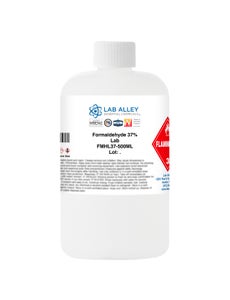
Formaldehyde
Buy Formaldehyde Solutions in Multiple Concentrations and Paraformaldehyde, Lab and Reagent Grade.
Buy formaldehyde online in the concentration and grade your lab or process needs, with the price right on the page. Solutions run from 4% and 8% for lower concentration work, through a 10% buffered solution for histology and tissue fixation, up to 30% and 37% in Lab and Reagent Grade for concentrated stock and industrial use. Paraformaldehyde, Reagent Grade solid is also available for labs that prepare their own fresh formaldehyde solutions from dry form.
Formaldehyde is classified as a known human carcinogen by IARC and the National Toxicology Program, and is regulated by OSHA, which sets a permissible exposure limit of 0.75 ppm and an action level of 0.5 ppm for workplace air. It ships to business, lab and school addresses rather than residential ones. The 5-gallon containers ship as hazardous material under DOT regulations, something worth factoring in before placing a large order, and no Autoship is currently available on any product in this category.
256,000+
customers served
99.5%
of orders ship in 1–2 business days
98.9%
inventory accuracy
SDS + COA
available online, every product
Formaldehyde - 1 products All Filters
Formaldehyde - 1 products About Formaldehyde
Formaldehyde, the simplest aldehyde. It's a colorless gas at room temperature but reacts readily with water to form stable solutions, which is how it's stored and shipped. You'll often hear concentrated formaldehyde solution called formalin, typically meaning a 37% aqueous solution stabilized with a small amount of methanol to prevent polymerization. One important point about concentration terminology that confuses a lot of buyers: a product labeled 10% buffered formalin actually contains around 4% formaldehyde by weight, because the percentage in that name refers to the proportion of formalin, not of pure formaldehyde. OSHA classifies it as a potential carcinogen, IARC and the National Toxicology Program classify it as a known human carcinogen. That's the accurate characterization, and it's the basis for the strict workplace exposure limits and PPE requirements that apply to anyone working with it. Formaldehyde has a sharp, intensely irritating odor detectable at low concentrations, and good ventilation isn't optional when working with the concentrated solutions.
COMMON APPLICATIONS
Tissue and biological specimen fixation, where formaldehyde cross-links proteins and preserves cellular structure, the primary use in histology, pathology and anatomy labs. The 10% buffered solution, which delivers approximately 4% formaldehyde in a phosphate buffered system, is the standard fixative for most routine histology and pathology work. Paraformaldehyde is used where a methanol-free, freshly prepared formaldehyde solution is needed, common in certain immunohistochemistry and cell biology protocols. Disinfectant and antimicrobial use in industrial and agricultural settings, including poultry, aquaculture and agricultural disinfection. Chemical synthesis, where formaldehyde is a building block in the production of resins, adhesives, textiles and plastics. Photography and industrial processing. Drug testing and biological staining protocols.
GRADES EXPLAINED
Lab Grade is solid purity for general educational, research and industrial use where strict analytical standards are not required. Reagent Grade meets tighter purity specifications for use in analytical and standardized laboratory methods. Neither grade carries food, Kosher, Halal or pharmaceutical certification; all formaldehyde products in this category are strictly for laboratory, industrial and institutional use.
TYPES & GRADES AT A GLANCE
Concentrated stock solution, stabilized with methanol.
Higher purity specification for standardized analytical use.
A slightly lower concentration stock, useful for certain protocols.
Neutral buffered formalin, approximately 4% formaldehyde, the standard histology fixative.
Intermediate concentration for specific tissue preparation methods.
Ready-to-use working strength for cell biology and certain fixation protocols.
Dry polymer solid for preparing fresh, methanol-free formaldehyde solutions.
WHY BUY FROM LAB ALLEY
256,000+ customers already order their chemicals and reagents from Lab Alley. 99.5% of orders ship within 1 to 2 business days, and 98.9% inventory accuracy means the grade you see in stock is the grade that ships. SDS and COA are available online for every formaldehyde product. None of these products carry food grade, Kosher or Halal certification; all are Lab or Reagent Grade for laboratory, industrial and institutional use only. No Autoship is currently available in this category.
Related: See our Methylene Blue collection, or browse all Specialty Chemicals.
Frequently Asked Questions
Where can I buy formaldehyde or formalin online?
Right here. We carry formaldehyde solutions at 4%, 8%, 10% buffered, 30% and 37% in both Lab and Reagent Grade, plus Paraformaldehyde, Reagent Grade, solid. Pick the concentration and grade, check the price, and order with no quote needed for standard sizes. Most in stock orders ship within 1 to 2 business days. Note that 5-gallon containers ship as hazardous material under DOT regulations, which affects lead time and shipping cost for large orders.
What is the difference between formaldehyde, formalin and 10% neutral buffered formalin?
Three names that confuse a lot of buyers. Formaldehyde is the pure compound, a gas dissolved in water. Formalin is the common name for a 37% aqueous solution of that gas, stabilized with methanol. Neutral buffered formalin (NBF) contains only about 4% actual formaldehyde because the '10%' label refers to its dilution from formalin, not its formaldehyde content. Our 10% Buffered product is that NBF, the standard fixative in histology and pathology labs worldwide.
What is formaldehyde actually used for?
Primarily as a biological fixative. Formaldehyde cross-links proteins and locks tissue structure in place, which is why it's the foundation of histology, pathology and anatomy specimen preservation. The 10% buffered formulation is the gold standard for most routine histology labs. Paraformaldehyde is used when a protocol calls for fresh, methanol-free solution, common in immunohistochemistry and cell biology. Outside the lab, formaldehyde is a building block in resins, adhesives, textiles and plastics, and it's used as a disinfectant in agricultural and industrial settings.
Is formaldehyde a carcinogen?
Yes, and stating that plainly matters. The International Agency for Research on Cancer (IARC) and the National Toxicology Program both classify formaldehyde as a known human carcinogen. OSHA sets a permissible exposure limit of 0.75 ppm and an action level of 0.5 ppm in workplace air. This is why proper ventilation, PPE including chemical resistant gloves and eye protection, and training on formaldehyde handling are required rather than optional whenever you work with these solutions, especially the concentrated 30% and 37% grades.
Can formaldehyde ship to a home address?
No. Like the rest of our chemical catalog, formaldehyde ships to business, lab and school addresses rather than residential ones. The 5-gallon containers also ship as hazardous material under DOT regulations, which means they require additional handling and documentation. Each product page lists its specific shipping details; call Customer Care at 512-668-9918 before placing a large order to confirm requirements for your location and order size.
Lab Grade vs Reagent Grade, which should I buy?
Match it to your requirement. Lab Grade is solid everyday purity for general educational, research and industrial use. Reagent Grade meets tighter purity limits for standardized analytical methods or protocols that specify reagent quality material. For routine histology fixation, either grade is generally appropriate; for analytical chemistry, trace analysis or methods with strict purity requirements, Reagent Grade is the right call.
What is paraformaldehyde and why would I use it?
Paraformaldehyde is the dry, solid polymer form of formaldehyde. When dissolved in water with a buffer and heat, it releases formaldehyde monomer without the methanol that's used to stabilize liquid formalin. Many immunohistochemistry and cell biology protocols specifically require methanol-free, freshly prepared 4% formaldehyde, which you make from paraformaldehyde rather than diluting a commercial formalin solution. It keeps well as a solid and gives labs more control over solution composition.
How should formaldehyde be stored?
In its original sealed container, in a well ventilated, dedicated chemical storage area away from heat sources, strong oxidizers and alkaline materials. Solutions should not be stored indefinitely, as formaldehyde can oxidize over time to form formic acid, which lowers pH and reduces fixation quality, particularly in unbuffered solutions. Keep it away from open flames since concentrated formaldehyde solution can be flammable. Wear appropriate PPE any time you open a container, and never store it in general use areas where ventilation is not controlled.
Guides & Resources
Formaldehyde Overview
Learn key facts about formaldehyde, its properties, and uses in manufacturing, research, and healthcare. Includes safety, storage, and available grades.
Read article →Formaldehyde Uses & Applications
Learn about formaldehyde grades, purities, and packaging options for food, pharmaceutical, and industrial use. Explore specifications, testing standards, and bulk availability to find the right n-Hexane for your operation.
Read article →Types of Formaldehyde
Learn about formaldehyde grades, types, and purity levels. Understand common concentrations, percentages, and how to choose the right grade for your application.
Read article →How to Store Formaldehyde
Discover safe ways to store formaldehyde and prevent toxic vapor buildup. Get clear guidance on storage conditions, labeling, and OSHA compliance.
Read article → Industries That Use Formaldehyde
R&D/Laboratory
Explore ACS, HPLC and LC/MS grade chemicals for R&D and laboratory use including solvents, acids, bases, buffers and standardized solutions for research and QC.
Learn more →Life Sciences & Biotech
Explore high-purity chemicals for life sciences and biotech research including solvents, reagents, acids, bases, enzymes, buffers and molecular biology grade solutions.
Learn more →Healthcare
Explore high-purity chemicals for the healthcare industry including USP alcohols, buffered formalin, histological solvents, hydrogen peroxide and disinfectants.
Learn more →Manufacturing & Industrial
Explore chemicals for manufacturing and industrial use including ACS grade solvents, acids, alkalis, glycols and water treatment chemicals available in bulk sizes.
Learn more →