





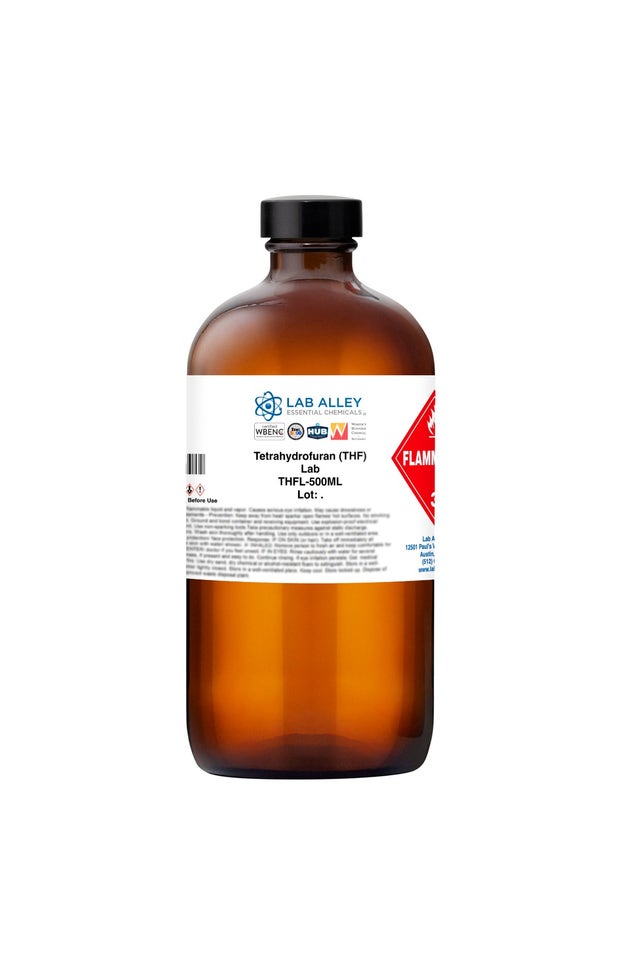




Tetrahydrofuran (THF), commonly known as Oxolane, is a compound of four carbons and one oxygen connected in a ring formation to form a cyclic ether. It is a colorless, organic solvent of low viscosity. Because it is of mid-range polarity and miscible with water, it has diverse use as a solvent. It is abundantly utilized as a polymer precursor in various polymer production sectors.
Tetrahydrofuran, also called THF or Oxolane, is a cyclic ether built from four carbons and one oxygen in a ring. This Lab Grade version carries CAS 109-99-9 and an assay of min. 99.0%, and it arrives as a liquid. It’s a colorless organic solvent with low viscosity. Its moderate polarity and miscibility with water make it a flexible solvent for many jobs, and it’s widely used as a polymer precursor. You’ll also find the paperwork on the page: the Safety Data Sheet, Technical Data Sheet, Allergen Statement, BPA Statement, Non Irradiation Statement, Paraben Statement, PFAS/PFOS Free Statement, Phthalates Statement and TSE/BSE Declaration, plus Certificates of Analysis listed by lot.
Chemists reach for THF as a synthetic precursor and solvent for reactions. It also shows up in varnishes, polyvinyl chloride adhesives, degreasing and biomass pretreatment. The trouble is rarely the chemistry. It’s finding a supplier who has your size, has the paperwork ready and can move a flammable liquid without drama. That’s where Lab Alley comes in. Documents are available instantly on the product page, sizes run from small 500ml bottles to a 55 gallon size, and we handle hazmat shipping from start to finish. Here’s the plan. Pick your size, set up Autoship if you reorder often, or ask for a custom quote through the quote request form. Either way, you get what we promise: on budget, on time, every time.
-
Synthetic precursor for chemical reactions
-
Solvent for synthetic reactions
-
Varnishes
-
Polyvinyl chloride adhesives
-
Biomass pretreatment
-
Degreaser
-
Polymer production precursor
-
Q: What is Tetrahydrofuran (THF) used for?
A: THF is used as a synthetic precursor and solvent for reactions. It also appears in varnishes, polyvinyl chloride adhesives, degreasing and biomass pretreatment, and it’s widely used as a polymer precursor.Q: What does Lab Grade mean, and is it suitable for synthetic reactions?
A: On this page, Lab Grade comes with an assay of min. 99.0%. The product is listed as a solvent and precursor for synthetic reactions, but check the Technical Data Sheet and a Certificate of Analysis against your method before you order.Q: What sizes are available, and does it ship as hazmat?
A: You can order 500ml, 1L, 1Gal, 4L, 5Gal, 20L and 55Gal sizes, plus cases of 4 x 1L, 6 x 500ml, 4 x 1Gal and 4 x 4L. It ships as hazmat, and the DOT line reads: Tetrahydrofuran, 3, UN2056, PG II. A hazmat fee is required for shipping.Q: How do I get the SDS and Certificate of Analysis?
A: Both are on the product page. The Safety Data Sheet and Technical Data Sheet sit under Product Manuals, and Certificates of Analysis are listed by lot in the Certificates of Analysis tab right beside it.Q: How should it be stored?
A: Start with the storage section of the Safety Data Sheet. The page calls THF extremely flammable (NFPA rating 3) and says its vapor can travel to an ignition source and flash back, so keep that in mind when you choose a spot.Q: What are the CAS number and assay?
A: The CAS number is 109-99-9 and the assay is min. 99.0%.Q: Is Oxolane the same thing as THF?
A: Yes. Oxolane is another common name for tetrahydrofuran.Q: Does THF mix with water?
A: Yes. The page describes it as a solvent that’s miscible with water.
Product Information
| CAS | 109-99-9 |
|---|---|
| Synonyms | Oxolane, Tetrahydro-Furan, Furanidine, Butylene oxide, Hydrofuran, Tetramethylene oxide, Oxacyclopentane, 1,4-Epoxybutane |
| Assay | Min. 99.0% |
| PubChem ID | 8028 |
| Grade | Lab Grade |
| Color | Max 20 |
| Physical form | Liquid |
| Appearance | Clear, colorless liquid |
| pH | ca. 7 - 8 |
| Melting point | -108.0 °C (-162.4 °F) |
| Boiling Point | 65.0 - 67.0 °C (149.0 - 152.6 °F) |
| Vapor pressure | 190.7 hPa (143.0 mmHg) at 20.0 °C (68.0 °F) |
| Density | 1.049 g/mL at 25 °C (77 °F) |
| Solubility | Fully Miscible in Water |
| Auto-ignition temperature | 321.0 °C (609.8 °F) |
| Molecular formula | C4H8O |
| Molecular weight | 72.11 |
| Autoship Available | Yes |
| Flash Point | -14°C (6°F) |
| Pillar | Essential |
| Residue after evaporation | Max 0.03% |
| Vapor density | 2.1 |
| Water | 0.05% max. |