R&D & Laboratory
Solvents, acids and cleaning chemicals for research and QC labs, in the grade your method calls for, with SDS and COA online before you order.
A stalled method is rarely about the science. More often it's a reagent that didn't arrive, a quote nobody answered, or a COA that nobody can find when an auditor asks for it. If you run a research or QC lab, you've probably lived all three. This page is built to take those delays off your plate. Order R&D and laboratory chemicals online, choose the grade your method or SOP calls for, and read the SDS and COA before anything ships. There's no sales call and no waiting on a quote. You pick what you need, place the order, and get back to the bench. And because 99.5% of orders ship within 1 to 2 business days, a Monday reorder doesn't turn into a Friday problem.
Browse the solvents, acids and cleaning chemicals that research labs reorder most. Acetone and isopropyl alcohol for rinsing and wiping. Undenatured ethanol for extraction and dilution. Nitric, hydrochloric and sulfuric acid in ACS Reagent Grade for digestions and pH work. Acetonitrile in HPLC Grade for your mobile phase. Sizes start at a single pint, which is handy when you're validating a new method, and climb to 55 gallon drums and 275 gallon totes when a shared lab supply needs to last. Every product page lists its grade, its sizes and its documents, so you know what's coming before you add it to your cart. If the chemical you want isn't on the first page of the grid, the size and Autoship filters narrow things down fast.
256,000+
customers served
99.5%
of orders ship in 1–2 business days
98.9%
inventory accuracy
SDS + COA
available online, every product
R&D & Laboratory - 1 products All Filters
R&D & Laboratory - 1 products About R&D & Laboratory
R&D and laboratory chemicals aren't one chemical family. They're the working set a lab reaches for every day: solvents that dissolve and extract, acids and bases that digest samples and set pH, oxidizers that clean glassware, and solutions you titrate against. What ties them together is documentation. In a research or QC lab, a reagent is only as useful as the paperwork that proves what's in the bottle.
Properties change a lot from one chemical to the next, but a few come up at almost every bench. Volatility is the big one. Acetone boils at about 56°C and dichloromethane at about 40°C, so both evaporate fast and belong in a hood. Ethyl ether is even more volatile and can form peroxides if a bottle sits too long, so date what you open. Water content is the quiet one. Ethanol and water form an azeotrope that caps ordinary distillation at about 95.6% ethanol, which is why 200 proof needs an extra drying step. Strength matters for acids, which are sold at set concentrations such as hydrochloric acid at 37%, nitric acid at 70% and sulfuric acid at 96%. Container choice counts too. Acids typically go in HDPE, while acetonitrile and many other solvents go in amber glass. The Chemical Storage Compatibility Chart lists the right container for each chemical, and the SDS covers flammability and corrosion hazards before you stock anything.
COMMON APPLICATIONS
Think in terms of the job on your bench. For sample prep and extraction, labs reach for acetone and undenatured ethanol. Extractions and synthesis often call for dichloromethane or ethyl ether, though both need careful handling. Digesting samples for metals analysis usually means nitric acid, and hydrochloric acid handles pH adjustment and titrant prep. Trichloroacetic acid at 85% is a staple for protein precipitation. HPLC work depends on HPLC Grade acetonitrile to keep baselines flat. At the end of the day, isopropyl alcohol 99.8% wipes down benches and equipment, and hydrogen peroxide helps break down organic residue on glassware.
GRADES EXPLAINED
Grade tells you how pure a chemical is and what testing sits behind its COA. Lab Grade is dependable for routine work like rinsing and general prep, but its exact impurity levels aren't guaranteed the way they are for ACS. ACS Reagent Grade meets the specifications published by the American Chemical Society, and each lot's COA shows measured values against those limits. Suppliers certify against the spec themselves, so the COA is worth reading. Reagent Grade covers standardized laboratory solutions made to a known concentration, without certification against the full ACS spec. HPLC Grade is made for use as a mobile phase or solvent, with low UV absorbance so impurities don't distort your baseline. LC/MS Grade goes a step cleaner, because mass spectrometry reacts to trace metals and impurities that a UV detector never sees. USP/FCC Grade, which you'll see on some of the ethanol, is built for food and pharmaceutical use. Match the grade to your method or SOP, and save the higher grades for the work that needs them.
TYPES & GRADES AT A GLANCE
Fast evaporating solvent for glassware rinsing and general extraction, in Lab Grade and ACS Grade.
Undenatured, denatured and SDA ethanol in 140, 190 and 200 proof for extraction, dilution and general lab use.
Isopropyl alcohol 99.8% Lab Grade for wiping benches, equipment and glassware.
HPLC Grade 99.9% for mobile phases and gradient runs.
Lab Grade solvent for extraction and synthesis. Orders need an EPA eligibility check at checkout.
70% ACS Reagent Grade and 67% Lab/Technical Grade for sample digestion.
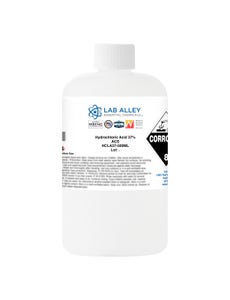
37% ACS Reagent Grade for pH adjustment, digestion and titrant prep.
96% ACS Reagent Grade, concentrated H2SO4.
85% solution, a common pick for protein precipitation.
30% and 34% Lab Grade for oxidation and residue removal, plus 34% Food Grade with Kosher and Halal certification.
Buffer solutions, reference standards and indicators for titration and calibration.
Routine bench work, rinsing and general prep.
Meets ACS specifications, with measured values on each lot's COA.
Standardized solutions for titrations, buffers and routine analysis.
Low UV absorbance solvents for HPLC mobile phases.
Cleaner than HPLC Grade, for mass spectrometry.
Pharmacopeia standard for pharmaceutical and compendial work.
Certification applies product by product. Check each product page.
Certification applies product by product. Check each product page.
WHY BUY FROM LAB ALLEY
256,000+ customers already order their R&D and laboratory chemicals from Lab Alley.
99.5% of orders ship within 1 to 2 business days, so a stockout doesn't stall your bench or your line.
98.9% inventory accuracy means the grade you see in stock is the grade that ships.
SDS and COA are available online for every R&D and laboratory product, and select products carry Kosher or Halal certification. Check each product page for which apply.
Kosher and Halal certification is listed on products such as Ethanol 200 Proof (100%) Undenatured Alcohol, USP/FCC Food Grade, Denatured Ethanol 200 Proof, SDA 40B Ethanol 200 Proof, Hydrogen Peroxide 34% Food Grade and Polysorbate 80, Food Grade. Organic Ethyl Alcohol, Corn, 190 Proof carries organic certification along with Kosher and Halal. The ACS, HPLC and Lab Grade acetone, acetonitrile and nitric acid listings don't name any of these certifications.
Frequently Asked Questions
What's the difference between ACS grade and Lab Grade chemicals?
ACS Reagent Grade meets purity specifications published by the American Chemical Society, and every lot comes with a COA that shows measured values against those limits. Lab Grade is pure enough for routine work, but its exact impurity levels aren't specified or guaranteed the same way. Use ACS when your method or SOP names it, such as titrations or standards. Lab Grade fits rinsing, cleaning and general prep.
What does the percentage on an acid or solvent mean?
For acids, the number is strength. Hydrochloric acid 37% is about 37% HCl by weight, with water making up the rest. For solvents such as acetonitrile 99.9% or isopropyl alcohol 99.8%, it's the assay, or purity. Alcohol also uses proof, which is twice the percentage by volume, so 200 proof is 100% ethanol and 190 proof is 95%. Lot specific values appear on the COA.
Do I need a permit to buy lab chemicals?
Permit rules depend on the product, and two come up most on this page. If you're buying Specially Denatured Alcohol (SDA) in 5 gallons or more, you'll need to email a TTB permit showing your annual purchase limit. Dichloromethane orders need an EPA eligibility form at checkout and won't ship until it's approved. If you're unsure about a product, call customer care at 512-668-9918 before you order.
Which R&D and laboratory products are Kosher or Halal certified?
Certification is set product by product, not for the whole category. On this page, Kosher and Halal appear on items such as Ethanol 200 Proof Undenatured Alcohol, Denatured Ethanol 200 Proof, SDA 40B Ethanol, Hydrogen Peroxide 34% Food Grade and Polysorbate 80 Food Grade. Many ACS and Lab Grade listings, such as acetone and nitric acid, don't name either one. Check the product page before you order.
Can lab chemicals ship to a home address?
Some can't. Certain chemicals ship only to businesses, schools and universities, or laboratories, and if you enter a residential address at checkout those items are removed from your order before shipping. Mercury has extra rules, including no shipments to apartments or parcel stores. Dichloromethane goes only to facilities equipped to handle it. If you're not sure your address qualifies, call 512-668-9918 before you order.
Which grade do I need for HPLC, LC/MS or general bench work?
Use HPLC Grade for HPLC with UV detection, where low UV absorbance keeps your baseline flat. Step up to LC/MS Grade for mass spectrometry, since trace metals and impurities that a UV detector misses can raise background and cut sensitivity. For titrations and standards, ACS Reagent Grade is the usual call. For rinsing and general prep, Lab Grade saves money. When in doubt, follow your SOP.
How is acetone different from isopropyl alcohol for cleaning lab glassware?
Acetone evaporates quickly and dissolves a wide range of organic residue, which makes it a favorite for rinsing glassware. It can attack some plastics, so keep it off those parts. Isopropyl alcohol 99.8% evaporates more slowly and is gentler, so it suits wiping benches, equipment and glassware. Many labs keep both on the shelf. Neither replaces the other in reaction or HPLC work, where grade matters.
Can I buy these chemicals in drums or totes?
Yes. Sizes run from a single pint for method development up to 55 gallon drums and 275 gallon totes, with 1 gallon and 5 gallon sizes in between for bench stock and shared supply. Not every chemical comes in every size, so check the product page. For volume pricing, repackaging or custom blends, request a quote through Bulk & Custom Chemicals.
Can I get a COA and SDS for each product?
Yes. Safety Data Sheets and Certificates of Analysis are posted online, so you can pull the paperwork before you order instead of chasing it after delivery. COAs are lot specific, which helps when you're documenting reagents for lab notebooks, method validation or an audit. If you can't find a document, ask customer care and they'll point you to it.
Do you accept purchase orders and net terms?
Yes. You can submit a purchase order online, and net terms are available through a credit application. Federal buyers can also order through GSA Advantage. If your lab reorders the same reagents on a schedule, Autoship is available on many products, and you can filter this page to see which ones.
Guides & Resources
Chemical Grades
Explore the various chemical grades and their applications in different industries. Understand the significance of purity standards, including ACS, USP, Lab Grade and more.
Read article →How to Safely Dispose of Nitric Acid
Discover how to dispose of nitric acid safely. This guide explains the disposal methods, neutralization steps, and environmental safety requirements of nitric acid.
Read article → Industries That Use R&D & Laboratory
R&D/Laboratory
Explore ACS, HPLC and LC/MS grade chemicals for R&D and laboratory use including solvents, acids, bases, buffers and standardized solutions for research and QC.
Learn more →Pharmaceuticals & Nutraceuticals
Explore USP and NF grade chemicals for pharma and nutraceuticals including solvents, excipients, propylene glycol, glycerin and HPLC reagents.
Learn more →Life Sciences & Biotech
Explore high-purity chemicals for life sciences and biotech research including solvents, reagents, acids, bases, enzymes, buffers and molecular biology grade solutions.
Learn more →Education
Explore chemicals for K–12 and university labs including dilute acids, bases, ACS solvents, biology reagents and indicators for classroom and research use.
Learn more →Healthcare
Explore high-purity chemicals for the healthcare industry including USP alcohols, buffered formalin, histological solvents, hydrogen peroxide and disinfectants.
Learn more →