




• On Budget, On Time, Every Time : Essential Chemicals for a Better World• WOMAN-OWNED SMALL BUSINESS (WOSB)• OVER 248K HAPPY CUSTOMERS• TRUSTED BY NASA, TESLA, SPACEX, BOEING & MORE• HIGH PURITY, NATURAL AND ESSENTIAL CHEMICALS• SERVING 16 INDUSTRIES• PROUDLY PARTNERED WITH ECODRIVE• COA & SDS AVAILABLE ONLINE• QUALITY LAB SUPPLIES & EQUIPMENT• CERTIFIED QUALITY: ISO 9001, KOSHER, ORGANIC & MORE• GSA CONTRACT HOLDER | GOVERNMENT APPROVED• FAST NATIONWIDE DELIVERY• On Budget, On Time, Every Time : Essential Chemicals for a Better World• WOMAN-OWNED SMALL BUSINESS (WOSB)• TRUSTED BY NASA, TESLA, SPACEX, BOEING & MORE• OVER 248K HAPPY CUSTOMERS• HIGH PURITY, NATURAL AND ESSENTIAL CHEMICALS• SERVING 16 INDUSTRIES• PROUDLY PARTNERED WITH ECODRIVE• COA & SDS AVAILABLE• QUALITY LAB SUPPLIES & EQUIPMENT• CERTIFIED QUALITY: ISO 9001, KOSHER, ORGANIC & MORE• GSA CONTRACT HOLDER | GOVERNMENT APPROVED• FAST NATIONWIDE DELIVERY

We are now ISO 9001 Certified

Get 5% OFF on your first order |  Use Code: WELCOME5

10% off All Acetone Products! Code ACETONE26

Polyethylene Glycol (PEG 200 to 8000) | USP, NF, FCC | Lab Alley

Polyethylene Glycol

Liquid and Granular PEG 200, 400, 3350, 4000 and 8000 in Lab, USP, NF and FCC Food Grade.

Polyethylene Glycol (PEG) is a family of polymers, and the number after the name is the average molecular weight. That number changes a lot. PEG 200 and 400 are liquids you can pour straight from the drum. PEG 3350, 4000 and 8000 show up as white granules that you dissolve in water before use. We carry all five, in Lab Grade, USP Grade, NF Grade and FCC Food Grade.

So who's buying it? Pharma teams use PEG 3350 and 8000 as excipients and coating plasticizers. Personal care formulators lean on the liquid grades for moisture and texture. Molecular biology labs go through a surprising amount of PEG 4000 and 8000 for protein and DNA precipitation. And plenty of plants just need a dependable lubricant or binder that shows up on time.

256,000+ customers served
99.5% of orders ship in 1–2 business days
98.9% inventory accuracy
SDS + COA available online, every product
Food And Lab Grade PEG 400, 3350, 4000 & 8000
  1. Certification Kosher Remove This Item
  2. Size 500g Remove This Item
Set Descending Direction
per page

About Polyethylene Glycol

Chemically, Polyethylene Glycol is simple. Ethylene oxide units link into a chain, H(OCH2CH2)nOH, with a hydroxyl group capping each end. It has next to no color or smell, it doesn't evaporate, and water takes it up easily.

Chain length is what you're really choosing. PEG 200 sits at 190 to 210 g/mol and stays liquid down to about minus 65 °C. PEG 400 (380 to 420) is thicker, and here's a practical catch: it starts to set up near 8 °C. Leave a drum on a cold loading dock in January and you may have to warm it before it'll pump.

Much above 1,000 and you're handling a waxy solid. Our PEG 3350 melts at 53 to 57 °C, PEG 4000 at about 58 °C, and PEG 8000 somewhere between 55 and 60 °C. Heavier grades also pull less moisture out of the air, so the granules store better than people tend to expect.

Flash points? High. 176 °C for PEG 400 and 270 °C for PEG 8000. Our SDS for PEG 200, 3350, 4000 and 8000 classifies each one as not hazardous under OSHA's Hazard Communication Standard.


COMMON APPLICATIONS

Most of the Polyethylene Glycol we ship ends up in one of five places.

Pharma takes the biggest share. PEG 3350 USP is the active ingredient in osmotic laxatives, and the heavier grades turn up as tablet binders and in ointment and suppository bases. PEG 8000 NF goes into tablet coatings, where it hardens the film but still lets it dissolve.

Cosmetic chemists mostly want the liquids. PEG 200 and 400 hold moisture and add body to creams, lotions, shampoo and toothpaste. PEG 3350 shows up here too, as a stabilizer with a smooth skin feel.

Food is narrow. Only PEG 400 FCC applies, and only within what 21 CFR 172.820 allows.

In research labs it's precipitation work, mostly. PEG 4000 and 8000 pull proteins, viruses and nucleic acids out of solution, and a lot of hydrogel recipes start with PEG. Then there's the industrial side: lubricants, surfactant manufacture, ceramic binders (PEG 3350) and cement additives (PEG 4000).


GRADES EXPLAINED

You'll see four grade labels on this page. They aren't interchangeable.

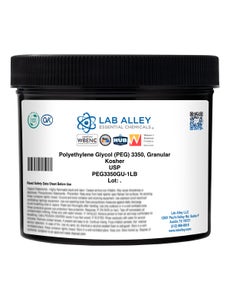
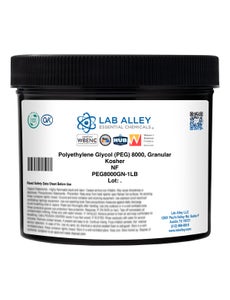
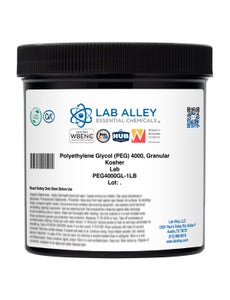
Lab Grade, our PEG 200 and PEG 4000, is clean material that hasn't been tested against a pharmacopeia. For R&D, teaching labs and industrial jobs, that's usually plenty.

USP Grade applies to PEG 3350. It meets the United States Pharmacopeia monograph, and our spec is tighter than the label alone tells you: assay 97.0 to 103.0%, diethylene glycol no more than 300 ppm, ethylene oxide no more than 1 ppm, formaldehyde under 15 ppm.

NF Grade covers PEG 8000. The National Formulary is the USP's sister compendium for excipients, which is why dosage form and supplement makers tend to specify it.

FCC Food Grade is PEG 400 only. Food Chemicals Codex compliant, GRAS for its listed food uses, heavy metals capped at 5 ppm.

One caveat. A grade tells you what the material was tested against. It doesn't tell you whether it's right for your finished product. That call is yours, and the documents on each product page should make it a quick one.


TYPES & GRADES AT A GLANCE

The thinnest of the bunch. A good solvent and humectant, with no certifications attached.
If a plant stocks only one liquid PEG, it's usually this one.
Pharmacopeial granules for drug and supplement production.
What most research labs order for precipitation and hydrogel work.
Our heaviest PEG, picked for tablet coatings and thick solutions.

WHY BUY FROM LAB ALLEY

256,000+ customers already order their chemicals from Lab Alley.

Most orders, 99.5 percent, ship within 1 to 2 business days. A polyethylene glycol order should not be what holds up your production or research.

Inventory accuracy sits at 98.9 percent, so the grade you see in stock is the grade that ships.

Every polyethylene glycol grade ships with SDS and COA available online, and PEG 400, 3350, 4000 and 8000 carry Kosher certification, with PEG 400 Food Grade also Halal certified.

Frequently Asked Questions

PEG 400 or PEG 3350, what's the real difference?
Size of the molecule, mostly. PEG 400 averages about 400 g/mol and it's a liquid, clear and a little syrupy. PEG 3350 is roughly eight times heavier and ships as white granules that melt around 53 to 57 °C. Need a solvent or humectant? Go liquid. Need a binder, or a dry powder you can weigh out? Granules. The grades differ too. Our PEG 400 is FCC Food Grade and our PEG 3350 is USP.
What does the number after PEG mean?
Average molecular weight, in grams per mole. It's an average because every batch is a spread of chain lengths inside a set range. PEG 200 runs 190 to 210. PEG 400 runs 380 to 420. PEG 8000 can land anywhere from 7,000 to 9,000. Higher number, longer chains, so a higher melting point and a thicker solution.
Can PEG 400 go into food?
Ours can, within the rules. PEG 400 FCC Food Grade meets Food Chemicals Codex specs and is GRAS under 21 CFR 172.820, which lists the food uses it's allowed in. The product page has a food grade statement, allergen and gluten free statements, and a GRAS document for your supplier file. None of our other PEG grades are sold as food grade, so keep them out of anything edible.
Which PEG products are Kosher or Halal?
Kosher: PEG 400, 3350, 4000 and 8000. Halal: only PEG 400 Food Grade. PEG 200 has neither. If your QA team wants the certificates on file first, they're in the Product Manuals tab on each product page.
Can polyethylene glycol ship to a residential address?
Possibly, but check before you order. Our SDS lists PEG 200, 3350, 4000 and 8000 as not hazardous under OSHA HazCom, and PEG 400 carries a combustible warning. Shipping rules are set product by product, so look at the Safety and Shipping tab before checkout, or call Customer Care at 512-668-9918. Ordering a drum? A business address with a loading dock will save you a headache.
Which grade should I use for pharmaceutical, cosmetic or lab work?
Whatever your spec or SOP names, first. No spec? Here's the usual pattern. Pharma and supplements go with PEG 3350 USP or PEG 8000 NF. Cosmetics use PEG 200 or 400. Food needs PEG 400 FCC and nothing else. For protein, virus or DNA precipitation, most labs pick PEG 4000 Lab Grade or PEG 8000.
How is polyethylene glycol different from propylene glycol?
They sound alike and they're both glycols. That's about where it ends. Propylene glycol is one small molecule, around 76 g/mol, and it's always a thin liquid. PEG is a polymer you can buy anywhere from pourable PEG 200 to solid PEG 8000. Both work as humectants and solvents. PG is simpler when you just want a light carrier, while PEG gives you more say over thickness and melting point. Our <a href="https://www.laballey.com/chemicals/solvents/propylene-glycol">Propylene Glycol</a> page has the PG grades if you want to compare.
Can I buy PEG in drums or bulk?
Yes. PEG 200 and 400 go up to 55 gallon drums, with 5 gallon pails in between, and PEG 400 also comes in 20 L. Both are sold in multi bottle cases as well. The granular grades top out at 50 lb and 25 kg bags. Want totes, pallets or a standing order? Get a quote through <a href="https://www.laballey.com/bulk-and-custom-chemicals">Bulk & Custom Chemicals</a>. And if you reorder the same grade on a schedule, <a href="https://www.laballey.com/pages/autoship">Autoship</a> takes 10% off.
How do I dissolve granular PEG?
Slowly, with stirring. PEG 3350 dissolves up to about 67% by weight at 20 °C, so room temperature water handles most working solutions. Heat helps with PEG 8000 at higher strengths, since that solution thickens fast. Keep opened bags sealed and somewhere cool and dry.

Guides & Resources

Polyethylene Glycol (PEG) Overview
Discover the key properties and uses of polyethylene glycol. Understand how this organic solvent supports food, cosmetic, and pharmaceutical production with safe handling practices.
Read article →
Types of Polyethylene Glycol
What are the different types of polyethylene glycol? Learn the differences between food, cosmetic, and pharmaceutical grades, plus their key applications.
Read article →
How to Store Polyethylene Glycol
Learn how to safely store polyethylene glycol. Discover best practices for storage, handling, and labeling to maintain quality, prevent contamination, and ensure compliance.
Read article →
Shelf Life & Expiration of Polyethylene Glycol
Learn the shelf life and expiration signs of polyethylene glycol. Understand storage conditions, moisture sensitivity, and how to extend stability for food, pharma, and industrial uses.
Read article →
How to Safely Dispose of Polyethylene Glycol
Discover how to dispose of polyethylene glycol safely. This guide explains disposal methods, neutralization steps, and environmental safety requirements of polyethylene glycol.
Read article →

Industries That Use Polyethylene Glycol

Pharmaceutical & Nutraceutical
Explore pharmaceutical and nutraceutical chemicals from Lab Alley. Find solvents, purified water, and specialty chemicals for critical applications.
Learn more →
Personal Care & Cosmetics
Explore high-quality chemicals and ingredients for personal care and cosmetics, including glycolic acid, ethanol, and denatured alcohol for formulations.
Learn more →
Food & Beverage
Explore food-grade chemicals for food and beverage production, including ethanol, citric acid, peracetic acid, hydrogen peroxide, and preservatives.
Learn more →
R&D & Laboratory
Explore high-purity chemicals for research, development, and testing, including nitric acid, acetone, dichloromethane, ethanol, and more.
Learn more →
Manufacturing & Industrial
Explore high-purity chemicals for manufacturing and industrial applications, including acetone, heptane, sulfuric acid, solvents, and more.
Learn more →