


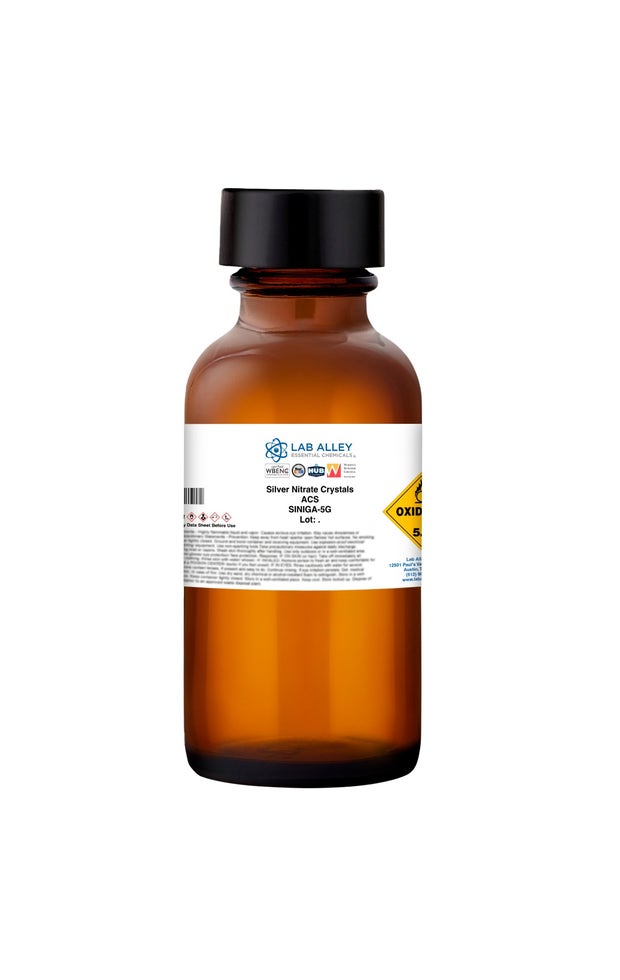

Silver Nitrate, AgNO3, is a colorless crystalline solid, in which each Ag+ center is bonded to 6 oxygens. It is prepared by reacting Silver with Nitric Acid. ACS (American Chemical Society) grade designation signifies high purity (at least 95%) and integrity of reagents.
Silver Nitrate crystals are uncolored and considered transparent, becoming black on exposure to light or organic material.
Silver Nitrate Crystals ACS Reagent Grade is AgNO3, CAS 7761-88-8, supplied as a solid with a listed assay of Min 99.0%. It’s a colorless crystalline solid, and each silver ion in the crystal is bonded to six oxygens. It’s made by reacting silver with nitric acid. The crystals are uncolored and transparent, but they turn black when exposed to light or organic material, so how you handle them matters. This listing carries the ACS grade designation, which comes from the American Chemical Society and points to reagent quality. You’ll find the Safety Data Sheet and the Technical Data Sheet under Product Manuals, plus Certificates of Analysis for specific lots. Pull those up before you order so you know what’s in the bottle.
People reach for silver nitrate in organic synthesis, halide abstraction, scanning electron microscopy, protein and nucleic acid staining, and photography. It’s also used as a laboratory reagent. The trouble is that your results can slip when the reagent isn’t backed by the right paperwork. That’s where we come in. Lab Alley lists the SDS, the TDS and lot specific COAs on this page so you can check them right away, and we offer sizes from 5g to 500g so you only buy what you need. Here’s the plan. Pick your size, set up Autoship if you reorder, or request a quote if you need something different. Either way, it’s on budget, on time, every time. Request a quote and we’ll take it from there.
-
Organic synthesis
-
Laboratory reagent
-
Halide abstraction
-
Scanning electron microscopy (SEM)
-
Staining of proteins and nucleic acids
-
Photography
-
Q: What is Silver Nitrate Crystals ACS Reagent Grade used for?
A: It’s used in organic synthesis, halide abstraction, scanning electron microscopy, staining of proteins and nucleic acids, and photography. It’s also used as a general laboratory reagent.Q: What does ACS Grade mean, and is it suitable for laboratory reagent work?
A: ACS refers to the American Chemical Society, and the designation signals high purity and reagent integrity. This listing shows a Min 99.0% assay and it’s sold as a laboratory reagent. For your specific method, check the Technical Data Sheet and the COA first.Q: What sizes are available, and does it ship as hazmat?
A: You can choose 5g, 25g, 100g, 250g or 500g. This page doesn’t state a shipping classification, so confirm hazmat handling with our team or on the SDS before you order.Q: How do I get the SDS and Certificate of Analysis?
A: Both are on this page. The Safety Data Sheet and Technical Data Sheet sit under Product Manuals, and the COAs are listed under Certificates of Analysis. If you need a specific lot, contact customer care.Q: How should Silver Nitrate Crystals be stored?
A: The crystals turn black when exposed to light or organic material, so keep them away from both. Our guide on how to store silver nitrate walks through it.Q: Why do silver nitrate crystals turn black?
A: They darken when they’re exposed to light or organic material. Fresh crystals are uncolored and transparent.Q: How is this different from other types of silver nitrate?
A: This one is ACS Reagent Grade with a Min 99.0% assay. Our Types of Silver Nitrate post explains how the other types compare.
Product Information
| CAS | 7761-88-8 |
|---|---|
| Assay | Min 99.0% |
| Grade | ACS Grade |
| Color | Colorless or white |
| Physical form | Solid |
| Appearance | Crystalline |
| Odor | Odorless |
| Melting point | 414 °F / 212 °C |
| Boiling Point | 824 °F / 440 °C |
| Density | 4.350 g/cm³ |
| Solubility | 2,150 g/l (68 °F / 20 °C) |
| Molecular formula | AgNO3 |
| Molecular weight | 169.87 |
| Autoship Available | Yes |
| Chloride (Cl) | 5 ppm |
| Clarity of Solution | To pass the test |
| Free Acid | To Pass Test |
| Iron (Fe) | 2 ppm |
| Lead (Pb) | 0.00001 |
| Pillar | High Purity |
| Substances not Pptd. by Hydrochloric Acid | 0.0001 |
| Sulfate (SO4) | 0.00% |