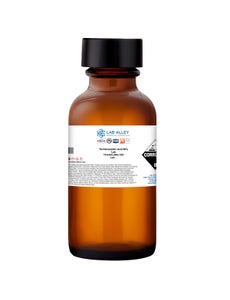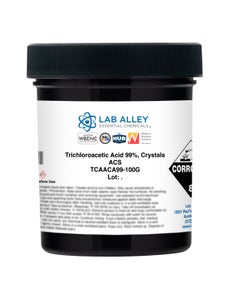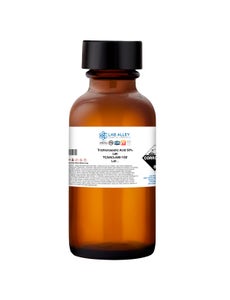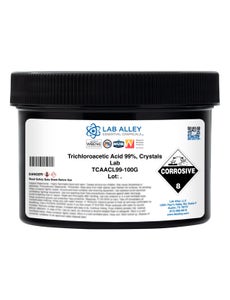





How to Safely Dispose of Trichloroacetic Acid
Trichloroacetic acid is a strong organic acid that causes severe burns on contact with skin and eyes, and disposal mistakes with this chemical carry real consequences for workers, waterways, and regulatory standing. Its aqueous solutions stay acidic even when diluted well below typical working concentrations, which means visual cues alone are not a reliable guide to whether a given waste stream is safe to discharge.
What sets this acid apart for disposal purposes is the combination of its corrosivity classification and its behavior under heat. Trichloroacetic acid meets federal corrosivity criteria, placing it squarely under hazardous waste rules rather than general industrial waste, and improper incineration or excessive heating breaks it down into toxic gases. Together, these properties mean waste handling decisions have to be verified against measured pH and documented procedure, not assumption.


In this article, we'll cover:
-
Why Proper Disposal Matters
-
How to Dispose of Trichloroacetic Acid
- Toxic Decomposition Hazards
-
Special Considerations
Why Proper Disposal Matters
Environmental Protection
Trichloroacetic acid is classified as very toxic to aquatic life, with effects that persist well beyond the point of initial exposure. Toxicity to freshwater algae has been measured at 0.27 mg/L, a concentration low enough that even small discharges can disrupt aquatic ecosystems. For this reason, waste containing the acid must never be allowed to reach drains, storm sewers, or natural waterways, regardless of the volume involved.
Health & Safety
The acid is classified as a Skin Corrosion Category 1A and Serious Eye Damage Category 1 substance, among the most severe hazard ratings available under this classification system. Anyone handling waste containing trichloroacetic acid risks serious chemical burns to skin, eyes, and mucous membranes if contact occurs during cleanup, transfer, or container handling. These risks apply throughout the disposal process, not only during the chemical's original use.
Legal Compliance
Trichloroacetic acid waste meets the RCRA D002 corrosivity criteria, since the acid measures a pH of 1.2 at 0.1M, well under the regulatory threshold of 2. This classification brings the waste under EPA RCRA generator requirements, along with whatever state and local hazardous waste regulations apply in the facility's jurisdiction. Generators are responsible for confirming their obligations before waste leaves the premises.
How to Dispose of Trichloroacetic Acid
Check Regulations
Before any disposal action, confirm the facility's generator status under 40 CFR 262, since this determines the applicable recordkeeping and shipping requirements. State and local hazardous waste rules should also be verified directly, as D002 corrosivity classification applies at the point the material is discarded, not at its original concentration or intended use.
Confirm Neutralization Requirements
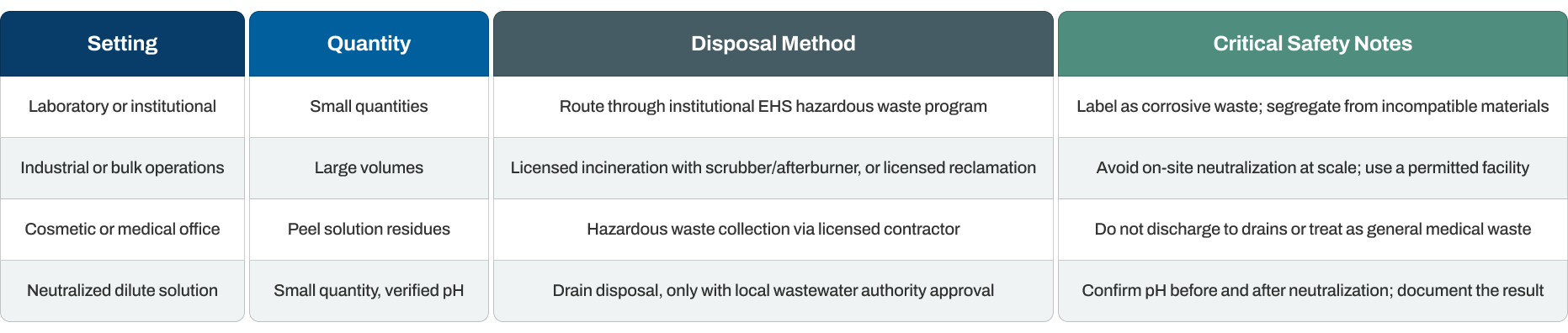
Where neutralization is being considered, an alkaline agent such as soda ash, lime, or sodium bicarbonate can bring the waste to a near-neutral pH range. This process requires continuous pH monitoring throughout treatment, since the reaction is not instantaneous and incomplete neutralization will leave the waste within hazardous corrosivity limits. Neutralization is a prerequisite for non-hazardous disposal, not a substitute for it.
Use Designated Waste Disposal Methods
The appropriate disposal pathway depends on the waste's treatment status, volume, and the setting in which it is generated.
Non-Hazardous Disposal
Drain disposal is only appropriate after neutralization has been verified to fall within locally permitted pH limits, and even then only with confirmed acceptance from the local wastewater authority. Untreated or still-acidic trichloroacetic acid solutions should never be assumed safe for drain disposal.
Hazardous Waste Disposal
Waste that has not been neutralized needs to be collected in corrosion-resistant containers with clear hazard labeling. From there, a licensed hazardous waste contractor should manage transport and disposal, with manifest documentation maintained for the full chain of custody.
Industrial Quantities
Bulk waste streams are typically better suited to a permitted facility equipped with incineration and acid-gas scrubber systems, or to licensed reclamation where available. Facility-level neutralization is rarely practical at industrial volumes and introduces additional handling risk.
Laboratory & Institutional Waste
Laboratories and institutions should route trichloroacetic acid waste through their internal EHS hazardous waste program. Waste should be labeled as corrosive and kept segregated from incompatible materials while awaiting pickup.
Never Mix Chemicals
Trichloroacetic acid should never be combined with strong oxidizing agents, bases outside of controlled neutralization, or reactive metals. Uncontrolled mixing can generate excess heat, release toxic gas, or trigger a violent reaction, any of which turns a routine disposal task into an emergency.
Follow PPE Guidelines
Disposal work calls for chemical-resistant gloves, a face shield or chemical safety goggles, and long-sleeved protective clothing. Work should take place under a chemical fume hood, with an eyewash station and safety shower within immediate reach in case of accidental contact.
Toxic Decomposition Hazards
Thermal Decomposition Risk
Burning or exposing trichloroacetic acid waste to excessive heat releases chloroform, hydrogen chloride gas, and phosgene, all of which pose serious inhalation hazards. Processing this waste through incineration is only appropriate at permitted facilities equipped with afterburner and scrubber systems capable of capturing these byproducts before release.
Suspected Carcinogen Handling
Trichloroacetic acid carries an IARC Group 2B classification and an ACGIH A3 rating, identifying it as a possible or animal carcinogen. Waste handlers should minimize direct exposure during collection and transfer, and labeling should reflect this classification alongside the corrosivity hazard already noted.
Special Considerations
Concentration-Dependent Classification
Dilution does not reliably move trichloroacetic acid out of hazardous territory. The acid measures a pH of 1.2 even at 0.1M, meaning solutions that appear dilute by weight can still fall well within corrosivity thresholds. Actual measured pH, not assumed concentration, should determine whether a given solution qualifies for non-hazardous disposal.
Cosmetic & Medical Office Use
Trichloroacetic acid is commonly used in chemical peel procedures in dermatology and medical office settings, and the resulting waste still meets corrosivity criteria regardless of its clinical origin. These waste streams need to follow standard hazardous waste procedures rather than being folded into general medical waste or municipal disposal.
Conclusion
Safe disposal of trichloroacetic acid depends on treating its corrosivity as a constant rather than a variable tied to appearance or dilution. Verified pH testing, proper neutralization where applicable, and routing through licensed hazardous waste channels form the backbone of compliant handling, whether the waste originates in a laboratory, an industrial process, or a medical office.
Facilities that build these steps into standard procedure, rather than treating them as exceptions, reduce both regulatory exposure and the risk of injury during routine waste handling. Getting disposal right on this acid is less about complexity and more about
For more detailed guidance, explore our Resource Library
Our Customer Care team is also available for more information and documentation, including chemical Safety Data Sheets.
Need Trichloroacetic Acid You Can Trust?
If you are looking for high-quality trichloroacetic acid for your lab, product line, or research facility, be sure to visit our store to explore our trusted selection and request a quote.
As your trusted partner in chemical supply, Lab Alley is always striving to meet the growing demands of our customers. We want you to be able to access all of your chemical needs in one place, along with streamlined online ordering and fast shipping.
Due to popular demand from our valued clientele, Lab Alley's trichloroacetic acid is available in a range of purities and packaging options to suit various commercial, laboratory, and personal needs.