





How to Safely Dispose of Water
Water sold in USP, HPLC, LC/MS, and Deionized Lab grades is not classified as a hazardous chemical, so disposal of unused, uncontaminated product is straightforward. Proper disposal still matters, however, because reagent-grade water is routinely used to rinse glassware, dilute samples, or flush systems that previously held other chemicals, and any residual contamination changes how that water must be handled.
What sets water apart from most chemicals in this series is that its disposal requirements depend almost entirely on its use history rather than on any inherent hazard. Pure water carries no RCRA listing, no flammability or reactivity concern, and no special regulatory classification of its own. The determining question for disposal is always whether the water picked up a contaminant, and if so, what that contaminant's hazard profile requires.
This distinction matters most in laboratory, production, and quality control settings, where reagent water is used constantly for rinsing, dilution, and equipment flushing, often in the same workflow as regulated solvents, acids, or reactive chemicals.
In this article, we'll explore:
-
Why Proper Disposal Matters
-
How to Dispose of Water
-
Special Considerations
Why Proper Disposal Matters
Environmental Protection
Unused, uncontaminated water presents no meaningful environmental risk when disposed of through normal drain or sewer channels. The environmental concern only arises once water has been used to rinse or process other chemicals, at which point it can carry residual contamination into wastewater systems. In those cases, the environmental risk profile belongs to whatever chemical the water contacted, not to the water itself.
Health & Safety
Disposing of pure water introduces no chemical exposure risk to personnel. Any hazard present during disposal is attributable to a contaminant the water has picked up, such as a solvent, acid, or reactive substance, rather than to the water. Personnel should assess use history before disposal rather than assuming risk based on the water alone.
Legal Compliance
Water is not a listed or characteristic hazardous waste under RCRA (40 CFR 261). Contaminated rinse or process water is regulated according to the classification of the contaminant it carries, which may trigger generator obligations, manifesting requirements, or discharge permitting depending on what that contaminant is. Facilities should treat the underlying contaminant, not the water, as the basis for any compliance determination.
How to Dispose of Water
Check Regulations
Before disposal, confirm whether the water contacted any regulated chemical during use. If it has, the generator status and applicable disposal requirements follow the contaminant's RCRA classification rather than any classification for water. This check should happen at the point of use, since it determines which disposal path applies downstream.
Use Designated Waste Disposal Methods
Non-Hazardous Disposal
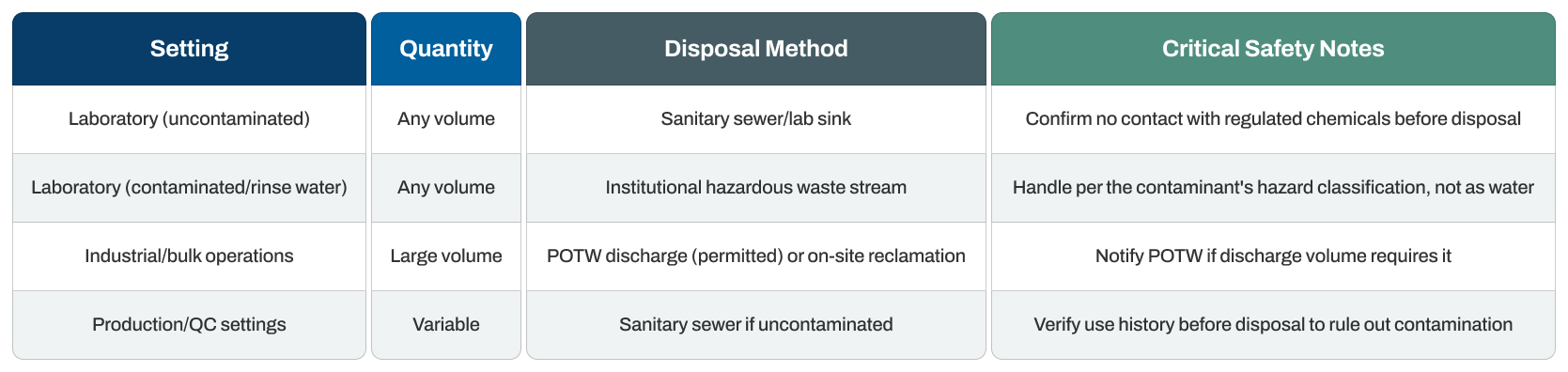
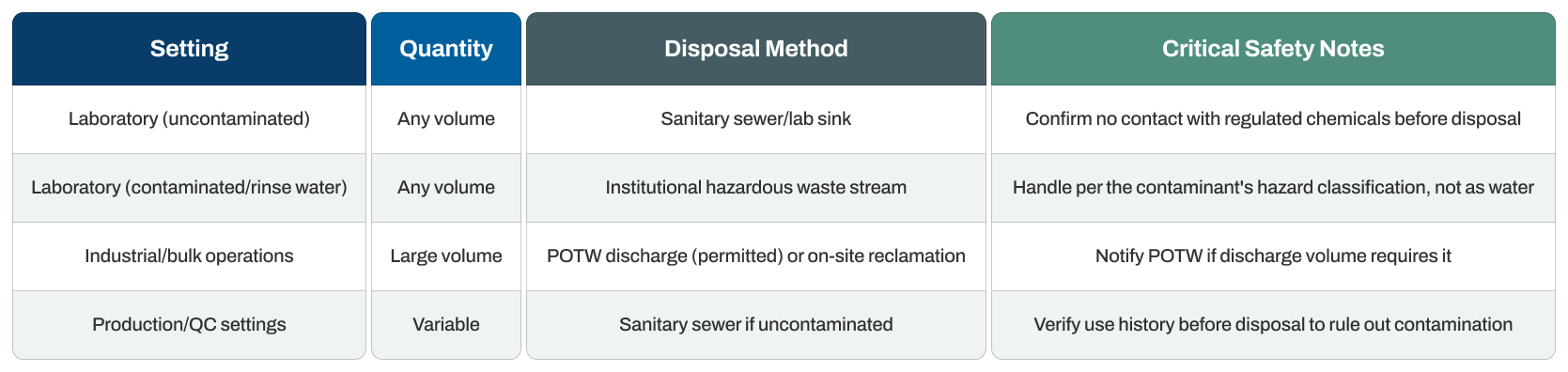
Uncontaminated water may be disposed of through a sanitary sewer or drain in accordance with local wastewater discharge permits issued by the publicly owned treatment works (POTW). No dilution is required beforehand, since the water introduces no additional load requiring treatment.
Industrial Quantities
Large-volume discharges of water may require notification to or a permit from the local POTW, depending on facility size and discharge volume. On-site treatment or reclamation systems can also allow water to be recycled rather than discharged, which is common in industrial and bulk laboratory operations handling high volumes of reagent water.
Laboratory & Institutional Waste
Institutional environmental health and safety (EHS) programs typically permit uncontaminated reagent water to be disposed of directly through a lab sink. Water that has rinsed hazardous materials, however, must be redirected into the institution's hazardous waste stream and handled according to that program's procedures for the contaminant involved.
Follow PPE Guidelines
Standard laboratory attire, including safety glasses and gloves, is sufficient for handling unused water during disposal. No respiratory protection or chemical-resistant PPE is necessary unless the water is known or suspected to be contaminated, in which case PPE should match the requirements of the suspected contaminant.
Special Considerations
Contamination-Dependent Classification
The single factor that determines how water must be disposed of is whether it contacted an acid, base, solvent, or other regulated chemical during use. Water that has done so must be evaluated and disposed of according to that contaminant's hazard classification rather than treated as plain water.
Facilities should build this check into standard operating procedures wherever reagent water is used alongside regulated chemicals, since the disposal pathway can otherwise be misapplied by default.
Conclusion
Water stands apart from most chemicals in this series because its disposal requirements are governed by use history rather than inherent hazard. Uncontaminated water can be disposed of through standard sanitary sewer or drain channels, while water that has contacted regulated chemicals must follow the disposal path required by that contaminant. Confirming use history before disposal is the single step that determines the correct handling method in every setting, from laboratory benches to industrial-scale operations.
For more detailed guidance, explore our Resource Library
Our Customer Care team is also available for more information and documentation, including chemical Safety Data Sheets.
Need Water You Can Trust?
If you are looking for high-quality water for your lab, product line, or research facility, be sure to visit our store to explore our trusted selection and request a quote.
As your trusted partner in chemical supply, Lab Alley is always striving to meet the growing demands of our customers. We want you to be able to access all of your chemical needs in one place, along with streamlined online ordering and fast shipping.
Due to popular demand from our valued clientele, Lab Alley's water is available in a range of purities and packaging options to suit various commercial, laboratory, and personal needs.