
• On Budget, On Time, Every Time : Essential Chemicals for a Better World• WOMAN-OWNED SMALL BUSINESS (WOSB)• OVER 256K+ HAPPY CUSTOMERS• TRUSTED BY NASA, TESLA, SPACEX, BOEING & MORE• HIGH PURITY, NATURAL AND ESSENTIAL CHEMICALS• SERVING 16 INDUSTRIES• PROUDLY PARTNERED WITH ECODRIVE• COA & SDS AVAILABLE ONLINE• QUALITY LAB SUPPLIES & EQUIPMENT• CERTIFIED QUALITY: ISO 9001, KOSHER, ORGANIC & MORE• GSA CONTRACT HOLDER | GOVERNMENT APPROVED• FAST NATIONWIDE DELIVERY• On Budget, On Time, Every Time : Essential Chemicals for a Better World• WOMAN-OWNED SMALL BUSINESS (WOSB)• TRUSTED BY NASA, TESLA, SPACEX, BOEING & MORE• OVER 256K+ HAPPY CUSTOMERS• HIGH PURITY, NATURAL AND ESSENTIAL CHEMICALS• SERVING 16 INDUSTRIES• PROUDLY PARTNERED WITH ECODRIVE• COA & SDS AVAILABLE• QUALITY LAB SUPPLIES & EQUIPMENT• CERTIFIED QUALITY: ISO 9001, KOSHER, ORGANIC & MORE• GSA CONTRACT HOLDER | GOVERNMENT APPROVED• FAST NATIONWIDE DELIVERY

We are now ISO 9001 Certified

Get 5% OFF on your first order |  Use Code: WELCOME5

Buy Citric Acid Online | Food Grade, ACS & Bulk | Lab Alley

Citric Acid

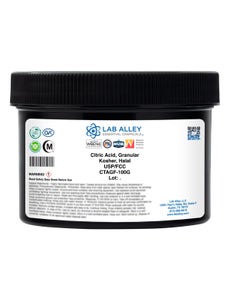
Buy Anhydrous and Solution Citric Acid in USP/FCC Food Grade, ACS and Lab Grade, Kosher and Halal Certified.

Buy citric acid online in the form and grade your process actually needs, with the price right on the page. Food and beverage makers want USP/FCC Food Grade, Anhydrous, or the 50% and 25% FCC solutions, all three Kosher and Halal certified. Analytical labs want ACS Grade, Anhydrous, tested to American Chemical Society limits. General cleaning, descaling and industrial use calls for Lab Grade solutions at 10% and 25%, already diluted so nobody has to dissolve powder by hand. There’s also a specialty 25% Citric Acid with 25% Fluorescein solution, a combined reagent used in specific analytical and tracer applications.

Every product ships with its SDS and COA posted online, and sizes run from small bottles up to 55 gallon drums and 275 gallon totes on select grades. Citric acid is about as mild as acids get, biodegradable, GRAS for food use, and the active ingredient in most natural descaling products, but it still ships to business, lab and school addresses like the rest of our acid catalog. If your formula calls for the salt form instead, browse our citrate salts.

256,000+ customers served
99.5% of orders ship in 1–2 business days
98.9% inventory accuracy
SDS + COA available online, every product
Powder And Solutions Used In The Food, Beverage, And Pharmaceutical Industries
  1. Pillar Natural Remove This Item
  2. Certification Kosher Remove This Item
  3. Size 50lbs Remove This Item
Set Descending Direction
per page

About Citric Acid

Citric Acid is an a-hydroxy acid or polyprotic (AHA); it can also be classified as a b-hydroxy acid with a chemical formula C6H8O7. It is odorless, colorless, and sour in taste and appears as liquid and as a white crystalline solid. This Acid widely occurs in a variety of fruits and vegetables, especially in citrus fruits (lemon juice contains 7-9% of Citric Acid), and is responsible for their tart taste. From a biochemical point of view, Citric Acid is of tremendous importance, considering that in a series of enzymatic reactions (the Krebs cycle or tricarboxylic acid cycle), humans and animals produce Citric Acid to generate energy through the oxidization of fats, proteins, and carbohydrates.

Citric Acid is an organic compound listed by the Food and Drug Administration (FDA) and is generally considered safe (GRAS) as a food additive.

It is commercially produced in millions of tons with a steady annual increase in consumption and production.

Major uses and applications

Citric Acid is used in the food, beverage, and pharmaceutical industries; it is the active ingredient in: pesticide products, the manufacture of ecologically compatible detergents, chemical cleaning, metal cleaning, concrete admixtures, and plasticizers.

Citric Acid is reported to function in cosmetics as a chelating agent, pH adjuster, or fragrance ingredient; it is used in almost every category of cosmetic products; it is reported to be utilized at concentrations up to 39% in products diluted for (bath) use and up to 4% in leave-on products.

Food industry

Citric Acid is used in numerous consumer goods, in food and beverage industries. As an acidulant, it stimulates a natural fruit flavor in soft drinks and syrups and provides the desired degree of tartness. It stabilizes commercially prepared juices, frozen fruits, candies, canned vegetables, fish, and meat products. In wines and ciders, Citric Acid inhibits oxidation and browning, assuring their transparency. As an adjusting pH agent, Citric Acid is a constituent of jellies, jams, and gelatin desserts. In dairy products, its antioxidant, acidifying, and emulsifying properties are used to produce ice creams and cheeses.

Pharmaceutical and chemical industry

Being biodegradable and safe for both industry and consumers, it is also utilized in many pharmaceuticals. As an anticoagulant is used in the transportation and storage of blood plasma, cosmetics, and toiletries supplements.

Citric Acid has the ability to form complexes with almost every metal ion utilized to produce efficient soaps, laundry detergents, and household cleaners. Using this property, Citric Acid is frequently used in analytical chemistry as a buffer masking agent for various metal ions and an eluting agent in ion exchange chromatography.

Citric Acid is applied in a broad range of applications, as a cleaner of steam or hot water systems to remove calcium layers, in electroplating, copper plating, metal cleaning, leather tanning, in the production of photographic reagents and inks, in construction (additives to cement), in a solution of fouling problems, paper, printing and textile industries.

Common Uses and Applications

  • Antioxidant
  • Cleaning agent
  • Emulsifying agent in ice creams
  • Additive of sour taste to soft drinks and other food items
  • Active ingredient of shampoo
  • Sucrose crystallization in caramel
  • Food coloring
  • Natural preservative
  • It removes the chalky deposit from evaporators, kettles, and boilers.

Industries

About Citric Acid

C6H8O7, a weak organic acid with three carboxyl groups, which is exactly why it's such a capable chelating agent, each of those three groups can grab onto a metal ion. At room temperature it's a white crystalline solid or a clear liquid once dissolved, odorless, with the sharp sour taste you already know from lemons and limes, since citrus fruit is loaded with the stuff naturally, lemon juice alone runs 7 to 9% citric acid. Most of what's sold commercially today, including what's in this category, is produced by fermenting sugar with a specific mold rather than squeezed from fruit, which is a cheaper and more consistent process at scale. It's also biodegradable and recognized as GRAS, generally recognized as safe, by the FDA for food use.


COMMON APPLICATIONS

Acidulant and flavor enhancer in soft drinks, juices and candy. Preservative and antioxidant that stabilizes canned and frozen foods and prevents browning in wine and cider. pH adjuster in jams, jellies and gelatin desserts. Natural descaling agent for coffee makers, kettles, dishwashers and industrial boiler and steam systems, where its chelating action dissolves mineral scale more effectively than a plain acid like vinegar. Chelating agent and pH adjuster in cosmetics, soaps and detergents. Buffer and masking agent for metal ions in analytical chemistry. And an anticoagulant used in blood plasma storage and transport.


GRADES EXPLAINED

USP/FCC Food Grade meets both pharmacopeia and food chemical standards, the one to use for food, beverage or pharmaceutical applications, and it's where our Kosher and Halal certified products sit. ACS Grade meets American Chemical Society limits for analytical work. Lab Grade solutions are solid everyday purity, premixed at useful concentrations for cleaning, descaling and general industrial use where food standards aren't required.


TYPES & GRADES AT A GLANCE

Granular powder for food, beverage and pharmaceutical use.
Concentrated, ready to use food grade solution.
A lighter food grade concentration for formulation and dosing flexibility.
Tested to ACS limits, for analytical and research methods.
Premixed dilutions for descaling, cleaning and general industrial use.

WHY BUY FROM LAB ALLEY

256,000+ customers already order their acids and chemicals from Lab Alley. 99.5% of orders ship within 1 to 2 business days, and 98.9% inventory accuracy means the grade you see in stock is the grade that ships. SDS and COA are available online for every citric acid product, and our FCC and USP/FCC Food Grade citric acid, in anhydrous, 50% and 25% forms, carries Kosher and Halal certification; check each product page for which applies.

Related: See our Phosphoric Acid and EDTA collections, or browse all Acids.

Frequently Asked Questions

Where can I buy citric acid online?
Right here. We carry citric acid as anhydrous powder and premixed solutions, in USP/FCC Food Grade, ACS and Lab Grade, from small bottles up to 55 gallon drums and 275 gallon totes. Pick the grade and size, check the price, and order with no quote needed for standard sizes. Most in stock orders ship within 1 to 2 business days.
Food grade vs ACS vs Lab grade, what's the difference?
Mostly purity and where it's headed. USP/FCC Food Grade meets both pharmacopeia and food chemical standards, the one to buy for anything eaten, drunk or taken as medicine. ACS Grade is tested to American Chemical Society limits, built for analytical methods. Lab Grade is solid everyday purity without an official standard, and the practical, lower cost choice for cleaning, descaling and general industrial use.
Which citric acid is Kosher or Halal certified?
Three products, all food grade: the Anhydrous USP/FCC Granular, the 50% Solution and the 25% Solution, all FCC grade. Each carries both Kosher and Halal certification. Our ACS Grade and Lab Grade solutions are not food grade and carry no religious certification, so check the specific product title before ordering for a certified application.
Is citric acid the same thing as ascorbic acid (vitamin C)?
No, though they get mixed up constantly. Both are mild acids found in citrus fruit, but they're chemically different compounds with different structures and different roles. Ascorbic acid is vitamin C, an essential nutrient. Citric acid isn't a vitamin at all, it's an acidulant, preservative and chelating agent. Recipes and cleaning guides sometimes use the names interchangeably, which is incorrect, so double check which one your application actually calls for.
Do I need a permit, and can citric acid ship to a home address?
No purchase permit is required for any citric acid product. Like the rest of our chemical catalog, it ships to business, lab and school addresses rather than residential ones. Each product page lists its specific shipping details, and Customer Care at 512-668-9918 can confirm before you order if you're unsure your address qualifies.
Which grade and form should I buy?
Match it to the job. Food, beverage or pharmaceutical formulation: USP/FCC Food Grade, anhydrous or one of the solutions depending on your process. Analytical methods: ACS Grade. Industrial cleaning, descaling or general use: a Lab Grade solution, already diluted to 10% or 25% so you skip dissolving powder yourself. Need a specific analytical tracer reagent: the citric acid and fluorescein combination solution.
Does citric acid actually work for descaling?
Yes, and often better than vinegar. Citric acid is a chelating agent, meaning it grabs onto the metal ions in mineral scale and pulls them into solution, rather than just dissolving them with raw acidity the way acetic acid in vinegar does. That's why it's the active ingredient behind most natural descaling products for coffee makers, kettles, dishwashers and industrial boiler systems. Our Lab Grade solutions are premixed specifically for that kind of general cleaning and descaling work.
Can I buy citric acid in bulk?
Yes. Several grades scale up to 55 gallon drums, and select food grade solutions are available in 275 gallon totes right on the product page. For pallets or a recurring delivery schedule, request pricing through Bulk & Custom Chemicals. Autoship takes 10% off eligible repeat orders.
How should citric acid be stored?
Keep anhydrous powder tightly sealed in a cool, dry place, since it can cake or absorb moisture if left open. Solutions should be kept at a stable ambient temperature and protected from freezing, which can affect viscosity and consistency. It's a mild acid with minimal reactivity compared to most of our stock, but it's still worth keeping away from strong oxidizers and bases.

Guides & Resources

Citric Acid Overview
Discover the key properties and uses of citric acid. Understand how this organic acid supports food, cosmetic, and pharmaceutical production with safe handling practices.
Read article →
Citric Acid Uses & Applications
Learn how citric acid works across food, pharma, cosmetics, cleaning, and industry. See key uses like acidulation, chelation, preservation, metal cleaning, pH control, and water treatment. Get practical notes on grades, solutions, and pack sizes so you source the right product for your process.
Read article →
Types of Citric Acid
What are the different types of citric acid? Learn the differences between food, cosmetic, and pharmaceutical grades, plus their key applications.
Read article →
How to Store Citric Acid
Discover how to store citric acid safely. Learn best practices for storage, handling, and labeling to maintain quality, prevent contamination, and ensure compliance.
Read article →
How to Safely Dispose of Citric Acid
Discover how to dispose of citric acid safely. This guide explains disposal methods, neutralization steps, and environmental safety requirements of citric acid.
Read article →

Industries That Use Citric Acid

Food & Beverage
Explore FCC and USP grade chemicals for food and beverage including citric acid, sodium benzoate, peracetic acid, emulsifiers and food safe sanitizers.
Learn more →
Pharmaceuticals & Nutraceuticals
Explore USP and NF grade chemicals for pharma and nutraceuticals including solvents, excipients, propylene glycol, glycerin and HPLC reagents.
Learn more →
Personal Care & Cosmetics
Explore high-purity chemicals for personal care and cosmetics including USP glycerin, SDA alcohols, witch hazel, emulsifiers and NF grade humectants.
Learn more →
R&D/Laboratory
Explore ACS, HPLC and LC/MS grade chemicals for R&D and laboratory use including solvents, acids, bases, buffers and standardized solutions for research and QC.
Learn more →
Manufacturing & Industrial
Explore chemicals for manufacturing and industrial use including ACS grade solvents, acids, alkalis, glycols and water treatment chemicals available in bulk sizes.
Learn more →