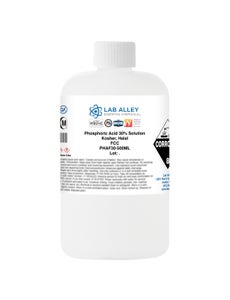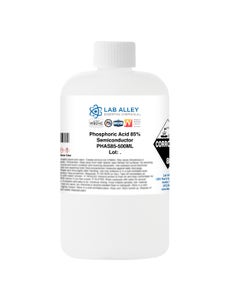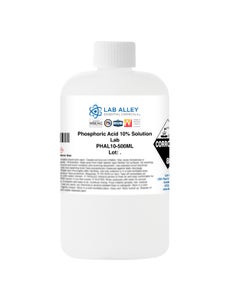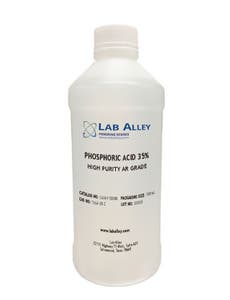






Types of Phosphoric Acid
Phosphoric acid (H₃PO₄), also known as orthophosphoric acid, is an inorganic triprotic mineral acid produced by either the thermal combustion of elemental phosphorus or a wet-process reaction between phosphate rock and sulfuric acid. The production route used has a direct bearing on achievable purity, which is why the acid is commercially available in a wide range of grades and concentrations, from ultra-pure semiconductor-grade material to bulk technical-grade material used in fertilizer production.
Grade and concentration are not interchangeable specifications, and the difference between them has real consequences for compliance and performance. A technical-grade acid that performs perfectly well in metal surface treatment will fail outright if substituted into a food or pharmaceutical application, since certifications such as FCC, USP/NF, and ACS define measurable purity thresholds rather than general quality tiers. Selecting the right type requires matching the application's regulatory requirements to the correct grade, confirming the required concentration, verifying any certifications the end use demands, and weighing cost against the purity level actually needed.
In this article, we'll explore:
-
Common Grades & Purities
-
Certifications & Standards
-
Chemical Forms & Variants
-
Applications Based on Type
-
How to Choose the Right Type
Common Grades & Purities
Food Grade (FCC)
Food-grade phosphoric acid meets Food Chemicals Codex (FCC) standards and carries FDA-affirmed GRAS status under the designation E338. It is held to strict impurity limits, including arsenic at no more than 3 ppm, fluoride at no more than 10 ppm, and heavy metals at no more than 10 ppm as lead, and is used as an acidulant and pH regulator across food, beverage, and brewing applications.
Pharmaceutical Grade (USP/NF)
Pharmaceutical grade meets the monograph specifications set by the United States Pharmacopeia and National Formulary, with an assay range of 85.0 to 88.0 percent H₃PO₄ by weight. Controlled limits on chloride, sulfate, iron, and hypophosphorous or phosphorous acid content support its use in drug formulations, dental etchants, and pharmaceutical excipient applications manufactured under cGMP conditions.
ACS/Reagent Grade
ACS Reagent Grade phosphoric acid carries an assay of at least 85.0 percent and is tightly controlled for chloride, nitrate, sulfate, heavy metals, and trace metal contaminants, often down to the parts-per-billion level for individual elements. This grade also satisfies USP/NF reagent specifications, which makes it suitable for analytical chemistry, reagent preparation, and high-precision laboratory work.
Industrial/Technical Grade
Technical grade carries lower purity than ACS or FCC material, with higher residual sulfate, fluoride, and metal content carried over from wet-process manufacturing. It serves applications where trace contaminants are not a concern, including fertilizer manufacturing for MAP and DAP, metal surface treatment, rust conversion, water treatment, and concrete etching.
Electronic/Semiconductor Grade
Electronic grade is manufactured to meet SEMI C36 standards, with impurity levels for critical metals typically held in the sub-ppb to low-ppb range, such as iron at no more than 20 ppb and sodium at no more than 50 ppb. This level of purity is mandatory for hot phosphoric acid etching of silicon nitride films, LCD panel manufacturing, and printed circuit board fabrication, where even trace metal contamination is unacceptable.
Certifications & Standards
GRAS Certification
Phosphoric acid holds FDA-affirmed GRAS status as a food additive and acidulant under 21 CFR, a designation that applies specifically to food-grade (FCC) material rather than to the chemical as a whole.
Kosher & Halal
Food-grade phosphoric acid is widely certified Kosher, classified as Parve, including for Passover use, and Halal across major schools of Islamic jurisprudence. Its mineral origin and synthetic production from phosphate rock, free of animal-derived or otherwise prohibited inputs, support compliance with both sets of dietary standards.
REACH Compliance
Phosphoric acid (CAS 7664-38-2) is a registered substance under EU REACH, and suppliers are expected to provide compliant safety data sheets along with REACH registration documentation on request. This is particularly relevant when sourcing industrial or electronic-grade material for use in EU markets.
Chemical Forms & Variants
Phosphoric acid is supplied almost exclusively as an aqueous solution, though its concentration and degree of molecular condensation vary meaningfully depending on the intended use.
Liquid vs. Solid Forms
The pure compound exists as a white crystalline solid with a melting point of approximately 42.4°C, but this form is rarely used commercially. The standard commercial form is an 85 percent aqueous solution, a viscous, syrupy liquid that is non-volatile and far easier to handle and transport than the solid.
Concentration Variants
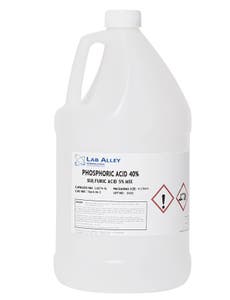
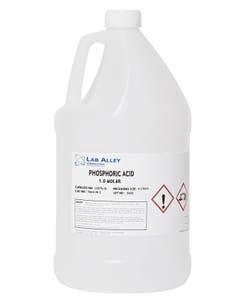
Commercial concentrations range from dilute solutions around 10, 25, and 30 percent up to 85 percent, which represents the highest concentration practical in aqueous form before the acid begins converting to polyphosphoric species. Dilute grades in the 10 to 35 percent range are typically used for pH adjustment, dental etching, and molar standard solutions, while the 75 to 85 percent range is standard for industrial, food, and laboratory use.
Condensed Phosphoric Acid Forms (Polyphosphoric Acid)
Above roughly 68 percent P₂O₅, equivalent to concentrations exceeding about 95 percent H₃PO₄, orthophosphoric acid begins condensing into polyphosphoric acid, a mixture of pyrophosphoric acid, triphosphoric acid, and longer-chain oligomers. This is a distinct industrial product rather than simply a more concentrated version of standard phosphoric acid, and it is used as a catalyst in alkylation and acylation reactions, in asphalt modification, and as an intermediate in chemical synthesis.
Applications Based on Type
Food & Beverage
Food and beverage use requires FCC food-grade material, typically Kosher and Halal certified, to satisfy FDA and international food regulations. It is used for acidulation in colas and other carbonated beverages, pH adjustment during brewing, and general food preservation.
Pharmaceutical & Healthcare
Pharmaceutical and healthcare applications require USP/NF grade material produced under cGMP conditions, since drug, dental, and medical uses leave no margin for the impurity levels found in lower grades. Typical uses include dental etchants, pharmaceutical excipients, and compounding reagents.
Cosmetics & Personal Care
Cosmetic formulations call for food- or pharmaceutical-grade ingredients where ingestion or skin contact is a factor, with technical grade acceptable in lower-risk applications. It is used for pH adjustment in skincare formulations and as an ingredient in certain hair care products.
Laboratory & Analytical
Laboratory and analytical work require ACS or reagent-grade material to meet the controlled impurity limits needed for reliable results. This grade supports analytical chemistry, buffer preparation, and titration work where reagent-grade purity is non-negotiable.
Industrial & Manufacturing
Industrial and manufacturing applications are generally well served by technical or industrial-grade material, where lower purity is both acceptable and cost-effective. Common uses include fertilizer production for MAP and DAP, metal surface treatment and rust conversion, water treatment, and concrete preparation.
Electronics
Electronics manufacturing requires semiconductor or electronic-grade material meeting SEMI C36 specifications, since even sub-ppb levels of metal contamination can compromise device performance. This grade is used for silicon nitride etching, LCD panel fabrication, and printed circuit board processing.
Agriculture
Agriculture represents the highest-volume application for phosphoric acid globally and relies on industrial or technical-grade material. It serves primarily as feedstock for monoammonium phosphate and diammonium phosphate fertilizer production.
How to Choose the Right Type
Choosing correctly starts with recognizing that grade, certification, and concentration are three separate decisions, not one combined judgment call based on a general sense of purity.
Match Grade to Application
Food, pharmaceutical, and electronic applications carry non-negotiable purity minimums set by regulation or process specification, while industrial applications generally tolerate lower-purity technical grade. Confirm the specific impurity limits the application requires before purchasing, since "high purity" on its own is not a standardized claim.
Verify Required Certifications
FCC certification is required for food and beverage use, USP/NF for pharmaceutical and dental applications, and SEMI C36 for semiconductor work. Kosher and Halal certification may also be required depending on the food manufacturing market being served.
Select Appropriate Concentration or Form
Concentration should be matched to the application rather than assumed: 85 percent suits most industrial, laboratory, and food uses, while dilute solutions in the 10 to 35 percent range are appropriate for pH adjustment, dental use, and molar standard preparation. Higher concentration does not equal higher purity, since grade and concentration are independent specifications that must both be confirmed.
Common Mistakes
The most frequent error is purchasing technical grade for food or pharmaceutical use to save on cost, when technical grade simply does not meet FCC or USP impurity limits. A related mistake is assuming ACS grade is acceptable for semiconductor work when SEMI C36 electronic grade is required, or specifying "85% phosphoric acid" without indicating which grade standard applies, leaving concentration and purity conflated.
Key Takeaways
Choosing the right type of phosphoric acid comes down to treating grade, concentration, and certification as three distinct, verifiable specifications rather than general indicators of quality. Technical grade, food grade, pharmaceutical grade, and electronic grade are defined by enforceable purity standards, and substituting one for another based on cost rather than specification is the most common path to a compliance failure or application breakdown.
Confirming the applicable standard, whether FCC, USP/NF, ACS, or SEMI C36, before placing an order removes the guesswork that descriptive terms like "high purity" tend to introduce, and it ensures the material delivered will actually perform as the application demands.
For more detailed guidance, explore our Resource Library.
Our Customer Care team is also available for more information and documentation, including chemical Safety Data Sheets.
Find Phosphoric Acid You Can Trust
If you are looking for high-quality phosphoric acid for your lab, product line, or research facility, be sure to visit our store to explore our trusted selection and request a quote.
As your trusted partner in chemical supply, Lab Alley is always striving to meet the growing demands of our customers. We want you to be able to access all of your chemical needs in one place, along with streamlined online ordering and fast shipping.
Due to popular demand from our valued clientele, Lab Alley's phosphoric acid is available in a range of purities and packaging options to suit various commercial, laboratory, and personal needs.